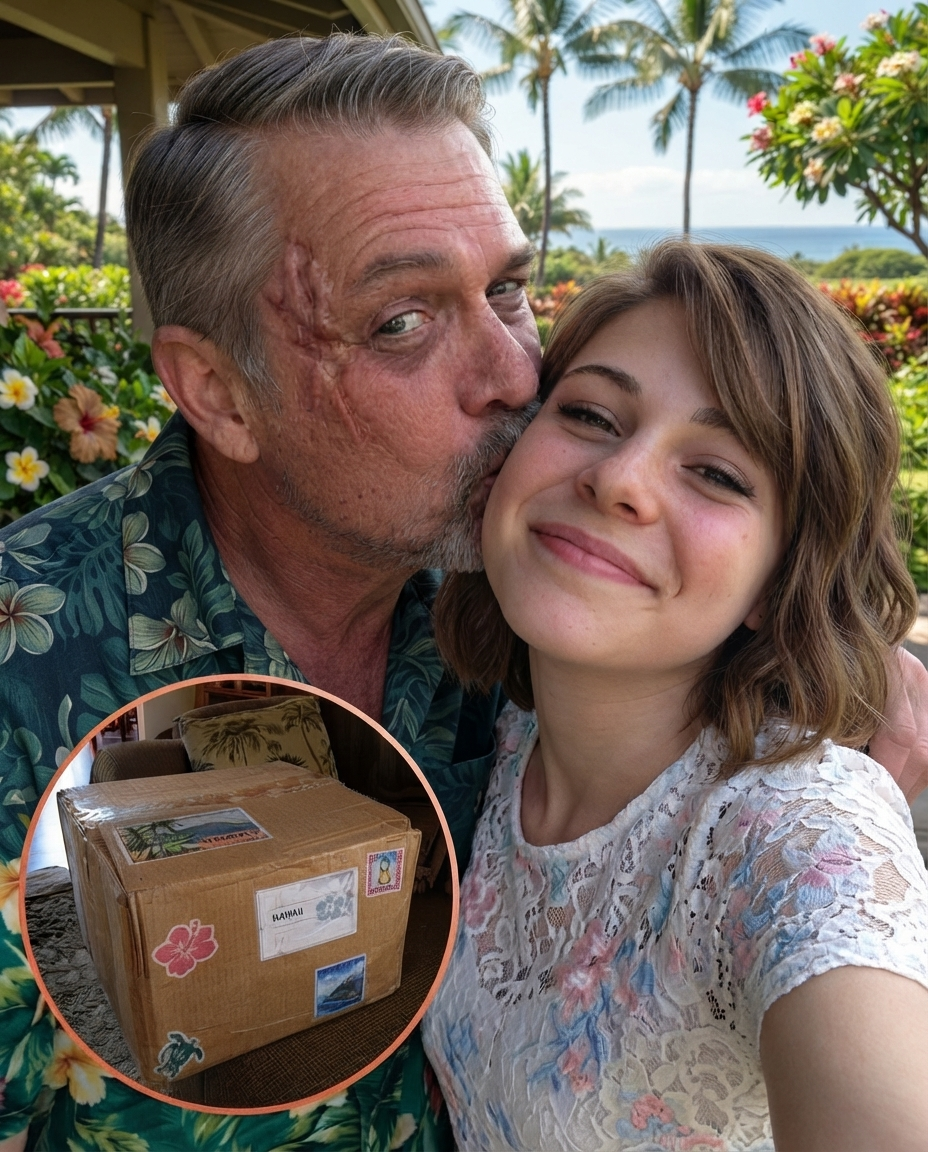

After the call ended, Mom and I remained in the kitchen beside Dad’s blue chair, neither of us ready to move. Ruth’s final words seemed to linger between us because they revealed how tragically simple the truth had been: Dad had spent decades believing his absence had closed a door that nobody on the other side had ever locked.
He had imagined anger growing with every year he stayed away. He had convinced himself that returning after five years would be awkward, after ten years embarrassing, and after several decades impossible, while the people in Hawaii had continued using his chair, repairing it when it broke, and refusing to throw it away because it was still Gilbert’s.
Mom picked up the faded beach photograph and studied the tiny figures near the cooler. For years, I had misunderstood what Dad saw whenever he opened that drawer. I thought he was remembering warm rain, palm trees, and the Pacific Ocean, but those things had only been the background.
The people were what mattered.
“I should’ve pushed harder,” Mom whispered.
“You tried.”
“Not enough.”
I understood why she blamed herself, especially after learning that the chair had been part of one final attempt to send Dad home. But I also understood something she was struggling to accept: Dad’s fear had never been something she could solve for him.
She had suggested Hawaii when I was ten, after his promotion, and again for their anniversary. She had even offered to buy the ticket herself, but every time Dad found another reason to postpone the trip.
Money.
Work.
Timing.
Then eventually, shame.
The cruelest part was that the shame existed almost entirely inside him.
Ruth had admitted that his foster family sometimes felt angry about his long absence, but her next sentence mattered more. Even after fifty years, she still would have gone to the airport to bring him home.
Dad had spent half his life waiting for a perfect moment when returning would no longer feel uncomfortable. That moment never arrived, because every year he postponed it only made the next year harder.
A week later, I decided to take the blue chair to my apartment.
Mom immediately protested.
“Annie, that’s your father’s chair.”
“I know, Mom.”
She looked almost offended when I carried it toward my car, but I wasn’t taking it because I wanted another piece of furniture. I wanted the chair somewhere it would continue doing what it had always done.
Giving someone a place at the table.
I positioned it in my kitchen despite the worn paint, repaired leg, and slight wobble that made it tap against the floor whenever someone shifted their weight. It looked completely out of place beside my newer furniture, which somehow made it feel even more important.
Every scratch represented a life Dad had rarely discussed. The black mark on the lower rung, the replacement wood in the repaired leg, and his name carved underneath were ordinary details, yet together they preserved a version of my father that had almost vanished with him.
I called Ruth again.
This time, we talked longer.
She told me more about the crowded house where Dad had learned he could expect breakfast the next morning and still have a chair waiting for him at dinner. I told her about the man he became in Oregon, the husband Mom had loved, and the father who still cheated at cards and whistled whenever he was nervous.
Two families had known different chapters of the same man.
Neither had known the whole book.
The following Sunday, Mom came to my apartment for coffee. She walked into the kitchen, saw me sitting in the blue chair, and stopped.
For several seconds, she simply stared.
Then she quietly took the seat across from me and placed Dad’s faded photograph between us.
This time, she was finally ready to tell me who everyone in the picture was.
Mom turned Dad’s faded photograph around and pointed toward the woman standing beside the cooler. For most of my life, she had been nothing more than a tiny stranger on an old Hawaiian beach, but now I knew she represented something Dad had carried quietly for decades.
“That’s the woman who raised him.”
I studied the photograph again. The image was so faded that I could barely distinguish faces, yet Dad’s thumb had worn the area around those people almost smooth from years of touching them.
The blue chair shifted beneath me and tapped unevenly against my kitchen floor.
Mom glanced down.
“Still does that.”
“Yeah.”
For the first time since Dad died, the memory made both of us smile.
Mom pushed the sugar bowl toward me while Oregon rain streaked the windows. Sitting there, I finally understood why Dad’s memories of Hawaii had always sounded so vivid and why Mom had once misunderstood them so deeply.
He hadn’t been longing for a prettier landscape.
He had been remembering belonging.
The foster home had been crowded and imperfect, filled with mismatched furniture and children coming and going. Yet for a teenage boy whose home life had become unstable, someone expecting him at dinner had been enough to transform an ordinary blue chair into proof that he had a place.
Then he left.
At first, returning was delayed by practical things. Later, embarrassment replaced those excuses, and eventually Dad became trapped by the amount of time itself. Every year he stayed away became another reason to believe he had waited too long.
But the chair had waited anyway.
Someone broke its leg, and they repaired it. Children sat in it. Decades passed, and whenever somebody suggested throwing it away, the woman who raised Dad refused because, in her mind, it still belonged to Gilbert.
That was the part I couldn’t stop thinking about.
Dad had spent years believing he needed to earn his way back into a family that had never completely removed his place at the table.
Mom looked at the photograph again.
“I wish he’d known.”
“So do I.”
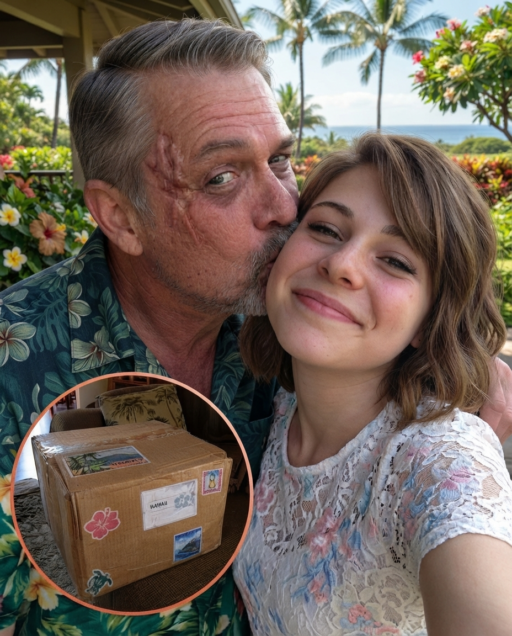
She had tried to tell him in the only way she thought might finally reach him. She arranged for his old chair to travel thousands of miles from Honolulu to Oregon, intending to place it in our kitchen and ask him one last time to go home.
Instead, it arrived after he was gone.
For a while, I thought that made the chair unbearably tragic. Eventually, I began seeing it differently.
Dad never got to sit in it again, but because it arrived, I learned about the family he had never fully explained. Ruth learned that Gilbert had a daughter. Mom finally told me why Hawaii had always carried so much tension in our home, and I discovered that the photograph Dad kept hidden among junk had never really been about a beach.
The chair connected two halves of his life after he was no longer here to connect them himself.
I began speaking with Ruth regularly. Through her, I heard stories about Dad as a teenager, while I gave her stories about the man he became. Neither of us could recover the years everyone had lost, but at least silence no longer controlled what remained.
Mom and I stayed at my kitchen table until our coffee went cold.
Before leaving, she rested her hand briefly on the blue backrest.
“Your dad would like it here.”
I looked down at the name carved beneath the seat.
“I think so too.”
After she left, I remained there listening to the rain against the windows. The chair rocked slightly beneath me, its repaired leg tapping the floor exactly as it must have done decades earlier in a crowded Hawaiian kitchen.
Dad had spent fifty years wondering whether he could still go home.
He never discovered the answer.
But his chair did.
And now it had a place at my table.