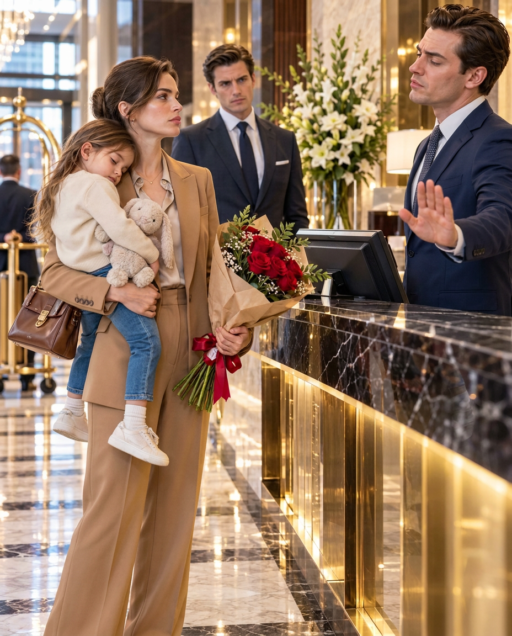
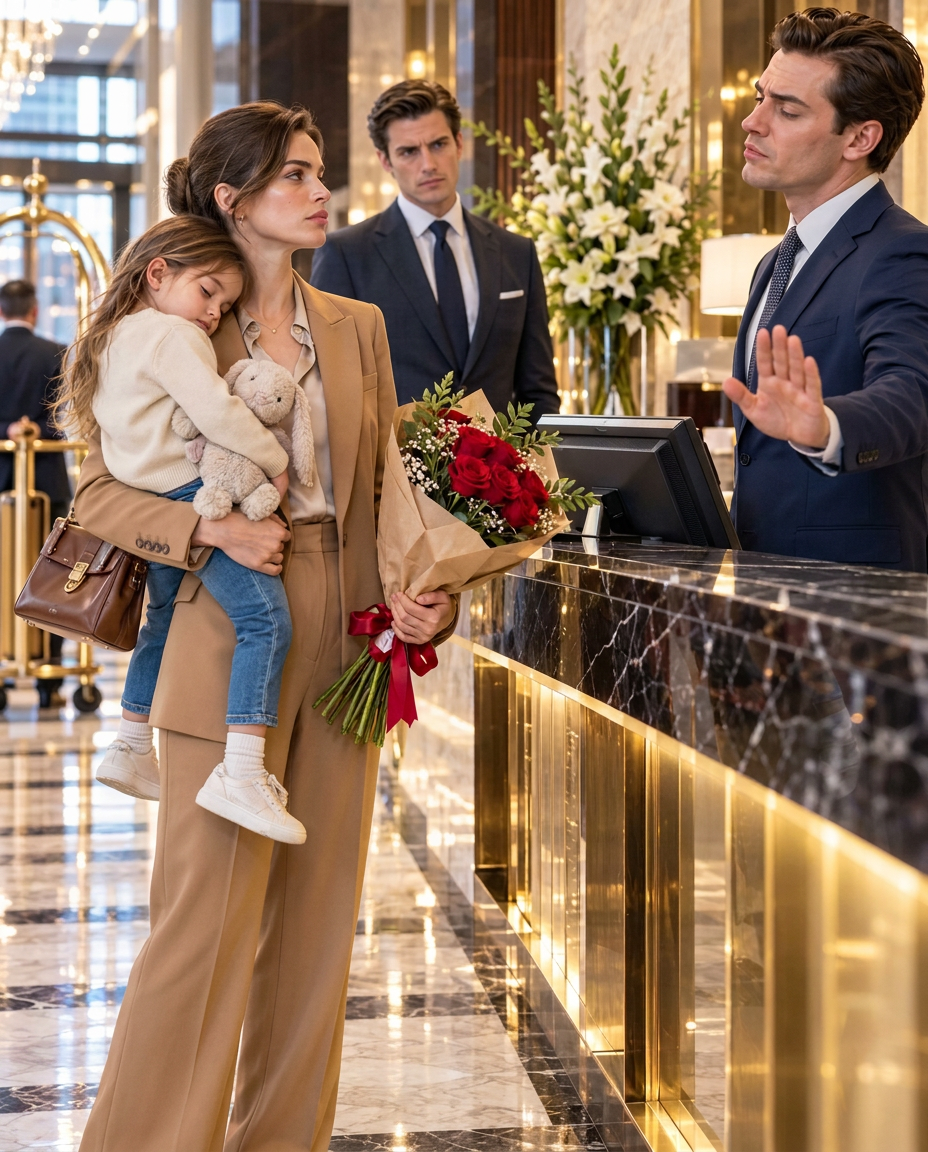

Robert Haines had managed the Grand Regent for eighteen months, and his performance reports had always impressed me. Revenue was increasing, operating expenses were controlled, and guest satisfaction scores appeared strong. During our previous meetings, he had seemed confident, professional, and perfectly suited to managing one of our most prestigious properties.
But those meetings had taken place when I was wearing expensive business suits. Standing before him in jeans and my old leather jacket, I was apparently just another troublesome guest.
“I understand there was a misunderstanding with your reservation last night,” Robert began. “I’ve already reviewed the situation.”
“Then perhaps you can explain what happened,” I replied.
He glanced at Patrick before telling me that a technical error had prevented the reception team from locating my booking. According to him, the problem had been resolved, and there was no reason to continue discussing it.
“Did the technical error also cause your employees to suggest I find a cheaper motel?” I asked. “And was it responsible for Karl laughing at me?”
Robert’s smile tightened. He insisted that no offense had been intended, then suggested that Lupita should never have interfered because housekeeping employees were expected to remain within their assigned responsibilities.
His response disturbed me more than Patrick’s original insult. Instead of questioning why a guest had been mistreated, he was criticizing the only employee who had offered assistance.
While we spoke, an elegantly dressed woman approached reception. Patrick immediately greeted her by name, asked about her stay, and offered transportation assistance. Karl hurried forward to help with her luggage.
I watched them provide the attentive service they had denied me.
They clearly understood how to treat guests respectfully. They simply reserved that courtesy for people who appeared wealthy or important.
When the woman left, I asked Robert whether he’d examined my complete reservation profile. He admitted that he’d only read the incident report because the booking issue had already been resolved.
I reached into my jacket and placed my corporate identification on the counter.
CLARA VANCE
FOUNDER & CHIEF EXECUTIVE
VANCE HOSPITALITY GROUP
Robert stared at the card. Patrick leaned forward, his face draining of color, while Karl stood completely motionless.
“Clara?” Robert whispered.
“Yes, Robert. We’ve met before.”
He immediately began apologizing.
“If I’d known who you were…”
I interrupted him.
“If you’d known I owned this hotel, would you have treated me differently?”
He hesitated before admitting that he would.
“Then that is precisely the problem,” I said. “I’m not upset because you failed to recognize me. I’m upset because you believe my identity should determine whether I deserve respect.”
The lobby had grown unusually quiet. Several employees were listening, but I kept my voice controlled because I wanted answers, not a public spectacle.
I explained that a hotel existed to make travelers feel welcome and safe, regardless of their clothing, financial circumstances, or social position. Lupita had understood that without knowing anything about me.
Then I ordered Robert to preserve the previous evening’s security footage and provide reception activity logs, employee training records, and six months of guest complaints involving reservations or staff behavior.
His expression changed when I mentioned the complaints.
“Is there something I should know?” I asked.
“No, absolutely not,” he answered much too quickly.
I told him that no disciplinary decisions would be made until the evidence had been reviewed. I also warned him that Lupita was not to face retaliation for helping me.
As I prepared to leave, Karl approached and apologized. He admitted that he’d assumed I was trying to obtain a room I couldn’t afford and acknowledged that his behavior had been unfair.
Then he mentioned Lily, saying he regretted that she’d overheard his remarks. His apology didn’t erase what happened, but it suggested he was beginning to understand the consequences.
Near the elevators, Lupita appeared carrying fresh linens. She noticed Robert’s expression and immediately looked frightened.
“Ms. Vance,” she asked quietly, “am I going to be punished?”
I stopped and turned toward her.
“Punished for helping my daughter and me?”
She didn’t answer. Instead, she glanced nervously at Robert, who suddenly avoided my eyes.
That reaction told me something important.
Lupita wasn’t simply worried about what might happen. She seemed to recognize a punishment she’d experienced before.
I invited Lupita into a private conference room near the executive offices. She sat nervously across from me, her hands clasped together, looking as though she expected to be reprimanded at any moment.
“Lupita, you’re not in trouble,” I assured her. “But I need to understand why you thought helping me might cost you your job.”
She hesitated before explaining that management had previously warned her about assisting guests outside her housekeeping responsibilities. Sometimes travelers needed directions, help locating family members, or someone willing to listen. But every minute spent helping them counted against the strict productivity targets imposed on housekeeping staff.
As she spoke, I felt increasingly uncomfortable. Those targets had been introduced following a corporate efficiency review, and I had personally approved them.
I’d believed the new standards would improve operations. Instead, they had created an environment where employees feared consequences for showing basic kindness.
Lupita eventually admitted that certain guests received better treatment than others. Clothing, luggage, payment methods, accents, and sometimes even skin color influenced how quickly employees offered assistance.
“Did you ever report this?” I asked.
“Once. My supervisor told Mr. Haines, but afterward he held a meeting reminding everyone to stay within their departments.”
She didn’t believe Robert deliberately encouraged discrimination. According to her, he simply valued efficiency, favorable reports, and avoiding complaints more than investigating why problems occurred.
Her explanation troubled me because it revealed something larger than individual misconduct.
For the next four hours, I reviewed security recordings, reservation activity, and complaint records. The footage confirmed that Patrick had spent only eleven seconds searching for my booking before dismissing me. He hadn’t opened the executive reservation system until Lupita intervened.
The complaint records were even more revealing.
During the previous six months, twelve guests had reported dismissive reservation handling, while seven described feeling judged because of their appearance or payment method. Patrick appeared in three complaints and Karl in two.
Instead of investigating the repeated behavior, management had closed the cases with complimentary breakfasts, loyalty points, upgrades, or other gestures.
That afternoon, I confronted Robert in his office.
“Why did you keep compensating guests without addressing the problem?” I asked.
He admitted that when he arrived eighteen months earlier, the property had been struggling financially. He focused heavily on faster service, profitable corporate accounts, VIP satisfaction, and impressive performance statistics.
“I never instructed anyone to mistreat ordinary guests,” he insisted.
“No,” I replied. “But you made it clear which guests mattered most.”
He lowered his eyes before admitting that Patrick had received informal warnings twice. Those incidents were never documented because Patrick was fast, successful at selling upgrades, and particularly effective with wealthy customers.
Then I asked about Lupita.
Robert reluctantly revealed that she’d been reprimanded six months earlier after helping an elderly guest locate his wife during a medical emergency. Because she stayed with him until security arrived, her housekeeping assignments fell behind schedule.
I stared at him, stunned that an act of compassion had been treated as poor performance.
After considering the evidence, I placed Patrick and Karl on suspension pending a formal HR investigation. Robert received ninety days of performance probation under corporate supervision, along with instructions to cooperate with an independent review of the hotel’s service culture.
I also ordered a reassessment of housekeeping targets and an end to language that encouraged employees to classify certain travelers as more valuable than others.
Robert accepted the decisions without arguing.
Before leaving, I met separately with Patrick and Karl. Patrick acknowledged his behavior and became emotional, while Karl admitted that he’d joined in because he wanted Patrick’s approval.
Neither received an immediate final decision. I wanted the investigation completed before determining consequences.
That evening, I returned to Suite 904, where Lily was waiting with Mr. Buttons and our vase of red roses.
“Did you decide what was fair?” she asked.
“Some of it,” I answered.
“Did you fire those men?”
“Not yet, sweetheart. Being fair means listening to everyone, even when you’re upset.”
Lily considered that before admitting she didn’t particularly like the idea. I laughed and told her that sometimes I didn’t either.