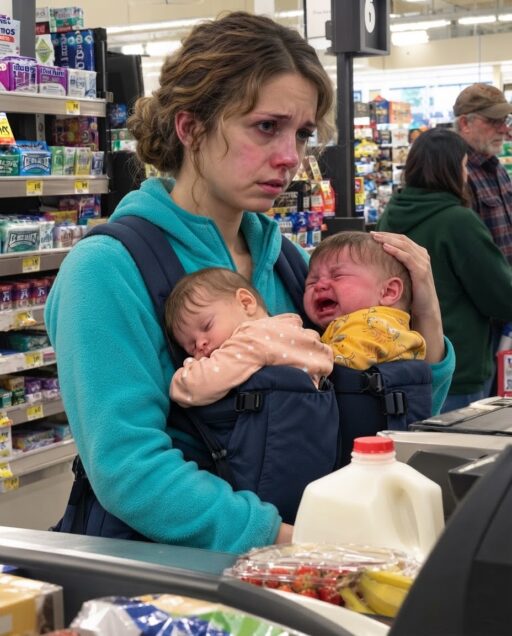
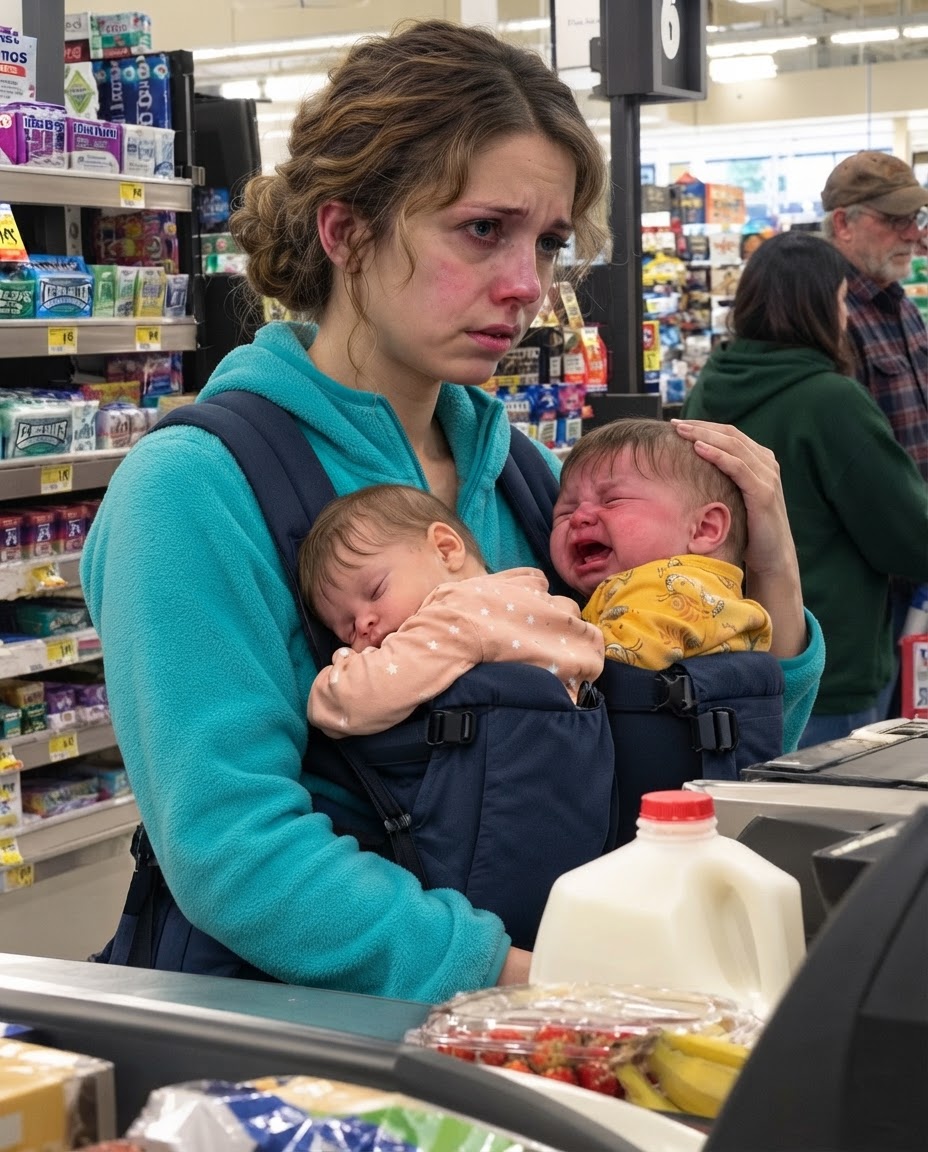

She filled a cart with diapers, formula, wipes, milk, eggs, chicken, vegetables, bread, and other necessities. I quietly reminded her that our own finances were already stretched thin, but she refused to put anything back.
“We can manage today, sweetheart. We’ll worry about next week when it comes.”
When Lori began ringing up our purchases, Mike appeared and announced an unexpected thirty-percent discount. He pretended it was a new store policy, although neither Lori nor I believed him for a second.
Maya’s little yellow house stood near the edge of town, with peeling paint, a sagging porch, and tiny blue socks hanging over the railing. When she opened the door and recognized me, she looked confused until her eyes moved toward Mom’s wrist.
“June?”
Mom nodded, and Maya immediately removed the security chain. Before either woman could say anything more, Mom stepped forward and embraced her.
“He would have been so proud of you. He would have been so happy to know you made it somewhere safe.”
Maya began crying and apologized for keeping the watch for so many years. Mom assured her that there was nothing to forgive because she’d protected something precious and brought it back to the family who loved him.
Inside, the house was sparsely furnished but spotless, with two chairs, a worn sofa, and a playpen near the living room wall. A calendar on the refrigerator had Monday circled in red, marking Maya’s first day at Willow Creek Nursing Home.
While Mom comforted Noah, I carried our groceries inside and arranged them in the kitchen. Maya protested that she couldn’t accept so much, but I returned the little bag containing her $8.42 and explained why repayment was unnecessary.
“You’ve already given us something money could never buy. You brought my father back home.”
We spent the afternoon sharing chicken soup and listening to Maya’s memories of Dad. She described his terrible jokes, his devotion to June, and the stories he’d told about my childhood, including the time I’d brought a wild possum into our bathroom.
Mom corrected several details, and soon all three of us were laughing so hard that I made the peculiar little hiccup sound Dad had always teased me about. Maya stopped laughing for a moment and smiled at me with tears in her eyes.
“There it is. Your father told me about that laugh.”
As evening approached, Mom gave Maya our telephone number and promised that she and the boys would never have to face another emergency alone. Before leaving, she offered to let Maya keep the watch, but Maya gently refused.
“I don’t need it the way I used to. Now I have something better. I have people who care about me.”
On our drive home, Mom asked me to pull over near Route 9, the road where Dad had died. She listened to the watch ticking and told me she’d spent years believing a piece of him had been lost there forever.
“But it wasn’t lost, Rachel. It was helping that girl build a life. Somehow, your father kept doing good things even after he was gone.”
I drove the rest of the way home thinking about Maya, her twins, and the promise Mom had just made. What neither of us realized was that our small visit would soon inspire people throughout Millbrook to do something extraordinary.
Within a week of our visit to Maya’s house, people throughout Millbrook began hearing about my father’s watch and the young mother who had kept it safe for twenty-two years. I hadn’t intended to share such a personal story, but Lori had never been particularly successful at keeping wonderful news to herself.
The response surprised me. Pastor Greene delivered two gently used cribs, Patty from the diner began bringing Maya dinner every Tuesday, and the director of Willow Creek Nursing Home arranged an advance on her first paycheck.
A ninety-one-year-old nursing home resident even knitted matching sweaters for Noah and Eli. One was blue and the other green, and Maya cried when she realized how many strangers wanted to help her children.
The following Friday, Dale Pruitt approached my register carrying bread and peanut butter. He was the same man who had sighed impatiently when Maya’s card was declined, but this time he looked uncomfortable rather than annoyed.
“I heard about your father and that watch. I also wanted to apologize for how I behaved that night.”
Dale explained that his repair shop had been struggling and he’d recently been forced to dismiss two employees. Although he had been worried about his own problems, he admitted that his frustration hadn’t justified humiliating a mother trying to buy diapers.
He placed an envelope on my counter and asked me to give it to Maya without revealing who had sent it. When I reminded him that money was tight for him too, he smiled sadly.
“Your dad once spent an hour helping me search for my stolen bicycle. We never found it, but I never forgot that he cared enough to try.”
That evening, I delivered the envelope to Maya and watched her discover three twenty-dollar bills inside. The accompanying note contained only a few words.
“Sorry for sighing. Good luck with the boys.”
Maya read it twice before attaching it to her refrigerator beside the calendar. She told me that every time she felt overwhelmed, she wanted to remember that people could change and that kindness sometimes arrived from unexpected places.
Life didn’t suddenly become easy for her. Her furnace failed in January, one of the twins developed an ear infection in February, and her husband never returned, leaving her to raise Noah and Eli without his help.
But she was no longer facing those difficulties alone. Mom began visiting every Wednesday and Saturday, initially to watch the babies while Maya rested, and eventually because the three of them had become inseparable.
Before long, Noah and Eli were calling my mother Nana June. She adored them, and I realized that the friendship we’d formed with Maya had given Mom a new sense of purpose after years of quiet loneliness.
Mom also wore Dad’s watch every day. She had a jeweler add holes to the old leather strap so it would fit her wrist, but refused his offers to replace the cracked band or polish away the scratch near the number four.
“Those marks belong to Tom. I want to keep them exactly as they are.”
My own life began changing too. I still worked at register three and worried about bills, but one January evening, I finally enrolled in an online veterinary assistant program.
The classes met twice a week, and completing the program would take approximately eighteen months. When I told Mom, she cried and placed an old photograph of twelve-year-old me holding an unhappy orange cat on our refrigerator.
“Your father would have taken you out for pancakes to celebrate.”
I knew she was right, and for the first time in years, the dream I’d abandoned after Dad’s death no longer seemed impossible.
At work, I started keeping a clean glass jar beneath my register with a handwritten label reading, FOR THE NEXT TEN MINUTES. Whenever someone couldn’t quite afford their groceries, I quietly used money from the jar to cover the difference without embarrassing them.
Lori began contributing, and Mike pretended not to notice. Other customers occasionally left coins or folded bills, and someone once deposited sixty dollars in an envelope marked, FOR WHOEVER NEEDS IT.
A few weeks later, Maya returned to my checkout line with Noah and Eli sitting in their double stroller. Both boys wore their knitted sweaters, and this time, her groceries included milk, formula, size-four diapers, and a package of marshmallow cookies.
When she tapped her debit card, the terminal displayed APPROVED. We exchanged smiles, remembering the evening when those same words had seemed impossibly far away.
Then Maya reached into her handbag and dropped a small bag of coins into the glass jar.
“Eight dollars and forty-two cents. Every month, as long as I’m able.”
“Maya, you really don’t have to.”
“I know. That’s exactly why I want to.”
I watched her leave with her boys and glanced at Dad’s photograph beneath the scanner. Twenty-two years earlier, he’d helped a frightened teenager reach safety, never imagining that she would someday meet his daughter and return something precious to our family.
That evening, I came home to find Mom asleep at the kitchen table beside an unfinished crossword puzzle. Her hand rested near her cup of chamomile tea, and Dad’s silver watch was fastened around her wrist.
I sat beside her and gently covered her hand with mine, listening to the familiar ticking. The watch had traveled through years of hardship and grief, yet somehow it had returned to the woman who’d bought it with so much love.
I thought about Maya, her children, the neighbors who had helped them, and the little jar beneath my register. None of us had enough money to solve every problem, but each person had found a way to make someone else’s life a little easier.
Dad had understood something that took me years to appreciate. Kindness didn’t have to be grand to matter, and its influence could travel much farther than the person offering it would ever know.
I looked at the watch and whispered softly.
“You were right, Dad. Sometimes ten minutes really can change someone’s entire life.”
And as the second hand continued moving, I realized that the kindness he’d started twenty-two years earlier was still finding its way into the world.