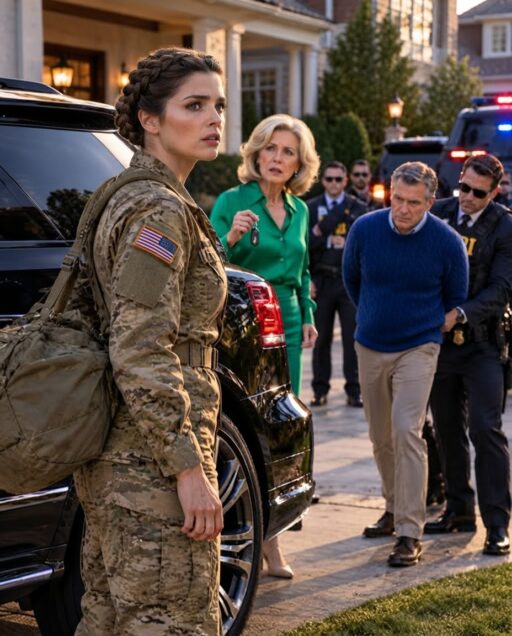
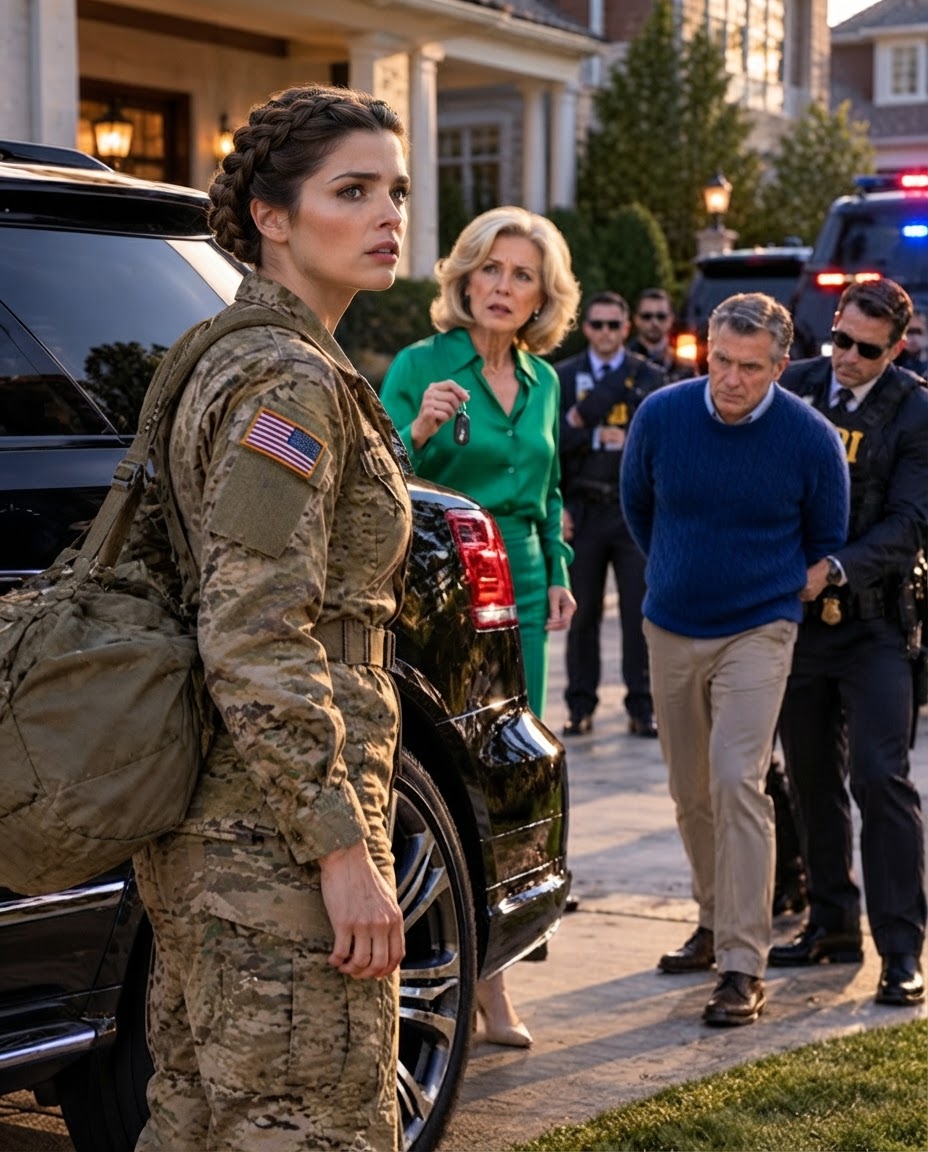

She began crying again, but I walked away. Whatever consequences awaited my parents, I couldn’t allow their betrayal to distract me from the threat still unfolding.
Daniel’s team discovered that the warehouse belonged to another company connected to Riverstone Logistics. Investigators believed it contained an independent communications system capable of initiating the transfer outside normal federal offices.
“Vance has a way to move the money and escape by river,” I told Daniel. “He won’t wait until morning.”
Shortly afterward, we traveled toward the warehouse in a convoy of unmarked vehicles. Daniel had arranged for federal tactical personnel to handle the arrest, while I assisted with identifying the financial systems and explaining the security procedures Vance might exploit.
During the drive, I examined the transaction records recovered from my father’s hidden safe. They revealed fraudulent invoices for medical supplies, vehicle armor, secure radios, and generators supposedly purchased for American troops overseas.
Many of those items had never been delivered.
The stolen funds had been routed through shell corporations and offshore accounts, including accounts in the Cayman Islands. Every forged authorization carried some version of my identity, transforming my military service into a convenient disguise for corruption.
“Your father wasn’t the mastermind,” Daniel said quietly. “Vance used him because he had access to your personal information.”
“That doesn’t make him innocent,” I replied. “He knew those supplies were supposed to protect soldiers.”
We reached the industrial district shortly before midnight. From a concealed observation point, agents identified several people inside the warehouse and a powerful cabin cruiser waiting beside the river dock.
Daniel received confirmation that the arrest warrants were active.
“Everyone stays focused,” he instructed. “We need Vance alive, and we need those records preserved.”
Minutes later, federal agents entered the building and ordered everyone to surrender. Two armed security contractors were detained after a brief confrontation, while a third man remained standing beside a portable satellite workstation.
It was Thomas Vance.
His silver hair was perfectly combed, and his expensive overcoat looked absurdly elegant against the warehouse’s rusting machinery. Even surrounded by federal agents, he wore the expression of someone convinced that his influence could protect him.
“You’re too late, Cho,” he announced. “The international transfer has already been processed through Zurich.”
I stepped forward, and his confident smile faltered.
“Colonel Ellison. Your early return from Iraq was rather inconvenient.”
“You stole my identity, diverted military funding, and arranged for me to be killed,” I answered. “Your inconvenience is the least of your problems.”
As agents handcuffed him, Daniel examined the workstation. The screen displayed the attempted transfer, but another notification had appeared beneath the transaction record.
TRANSACTION ABORTED BY FEDERAL MONETARY OVERSIGHT COMMAND.
Daniel turned toward me.
“The federal freeze took effect three minutes before his authorization. The money never reached his offshore account.”
For the first time, Vance looked genuinely frightened.
Outside, federal marine patrol vessels surrounded his waiting boat. His escape route had disappeared, his guards were in custody, and the eight-million-dollar transfer had failed.
But as agents escorted him away, Vance leaned toward me.
“You think arresting me ends this? You have no idea how many people are involved.”
I held his gaze.
“Then I suppose you’ll have plenty of company when the investigation is finished.”
Daniel continued examining the recovered files while forensic specialists secured the equipment. The evidence suggested that Operation Glass House extended across several states and multiple federal departments.
Then he opened an encrypted archive containing the original authorization records.
“Mara,” he said, “we’ve found the documents that can prove you never authorized a single payment. But there’s something else here about your parents that you need to see.”
Daniel Cho studied the recovered authorization records while federal technicians secured Thomas Vance’s computers. The documents confirmed that my military credentials had been duplicated without my knowledge and that the fraudulent payments had been arranged through a network of shell corporations.
There was also evidence showing how my father had become involved. Richard had believed Vance’s promises about a private investment fund, conveniently ignoring the suspicious transactions and the danger he was creating for his own daughter.
“Your father may have convinced himself this was legitimate,” Daniel explained. “But he knowingly provided your personal records and allowed Vance’s people to use your identity.”
I looked toward the river, struggling to reconcile the father who had raised me with the man who had helped destroy my reputation.
“He knew what those military supplies meant,” I answered. “He knew soldiers depended on them, and he chose money anyway.”
By dawn, Vance and his associates were in federal custody. Investigators had secured the offshore transaction records, recovered the stolen authentication equipment, and prevented the $8,417,000 transfer from reaching its intended destination.
We returned to the FBI’s Washington Field Office as news crews gathered outside. Inside a secure conference room, Daniel placed a thick evidence folder in front of me.
Across its cover was a single word stamped in red.
EXONERATED.
For several seconds, I couldn’t speak. Months of uncertainty, forged signatures, and fear that my military career might be destroyed had finally given way to evidence establishing my innocence.
A federal prosecutor entered the room and shook my hand.
“Colonel Ellison, your cooperation helped prevent an enormous theft of defense funds. The evidence also supports charges against several individuals involved in this operation.”
I thanked him, but one question weighed more heavily than any professional recognition.
“What happens to my parents?”
He explained that my father faced conspiracy and identity fraud charges, although his cooperation against Vance could influence the eventual sentence. My mother faced charges connected to the fabricated biometric evidence and her efforts to mislead investigators.
I listened without interrupting.
Part of me remembered childhood birthdays, family dinners, and the parents who had once celebrated my decision to serve in the Army. Another part remembered the forged confession they’d prepared, the stolen fingerprint, and the accusation my mother had shouted in front of federal agents.
I couldn’t pretend those choices hadn’t happened simply because we shared the same last name.
Later that afternoon, Daniel accompanied me to the federal motor pool, where my Mercedes had been delivered following its forensic examination. Investigators had documented the evidence inside the vehicle and cleared it for release.
I approached the rear wheel and ran my fingers over the three-inch scratch that had first caught my attention. The damage was small compared with everything my family had done, but it reminded me how quickly trust could be destroyed.
Daniel stood beside me.
“The Army Criminal Investigation Division has closed its inquiry into your involvement. General Morrison also signed your recommendation for promotion to full colonel this morning.”
I turned toward him, overwhelmed by the news.
“Thank you for believing me.”
He shook his head.
“I followed the evidence, Mara. That’s what investigators are supposed to do.”
For the first time since returning from Baghdad, I felt the weight of the investigation beginning to lift. My reputation had survived, my career remained intact, and the people responsible for the fraud would have to answer for their actions.
I climbed into the Mercedes and started the engine. Instead of returning to my parents’ house, I headed west toward the Blue Ridge Mountains, leaving Richmond and its painful memories behind.
As the afternoon sunlight stretched across the highway, I thought about everything my parents had been willing to sacrifice. They had traded my trust, my identity, and potentially my freedom for a chance to escape their financial mistakes.
But they hadn’t succeeded in taking the one thing that mattered most.
My integrity.
I couldn’t repair my family with a financial investigation, and I couldn’t erase the betrayal that had brought federal agents to my childhood home. What I could do was continue living according to the principles I’d spent my career defending.
I lowered the window and let the cool mountain air fill the car.
Fourteen months earlier, I’d left America to serve my country. When I finally returned, I discovered that the greatest threat to my future had been waiting inside my own family.
My parents had nearly cost me everything, but they had taught me one final lesson: sharing someone’s blood doesn’t give them the right to destroy your life. And sometimes, the only way to reclaim your future is to let the people who betrayed you face the consequences of their choices.