

“She can’t even afford an economy ticket,” my father announced at Denver International Airport, loud enough for the passengers behind us to hear. “Thirty-four years old, and she still expects her family to pay for everything.”
My stepsister, Brindle, laughed while holding up her phone to record my humiliation. Beside her, my stepmother, Delphine, adjusted her expensive cream jacket and gave me the sympathetic smile she always wore when she wanted to make an insult sound like kindness.
“Don’t embarrass her, Harlon,” Delphine said. “Some people simply aren’t meant to be successful.”
I tightened my grip on my worn leather carry-on, refusing to give them the reaction they wanted. What none of them knew was that I had received a letter three weeks earlier that could change everything about our family.
My name is Marlo Cassidy, and I grew up in Colorado as the daughter my father preferred to forget. My mother, Coraline, died when I was nine, leaving me with a man who gradually replaced our memories with a new wife, a favored stepdaughter, and a household where I was always the outsider.
My father owned three successful car dealerships, but he constantly reminded me how expensive I was to raise. While Brindle received designer clothes and elaborate birthday parties, I worked part-time jobs and learned to stop asking for things.
That morning, we were traveling to Savannah, Georgia, for my maternal grandmother’s ninetieth birthday. My father had booked first-class seats for himself, Delphine, and Brindle, then sent me an economy boarding pass for seat 34B.
“You’re welcome,” his message had said.
At the gate, Brindle scanned her boarding pass before turning toward me with a mocking grin.
“Enjoy your middle seat, sis. Try not to spill anything on the person next to you.”
Several passengers glanced in my direction, and I felt the familiar embarrassment rising in my chest. My father walked down the jet bridge without looking back, apparently certain I would follow like I always did.
But this time, I stepped out of line.
I sat beside the terminal window and opened my carry-on, carefully removing a white envelope from an Atlanta law firm called Rothwell, Pace, and Kim.
Inside was a letter I’d already read more times than I could count.
Three weeks earlier, my grandmother’s attorney had called with astonishing news about my mother’s family. He explained that my grandmother had established a separate family trust, protected from my father’s control, and had recently authorized its transfer to me.
Its current value was slightly more than $84 million.
I had nearly dropped my phone when he told me.
Until that moment, I had been living in a small Denver apartment, earning $42,000 annually as a nonprofit grant writer. I bought secondhand clothes, drove an aging sedan, and worried about unexpected expenses like everyone else.
My father had mistaken my ordinary lifestyle for proof that I was worthless.
He had no idea that the quiet daughter he mocked was now wealthier than he had ever imagined becoming.
I slipped the letter back into its envelope and sent a message to a number saved in my phone.
I’m ready.
The response arrived almost immediately.
Your aircraft is prepared, Miss Cassidy. Captain Ruiz will meet you at the private terminal. A car is waiting outside Door 6.
I stood, adjusted my sweater, and walked away from the gate.
Outside, a black town car waited at the curb. The driver stepped forward, opened the rear door, and greeted me with a respectful smile.
“Your jet is ready, ma’am.”
For the first time that morning, I smiled.
Twenty minutes earlier, my father had publicly declared that I couldn’t afford an economy seat. Now I was being driven to a private aircraft that would take me directly to Savannah.
But the money wasn’t the reason my hands were trembling.
There was another document inside that envelope, one my grandmother’s attorney had urged me to read carefully.
It concerned the trust my mother had established for me before her death.
That account had once contained nearly $3 million.
When I turned twenty-one, my father told me there was almost nothing left.
I had believed him.
Now I knew that someone had spent the money, and my grandmother had spent years documenting exactly where it went.
As the driver pulled away from the terminal, I looked down at the final page of the attorney’s letter.
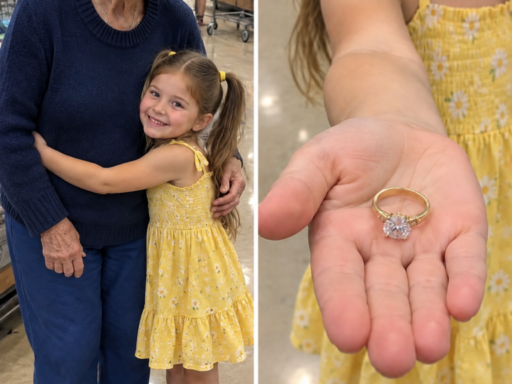
My father’s name appeared beside a series of withdrawals totaling more than $2.6 million—and one of those payments had purchased my stepmother’s engagement ring.
I stared at the financial statement in my hands as the town car approached Denver’s private aviation terminal. My father’s signature appeared beside withdrawals that had funded the comfortable life he constantly reminded me I didn’t deserve.
The most painful entry wasn’t the largest transaction.
It was a $94,000 payment to a luxury jeweler in 2005, the year he proposed to my stepmother, Delphine.
I remembered that Christmas clearly. My father had presented Delphine with a sparkling diamond ring while I stood nearby wearing a sweater my grandmother had mailed me because nobody else had remembered to buy me a gift.
He had called the ring a symbol of his new beginning.
Now I knew my mother’s money had paid for it.
At the private terminal, Captain Ruiz greeted me beside a cream-colored Gulfstream jet. He introduced himself warmly, asked whether I needed anything before departure, and assured me we’d reach Savannah well before my father’s commercial flight.
I settled into a leather seat and opened the accountant’s report again.
My mother, Coraline Whitfield Cassidy, had established a trust for me before her death. It was intended to pay for my education and provide financial security when I became an adult.
My father had been appointed trustee until my twenty-first birthday.
Instead of protecting those funds, he had transferred money into businesses and accounts connected to himself.
The report identified payments toward a second car dealership, renovations to his Colorado mansion, Delphine’s jewelry, and Brindle’s private education.
The house had six bedrooms.
Somehow, there had never been one for me.
I remembered sleeping on a folding bed in the basement whenever I visited during college breaks. Delphine claimed the upstairs rooms were needed for guests, although Brindle had an entire dressing room filled with shoes.
I had accepted those humiliations because I believed my father was spending his own money.
Now every memory felt different.
When I turned twenty-one, he had taken me to a diner in Boulder and pushed a folder across the table.
“Your mother left a little money,” he’d said. “Unfortunately, the investments didn’t work out.”
The account balance was $142.
I signed the paperwork because I trusted him, never realizing I was accepting an explanation for money he had already diverted.
For years afterward, he criticized me for working two jobs and struggling with tuition.
He had stolen the very resources that could have prevented those struggles.
By the time our aircraft landed near Savannah, I was exhausted from reading.
My grandmother, Adalline Whitfield, was waiting inside the private terminal in a wheelchair, wearing a pale blue dress and the pearl necklace I remembered from childhood.
The moment she saw me, her eyes filled with tears.
“My sweet Marlo.”
I knelt beside her and wrapped my arms around her waist. For several moments, I couldn’t speak, because being held by someone who loved me without conditions was something I had missed for far too long.
“Grandma, he humiliated me again,” I finally whispered.
She stroked my hair.
“I know, sweetheart.”
“He told strangers I couldn’t even afford economy.”
Her expression hardened.
“Then tomorrow he can explain how he afforded everything he purchased with your mother’s money.”
I looked up.
“Tomorrow?”
“My birthday party. Fifty guests, including people who knew your mother and trusted your father to protect you.”
I felt a sudden wave of anxiety.
“Grandma, are you planning to confront him publicly?”
“I’m planning to tell the truth,” she answered. “But only if you’re comfortable with it.”
I considered everything I’d endured in silence, from forgotten birthdays to the years I’d spent believing I wasn’t worthy of my father’s affection.
Then I nodded.
“Tell them.”
At her Savannah townhouse, my grandmother showed me three cream-colored envelopes arranged neatly on her writing desk.
One bore my father’s name.
The second was addressed to Delphine.
The third was for Brindle.
“Each contains information that person needs to understand,” Grandma explained.
I reached toward my father’s envelope, but she gently stopped me.
“There’s something else you should know before tomorrow.”
She opened a separate folder and removed a letter written in my mother’s handwriting.
I recognized the signature immediately.
Coraline Cassidy.
My grandmother watched me carefully as I unfolded the page.
“Your mother wrote that shortly before she died,” she said. “She was beginning to worry about how your father handled money.”
I read the first paragraph, my throat tightening.
Then I reached the final sentence.
“If anything happens to me, please make sure Harlon never gains control of Marlo’s future. There is something about his business dealings that I no longer trust.”
I read my mother’s final warning three times before carefully folding the letter. For twenty-five years, I had believed her death was the moment my father became distant, but now I wondered whether she’d already seen the selfishness I spent my childhood trying to excuse.
My grandmother sat beside me in her Savannah living room, watching my face with concern. She explained that my mother had questioned several business transactions before her death, although she hadn’t lived long enough to investigate them fully.
“Your mother wanted you protected, Marlo,” Grandma said. “Your father was supposed to honor that.”
Instead, he had used my inheritance to build another family’s comfortable life.