
“Long enough that this was not an oversight. And there’s another email about how they planned to deal with you after closing.”
The humiliation at the anniversary party had felt spontaneous.
The evidence suggested my family’s confidence had been building for months.
Part 4: What They Planned After Closing
The first email Elena showed me had been written by the lodge’s outside accountant eight months earlier. He questioned repeated payments to Paige Events and warned that transactions involving an owner’s separate company required documentation and approval.
Dad replied from his personal account.
Do not copy Claire. Paige is correcting it before year-end.
Nothing had been corrected.
Another thread showed Paige discussing the Meridian Shore offer with my parents. She estimated how much cash each person would receive once my interest had been assigned to her. Beside my name, the projected distribution was zero.
Then I read the message Dad had sent three weeks before the anniversary.
Claire always gives in when her mother cries. We’ll handle her after closing.
For years, I had believed my parents called me because they trusted me. The email revealed something uglier: they trusted my guilt.
They expected me to discover the transaction after the money had been distributed, listen to Mom cry about breaking up the family, and surrender rather than fight.
The anniversary humiliation might not have been deliberately staged, but their confidence came from the same assumption. They believed I would accept any insult if resisting threatened the family’s comfort.
Elena sent a formal demand requiring withdrawal of the disputed assignment, a full accounting of Paige Events, and suspension of any sale until the LLC’s true ownership was recognized. She also advised the relevant parties that the signature was under investigation.
Within forty-eight hours, the assignment transferring my interest for one dollar was withdrawn.
Paige called repeatedly. Mom left messages saying lawyers were turning us against each other. Dad claimed his email had been taken out of context.
I saved everything and answered none of it.
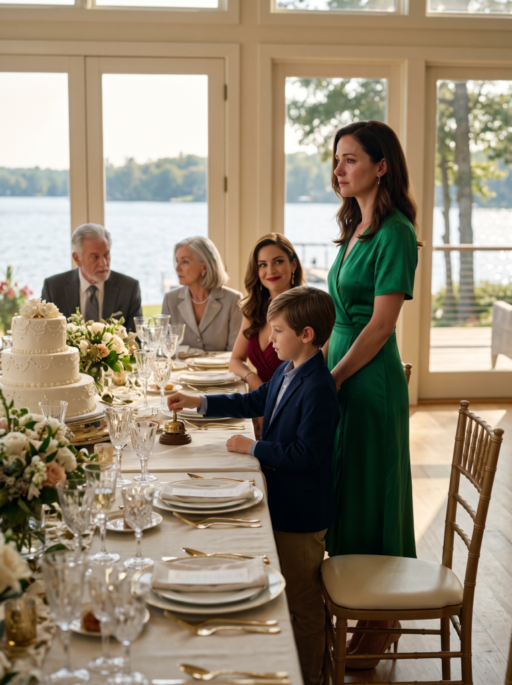
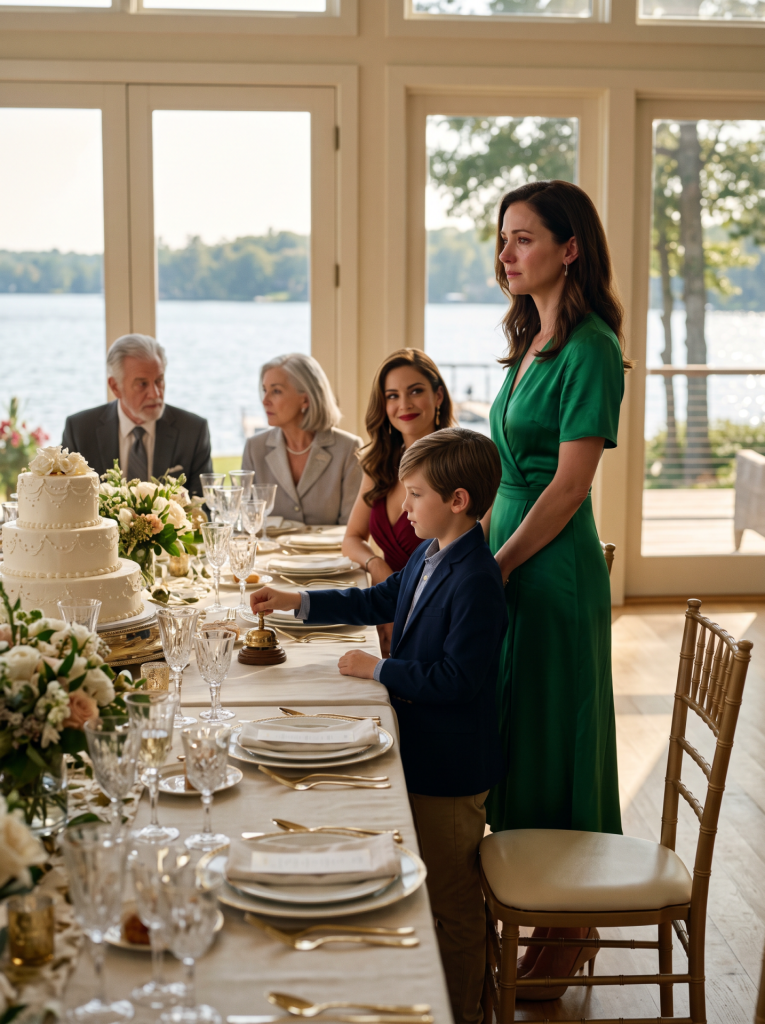
Four days later, a small package arrived at my apartment. Inside was the brass service bell from the anniversary party and a folded sheet of notebook paper.
Ben’s handwriting was uneven.
Dear Aunt Claire,
I’m sorry I called you the family ATM. Mom said everyone would laugh, and I thought it meant you helped people. I didn’t know it meant they only acted nice when they wanted money. I’m sorry I made you leave. I miss visiting the lodge office with you.
Love, Ben.
Below the letter, he had drawn the two of us behind the lodge’s front desk. The brass bell sat between us.
I cried harder over that page than I had over the forged documents.
Ben was the only person who had apologized without asking me to release money, stop an investigation, or restore someone’s comfort.
I wrote back that I loved him and knew an adult had given him the words. I also told him jokes could hurt people, and courage sometimes meant refusing to laugh when everyone else did.
I forgave him.
I did not forgive the financial deception simply because he was caught inside it.
With the false transfer removed, Meridian Shore could not close under the existing contract. The company withdrew rather than wait through an ownership dispute and possible litigation.
That did not solve the deeper problem. Paige could not repay $96,000 immediately. My parents wanted to retire, and none of us could continue operating a business together without trust.
I had enough voting power to block another dishonest sale, but I no longer wanted my future tied to relatives who considered my signature an obstacle.
After several weeks of negotiation through counsel, all owners agreed to hire an independent broker and obtain a forensic accounting. Any buyer would have to recognize the real ownership structure, restore the diverted funds in the closing calculations, and disclose its plans for the property.
Two legitimate offers eventually arrived.
One was higher and would still demolish the lodge.
The other came from a regional hospitality company that promised to renovate the buildings, retain the staff, and continue operating under the Willow Lake name.
For the first time, I had to decide whether saving the lodge meant keeping my ownership—or finally letting it go.
Part 5: What I Stopped Paying For
I chose the offer that preserved Willow Lake Lodge.
It was slightly lower than the demolition bid, but it treated the property as more than acreage beside a profitable lake. The buyer agreed to renovate the cabins, keep the dining hall, retain qualified employees, and preserve the old brass nameplate above the entrance.
The sale took four months to complete.
This time, every owner had separate counsel. Every signature was independently verified. The forensic accountant traced the $96,000 transferred to Paige Events, and the settlement credited that amount back to the LLC before the remaining proceeds were distributed according to the legitimate ownership percentages.
My 51 percent was finally treated as 51 percent.
There was no dramatic courtroom confession. Justice arrived through revised spreadsheets, verified documents, and a closing statement that nobody could quietly alter.
My parents moved into a smaller condominium outside Madison. Paige did not receive the controlling ownership or effortless payout she had expected. What remained of her distribution was reduced by the money her company owed, and she had to rebuild her business without using lodge deposits.
Mom eventually asked whether we could put everything behind us.
“I miss my daughter,” she said during one phone call.
“I miss the mother I believed would protect me,” I replied.
I did not permanently close the door, but I stopped allowing tears to decide when it opened. Any reconciliation would require honesty, accountability, and time—not another demand disguised as family unity.
I continued writing to Ben. Paige sometimes tried to use access to him as leverage, but I refused to negotiate money through a child. When he called, I listened to stories about school, baseball, and the model buildings he liked making from scrap wood.
That autumn, I moved out of the one-bedroom apartment where I had spent years postponing my own life. My new two-bedroom place overlooked a tree-lined park and had a balcony wide enough for a table, two chairs, and the herb garden I had always wanted.
I bought the furniture slowly. Nothing needed to prove I could afford it.
One Saturday, Ben sent me a photograph of his latest school project. He had built a miniature front desk from cedar-colored craft wood. Attached to the top was the brass bell from the anniversary party.
His message read:
I made the lodge desk the right way this time. The bell is for welcoming people.
I stared at the picture for a long moment before replying.
I’m proud of you, Ben.
Then I stepped onto my balcony and listened to the city waking beneath me.
For six years, I had believed sacrifice was the price of keeping my family together. I paid bills, solved emergencies, protected a business, and accepted smaller pieces of my own life because I thought love meant giving until nobody else had to feel uncomfortable.
But people who love you do not move your chair away from the table while quietly signing your name behind your back.
Willow Lake Lodge had cost me $312,000, countless weekends, and more trust than I could recover. Selling it did not mean those years had been wasted. It meant I had finally stopped confusing endurance with loyalty.
The most valuable thing I received from the sale was not my share of the money.
It was the certainty that I never again had to pay for the right to belong.