
Chelsea stood behind him with her arms crossed.
“You should be resting. This obsession proves Ryan was right.”
Mara handed her a notice preserving all business records, computers, security footage, and financial accounts.
“Deleting anything after receiving this may create another problem,” she said.
The color left Chelsea’s face.
The locksmith restored my access and replaced the locks Ryan had installed. We entered the parlor while the title representative photographed the property records Ryan had left on the desk.
Lucy appeared at the top of the stairs. Ryan ordered her back to her room, but she pointed toward the library.
“The key came from there,” she told me. “Dad said Grandpa’s things could ruin everything.”
Chelsea quickly led her away.
In the library, the brass key did not fit the desk, cabinets, or display cases. I remembered Thomas standing near the back shelves during the final year of his life, measuring panels and refusing to explain what he was building.
Mara’s digital investigator called before I could examine the wall.
He had recovered the metadata from the false power of attorney.
The file had been created on Ryan’s laptop and uploaded from his administrative account.
The timestamp was precise.
Six hours after I entered the operating room, my son had begun creating the document that declared me incapable of controlling my own life.
Part 3: The Room Behind the Library
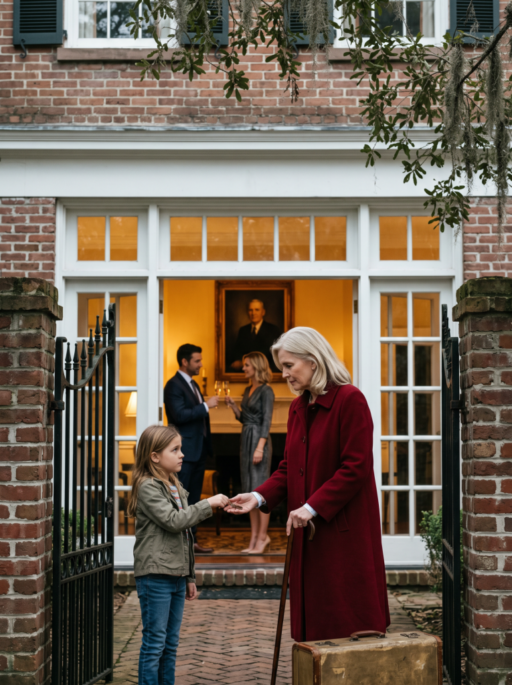
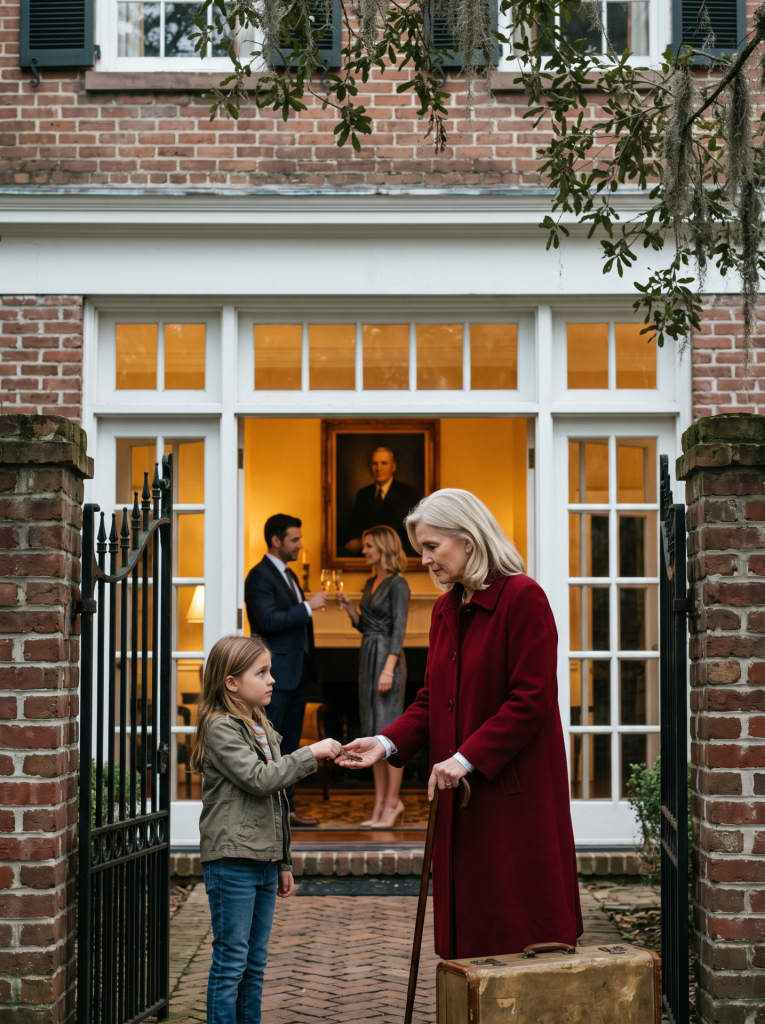
The brass key fit a narrow opening concealed inside a carved magnolia on the library wall.
When I turned it, something clicked behind the shelves. One section moved forward, revealing a cramped passage and a room I had never entered.
The space had once been a service office when Magnolia House was built. Thomas had restored it quietly, lining the walls with cedar shelves and fireproof cabinets.
His reading glasses rested on the desk.
For one irrational second, I expected him to walk in and ask why I was touching his papers.
Instead, I found labeled binders, original LLC agreements, trust records, family letters, and twenty-eight years of handwritten ledgers. A small camera sat beside an envelope bearing my name.
My hands shook as I inserted its memory card into Mara’s laptop.
Thomas appeared on the screen, thinner than I remembered him but still wearing the calm expression that had steadied me through every crisis.
“Caroline, if you are watching this, someone has confused access with ownership.”
I covered my mouth.
“I hope I was wrong to prepare this room. But if Ryan ever tries to use your love for him as permission, remember this: access is not ownership. Family is not permission.”
Thomas explained that he had noticed irregularities in vendor payments before his final illness. He had not found enough evidence to accuse Ryan, and he had feared forcing me to choose between my husband and my son.
So he had strengthened the trust.
The documents confirmed I retained lifetime control of Magnolia House. After my death, Lucy—not Ryan—would become the successor beneficiary.
If her parents faced a conflict of interest, neither of them could control her share. The bank co-trustee would protect it until she reached the age specified in the trust.
That was why Ryan needed me declared incompetent or gone.
He could not inherit Magnolia House directly. But with a broad power of attorney and a fast sale, he could convert the property into cash before the trust or bank stopped him.
Thomas’s ledgers exposed the earlier theft.
Ryan had hidden payments to Chelsea Heritage Events among legitimate vendor expenses. Some invoices billed Magnolia House for linens it already owned. Others charged for tables, chairs, and floral structures purchased years earlier with inn funds.
Chelsea’s struggling company had been surviving on our guests’ deposits.
Mara called in a forensic accountant. By midnight, he had traced the full $214,000 and uncovered another document.
Ryan had pledged a portion of Magnolia House’s future revenue as security for a private business loan. The lender believed the money would fund renovations before the sale.
There had been no authorized loan and no approved renovations.
“He borrowed against events that haven’t happened yet,” I said.
“Including weddings scheduled next year,” the accountant replied. “If the lender enforces the agreement, the operating account could be restricted while ownership is investigated.”
The betrayal was no longer only personal.
Housekeepers, cooks, maintenance workers, and front-desk employees depended on those accounts. Couples had trusted us with weddings they had saved years to afford.
Ryan had risked all of them.
I remained in Thomas’s hidden room long after everyone else left. Grief and anger sat together inside me, neither one stronger than the other.
Ryan had once been the little boy who followed Thomas through the halls carrying a toy hammer. I had mistaken my memories of that child for evidence of the man he had become.
Headlights swept across the library windows shortly before ten.
Ryan entered with Chelsea, a corporate attorney, and the hotel representative from the previous day.
He stopped when he saw the open passage.
“You found the room.”
That confirmed he had known it existed.
“You told Lucy to hide the key.”
“I was protecting her from things she couldn’t understand.”
“You were using her to hide evidence.”
The hotel representative looked between us.
“Mr. Mercer assured us the title issue would be resolved tonight.”
Ryan placed a folder on the library table.
“The closing is scheduled for nine tomorrow morning. Atlantic Crown has already committed resources. You can sign a confirmation, receive the money, and move somewhere appropriate.”
“Or?”
His expression hardened.
“Or everyone will see that you’re too emotionally unstable to manage this property.”
Mara stepped beside me.
“Your authority has been revoked, and the transaction is frozen.”
Ryan smiled.
“Then we’ll let the closing attorney decide.”
I looked at Thomas’s ledgers, the trust documents, and the video still visible on the laptop.
“Fine,” I said. “Bring everyone to the main dining room at nine.”
Chelsea looked relieved, assuming I had surrendered.
I closed the brass key inside my hand.
“But tomorrow, Ryan, every person involved will hear exactly what you tried to sell—and what never belonged to you.”
Part 4: The Closing That Never Existed
At nine the following morning, Magnolia House’s dining room looked less like a closing and more like a hearing.
Ryan and Chelsea arrived with their attorney. Atlantic Crown sent two executives. The title company’s closing counsel sat across from Mara, while the bank’s trust officer placed a locked document case beside her chair.
A sheriff’s deputy remained near the door.
Ryan looked at the gathering and smiled patiently.
“My mother is recovering from major surgery. She’s frightened, confused, and reacting emotionally to necessary changes.”
I took my seat at the head of the table—the chair Thomas had used during staff meetings for twenty-eight years.
“I know exactly where I am,” I said. “Do you?”
Ryan slid the fabricated power of attorney forward.
“This document gives me authority.”
Mara placed the genuine temporary authorization beside it.
“This one gives you authority to manage reservations for six weeks. The signature page from it was copied onto the other document.”
She displayed the metadata showing when the false file was created, which account uploaded it, and which device produced it.
Then she presented my cardiologist’s statement.
“Mrs. Mercer has full decision-making capacity. No physician recommended assisted living or found cognitive impairment.”
The bank’s trust officer opened her case and removed the original trust agreement.
“Magnolia House is owned through Mercer Heritage Holdings LLC,” she said. “Mrs. Mercer is its sole voting member. In addition, any sale requires the bank’s written approval as co-trustee. We received no request and granted no consent.”
The closing counsel shut the file in front of him.
“Without valid authorization from the LLC and trust, there is no transaction to close.”
One Atlantic Crown executive turned to Ryan.
“You told us the bank had approved the sale.”
“It was a technicality,” Ryan replied. “My mother was always going to agree.”