
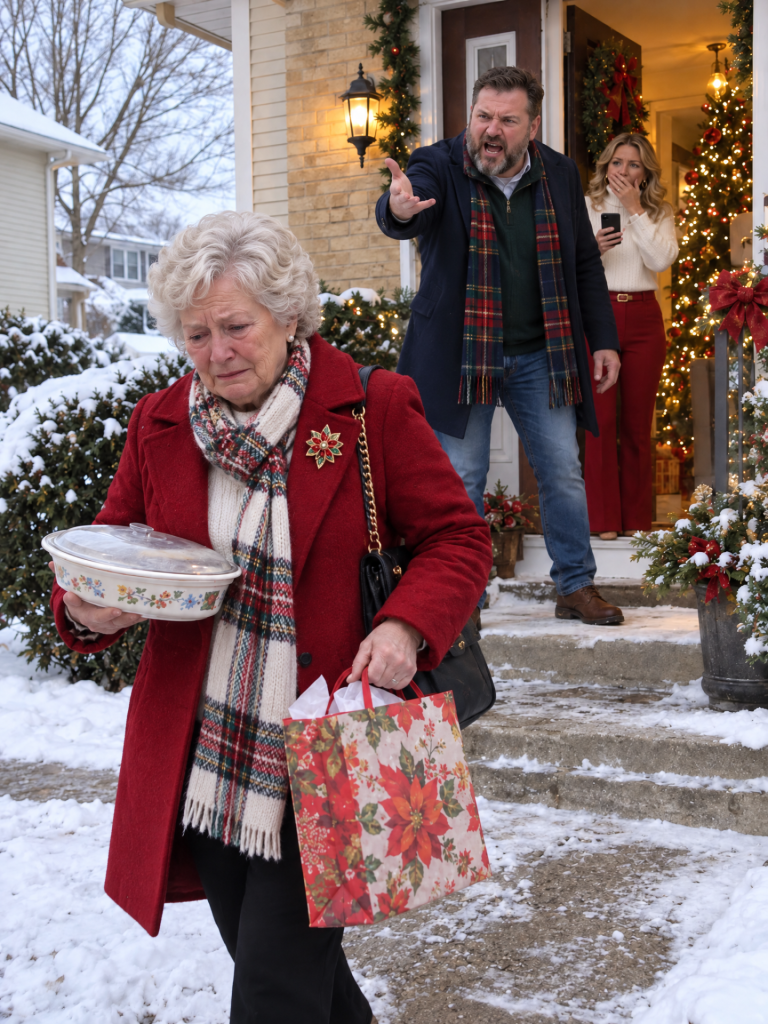

“Dad, who’s at the door?”
My six-year-old grandson’s voice came from inside the house as my son Daniel stood in the doorway, deliberately blocking my view of the Christmas celebration. Without even looking back at his child, he answered with two words that would remain in my memory long after that terrible evening.
“Wrong house.”
I stood on his snow-covered porch holding a freshly roasted turkey and a red gift bag filled with presents for my grandchildren. When I tried to speak, Daniel lowered his voice and looked at me with an expression that made me feel like an unwelcome stranger.
“Please go home, Mom. Don’t embarrass me in front of everyone.”
Before I could respond, he stepped inside and closed the door, leaving me alone in the freezing December air. Through the windows, I could hear Christmas music and cheerful laughter, while snowflakes settled on the foil covering the turkey I’d spent hours preparing.
My name is Margaret Whitmore, and I was sixty-eight years old when my only son decided I wasn’t welcome at his Christmas celebration. I’d spent thirty-one years working as a school nurse at Jefferson Elementary in Livingston, New Jersey, and had been married to my husband Richard for thirty-four years before a sudden heart attack took him away.
Richard had owned a small hardware store, and we’d lived modestly throughout our marriage, saving whatever we could while raising Daniel. I wasn’t accustomed to expensive vacations or fashionable clothes, but I’d always believed that a loving family was worth more than anything money could purchase.
Christmas had always been my favorite holiday because it brought everyone together around one table. Richard used to carve the turkey while I prepared the gravy, and Daniel would secretly steal pieces of crispy skin whenever he thought his father wasn’t watching.
After Richard died, spending Christmas Eve at Daniel’s house became our annual tradition. His wife Claire prepared appetizers, I brought the turkey, and our grandchildren Sophie and Owen opened one present each before bedtime.
That year, however, Daniel had seemed unusually distant whenever we spoke on the telephone. When I asked what time I should arrive for Christmas Eve dinner, he vaguely promised to let me know, but the promised call never came.
I assumed he’d simply forgotten because we’d celebrated together every year since Richard’s death. So I prepared our traditional turkey, wrapped a blue sweater for six-year-old Owen, and purchased a delicate snow globe for nine-year-old Sophie.
On Christmas Eve, I put on my good gray wool coat and drove twenty minutes from my small house in West Orange to Daniel’s beautiful colonial home in Maplewood. I even secured the turkey on the passenger seat with a seat belt, remembering an unfortunate incident years earlier when an entire pan of stuffing had spilled during a sharp turn.
When I arrived, expensive cars lined the street, including the silver Mercedes belonging to Claire’s parents, Gordon and Patricia Hollister. Through the enormous living-room window, I saw an elegant Christmas tree, beautifully dressed guests holding champagne glasses, and children playing in matching red pajamas.
Daniel stood beside Claire, laughing with several guests, and for a brief moment I felt proud that my son had built such a wonderful life. Carrying the turkey and presents, I climbed the porch steps and rang the doorbell, expecting him to greet me with the same warmth he had shown every previous Christmas.
Instead, he opened the door only halfway and stared at me in disbelief. Claire appeared behind him holding a glass of wine, but her expression immediately hardened when she realized who was standing outside.
“You shouldn’t have come, Mom. I never invited you.”
I tried to remind Daniel that I’d attended every Christmas Eve gathering since his father died, but he explained that the evening was intended for Claire’s relatives and important business acquaintances. He seemed particularly concerned about several guests from Gordon’s firm, insisting that my presence would make the situation uncomfortable.
Through the narrow opening behind him, I noticed the beautifully arranged dining table with fourteen place settings. Not one of those fourteen places had been reserved for me, despite everything I’d done to help my son’s family over the years.
Then Owen called from inside, asking who had arrived, and Daniel told him it was the wrong house. I could barely believe that my own son would rather lie to his child than acknowledge his mother standing outside in the snow.
After he shut the door, I remained on the porch for nearly a minute, struggling to understand what had happened. Through the window, I spotted Sophie sitting on the staircase with a mug of hot chocolate, and I thought she might have recognized me.
I lifted my hand in a small wave before carefully descending the icy steps and returning to my car. As I drove home, I kept wondering what I’d done to deserve such humiliation, never imagining that the worst part of the evening was still ahead.
Because before midnight, Daniel would call me again, and what he said would finally make me reconsider fourteen years of sacrifices I’d never questioned.
I returned home shortly after nine that Christmas Eve, still wearing my winter coat and carrying the turkey Daniel had refused to accept. I placed the food and my grandchildren’s presents on the kitchen counter, then sat alone in the darkness, trying to understand why my own son had treated me like an unwanted stranger.
I replayed every recent family gathering, wondering whether I’d offended Claire or embarrassed Daniel without realizing it. Despite everything, I kept hoping my phone would ring and my son would apologize, explaining that he’d made a terrible mistake.
At 10:47 p.m., Daniel’s name finally appeared on my screen, and I answered immediately. But instead of an apology, I heard loud music, clinking glasses, and several people laughing in the background.
“Did she actually show up carrying an entire turkey? Who does that?” Claire exclaimed, laughing loudly enough for everyone nearby to hear.
Daniel tried to quiet her, but I could hear him laughing too. When he finally addressed me, his speech was slightly slurred, and his tone carried none of the regret I’d desperately hoped to hear.
“Mom, don’t start crying tomorrow and pretending you’re the victim. You embarrassed yourself by showing up without an invitation.”
I remained silent, stunned that he was calling simply to humiliate me again. Then Claire made another remark that revealed something far more disturbing about how they viewed me.
“Tell her that money can’t buy her a place at our Christmas table!”
“Money can’t buy you a spot here, Mom,” Daniel repeated.
Everyone burst into laughter before the call abruptly ended, leaving me staring at the silent phone. What confused me most wasn’t the cruelty of their words, but the fact that Claire had specifically mentioned money.
Fourteen years earlier, Daniel had sat at that same kitchen table crying because his first business had collapsed. His landscape design company had failed after his partner disappeared with the remaining business funds, leaving Daniel responsible for unpaid suppliers, bank debts, and an apartment he could no longer afford.
Claire was pregnant with Sophie at the time, and Daniel was terrified of becoming a father without the means to support his family. Richard had been dead for two years, and I’d recently sold his hardware store, leaving me with his life insurance proceeds and the savings we’d accumulated throughout our marriage.
“I’m going to be a father in four months, Mom, and I can’t even afford the rent. I don’t know what to do.”
I couldn’t bear watching my son struggle, so I took out my checkbook and paid his outstanding supplier debts. I also provided the down payment for a modest starter home in Union, telling him he could repay me whenever his finances improved.
“You saved my life, Mom. I’ll never forget what you’ve done for us.”
Unfortunately, that initial assistance became the beginning of fourteen years of financial dependence. When Daniel and Claire decided their starter house was too small, they purchased an expensive colonial home in Maplewood, even though Daniel’s income couldn’t support the mortgage.
I agreed to contribute $2,100 every month, believing the arrangement would end once Daniel received a promotion. Later, Claire wanted Sophie to attend a prestigious private academy in Short Hills, so I began covering the $3,400 monthly tuition as well.
When Daniel launched a consulting business, I supplied the startup capital and eventually added another $1,500 monthly payment to keep it operating. Over time, I also helped cover their car insurance, home repairs, medical expenses, summer camps, and countless financial emergencies.
I even established a separate account called the Family Fund, allowing Daniel to withdraw money whenever unexpected expenses arose. I rarely questioned his requests because I believed supporting my son and grandchildren was simply part of being a loving mother.
Meanwhile, my own house had a leaking roof that I couldn’t afford to repair, and I continued driving a fourteen-year-old Toyota Corolla. My doctor had recommended cataract surgery, but I postponed it because my insurance wouldn’t cover the entire cost.
For several years, my neighbor Ruth had invited me on a spring trip to see the tulips in Holland, Michigan. I always declined, convincing myself that Daniel’s family needed the money more than I needed a vacation.
That Christmas Eve, however, I finally opened my laptop and reviewed every payment I’d made over fourteen years. I searched through online banking records and old statements until I had accounted for the mortgage assistance, school tuition, business funding, insurance, and emergency withdrawals.
When I added everything together, the total left me staring at my legal pad in disbelief. I’d given Daniel and Claire $412,000, more than half of everything Richard and I had worked our entire lives to save.
Suddenly, I understood why Daniel had been so desperate to keep me away from his Christmas party. Claire’s wealthy parents believed their son-in-law was a successful, self-made businessman, and my presence threatened to expose how much of his lifestyle depended on his widowed mother’s savings.
I opened my banking account and studied the automatic transfers that had supported their comfortable life for years. My hands trembled as I selected the first recurring payment, but I could still hear Daniel telling his children that their grandmother had come to the wrong house.
I canceled the mortgage assistance, followed by the tuition payments, business support, and insurance transfers. Then I closed the Family Fund, moved its remaining balance into my personal savings, and removed Daniel’s access.
At 12:16 a.m., I shut my laptop without sending a message or making another phone call. I didn’t feel victorious, because withdrawing that support from my own child was one of the most painful decisions I’d ever made.
But for the first time in fourteen years, I went to bed without wondering what financial problem Daniel would need me to solve next.
By Christmas morning, my son would discover that the woman he’d thrown out into the snow had been paying for nearly everything he was so proud to show off.
When I woke up on Christmas morning, sunlight was streaming through my bedroom window, illuminating the fresh snow that covered the neighborhood. For a few peaceful seconds, I almost forgot what had happened the night before, until I reached for my phone and saw the notifications filling the screen.
Twenty-five missed calls, all from Daniel.