
“Mommy, when are we going to Grandma’s house?”
My eight-year-old daughter, Sophie, stood beside our front door wearing a red Christmas sweater decorated with a tiny silver bell. Her eleven-year-old brother, Noah, waited nearby in his green reindeer sweater, holding a box of homemade pie we’d prepared for our family gathering.
My name is Claire Whitmore, and I’m thirty-nine years old, divorced, and raising two wonderful children in Marshfield, Wisconsin. That Christmas afternoon, while our neighbors welcomed relatives into their homes, my children and I were still waiting for my mother to tell us when we should arrive.
Six days earlier, Evelyn Whitmore had invited us to Christmas dinner at the family farmhouse. She’d specifically asked me to bring Noah and Sophie, along with my casserole, and promised to confirm the time once my aunt Carol’s arrival was settled.
By two o’clock, however, I still hadn’t received a message. I kept checking my phone, hoping that this holiday might finally be different from the years when my mother made us feel like an afterthought.
At 2:15, I decided to call her, and she answered cheerfully after several rings. Behind her voice, I could hear people talking, chairs moving, and silverware clinking against plates.
“Hi, Mom. What time would you like us to come over?”
There was a brief pause before she responded as casually as if she’d forgotten to mention a change in the weather.
“Oh, sweetheart, we already ate. Everyone arrived early, so we decided to have dinner at noon.”
I stared toward the hallway, where Noah was watching me expectantly. Sophie stood beside him with a little purse filled with handmade Christmas cards, including one she’d spent two evenings decorating for her grandmother.
“You already had Christmas dinner without us?”
“Claire, don’t make a big deal out of it. Aunt Carol came early, everyone was hungry, and we couldn’t let the food get cold.”
Then I heard my younger sister, Jenna, laughing in the background. My mother made no attempt to apologize or explain why nobody had called, even though she knew my children had been looking forward to the gathering all week.
I quietly wished her a merry Christmas and ended the call. When Noah asked whether Grandma was ready, I forced a smile and told both children that we’d be celebrating at home instead.
Our modest duplex didn’t have a proper dining room, but I brought out our nicest plates and arranged them along the kitchen counter. We warmed the casserole, sliced the pie, and lit a vanilla candle, trying to turn an unexpected disappointment into a pleasant evening.
As we sat down, Noah looked at his sister before asking a question that nearly broke my heart.
“Mom, did Sophie and I do something wrong? Is that why Grandma didn’t want us there?”
I immediately pulled him close and assured him that neither child had done anything wrong. But inside, I wondered how my children had learned to blame themselves for the unkind decisions of adults who were supposed to love them.
That evening, we watched Christmas movies together until Sophie fell asleep against my shoulder. Before going upstairs, Noah hugged me and said he was glad we’d stayed home, although I could still hear the disappointment beneath his words.
After the children went to bed, I opened a kitchen drawer and removed a thick envelope labeled MOM — TAXES, JANUARY. Inside was $5,200 I’d painstakingly saved throughout the year to cover the property taxes on my mother’s farmhouse.
I thought about the vacations we’d postponed, Sophie’s swimming lessons, and the winter boots Noah desperately needed. I’d denied my own children those things so I could keep supporting a woman who hadn’t even saved them two seats at Christmas dinner.
For the first time, I asked myself whether my mother would still want me in her life if I stopped paying her bills. The answer frightened me, but as I held that envelope, I realized I was finally ready to find out.
What I didn’t know was that my decision would uncover a secret my father had protected for thirteen years, along with a betrayal far more serious than an invitation to Christmas dinner…
The week after Christmas, I finally did something I’d been afraid to do for years. Instead of handing my mother the $5,200 I’d saved for her property taxes, I decided to spend that money on the people who needed me most: my children.
I deposited $3,500 into savings accounts for Noah and Sophie, paid an overdue dental bill, and booked three nights at an indoor waterpark resort in Wisconsin Dells. When I showed the children our spring break reservation, Sophie squealed with excitement, while Noah stared at the pictures before throwing his arms around me.
Seven days after Christmas, my mother called. She didn’t ask about the children or apologize for excluding us from dinner.
“Claire, the property taxes are due. I need that fifty-two hundred dollars.”
I glanced at our vacation confirmation and answered calmly.
“I already spent it, Mom.”
She went silent before demanding an explanation, clearly convinced I was joking. When I told her the money was gone, she insisted it had been intended for the farmhouse.
“No, Mom. That money was mine, and I decided to use it for my children.”
Her voice became sharp as she accused me of being selfish after everything she’d supposedly done for me. For the first time, I asked whether she’d even noticed that Noah and Sophie had been missing from Christmas dinner.
She refused to discuss it, so I told her I was finished paying to be treated like an inconvenience. Then I ended the call without apologizing.
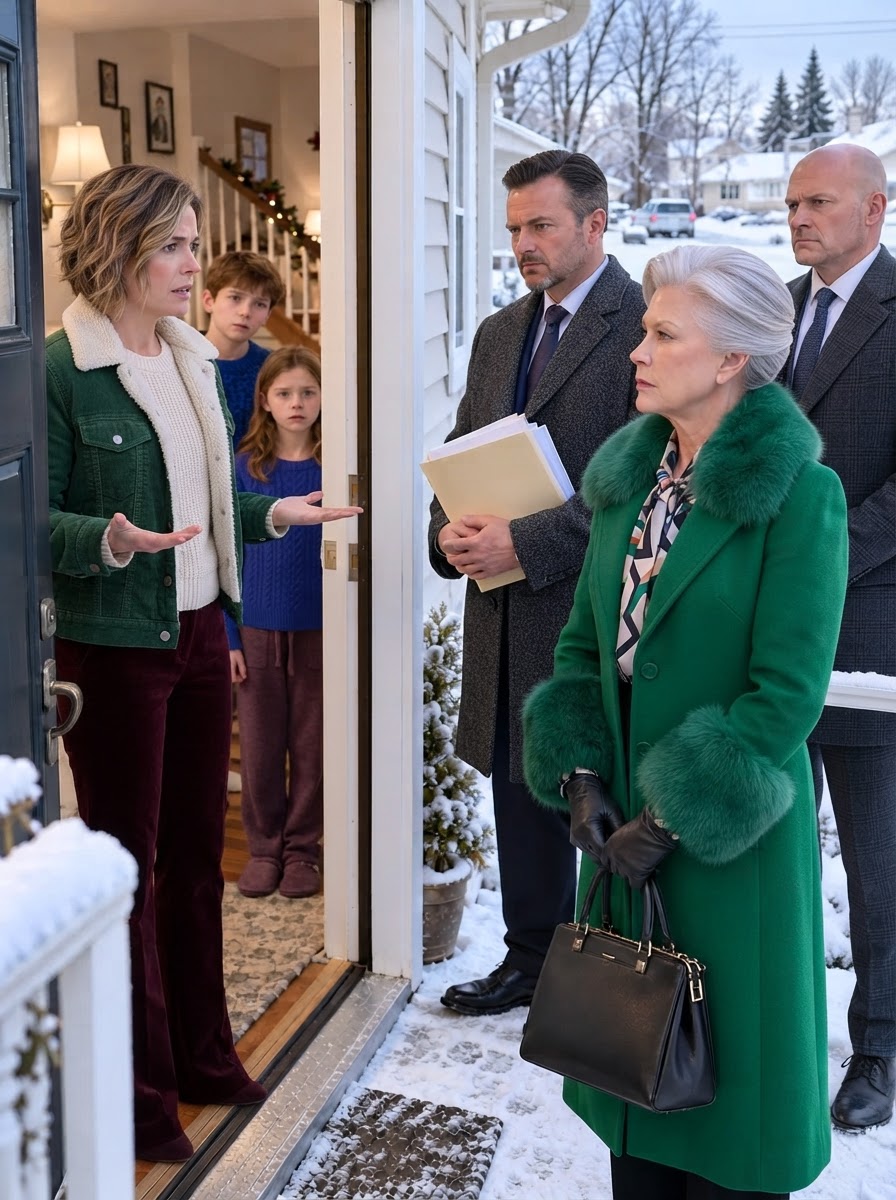
I thought that would be the end of our argument, but at 6:03 the following morning, someone began pounding on my front door. When I opened it, my mother stood on the snowy porch wearing her burgundy coat, accompanied by two unfamiliar men carrying folders.
The taller man introduced himself as Robert Hayes, an attorney, while his companion, Henry Pike, was a title examiner. They explained that they’d come to clarify the legal status of the Whitmore farmhouse.
My mother crossed her arms and announced that my refusal to cooperate had forced her to make certain matters official. Robert opened his folder and showed me a document dated November 2013, shortly after my father’s death.
At the bottom was my signature.
“This is a trustee acceptance,” Robert explained. “Your father transferred the farmhouse and surrounding acreage into a family trust before he died. According to these records, you’re the successor trustee.”
I stared at him, completely confused. My mother had always claimed the farmhouse belonged to her, yet Robert explained that she’d recently attempted to use the property as collateral for another financial arrangement without clear authority to do so.
“Claire, just sign what they need, and everything will go back to normal,” my mother interrupted.