
My mother arrived at my farmhouse on a cold Tuesday evening in March, but she never took off her coat. She sat at my kitchen table with her purse hanging from her arm, while my father nervously turned his old seed cap between his hands.
My husband, Dale, had just finished working in the hog barns and was sitting quietly beside us. I could tell my parents had come to discuss something serious, and when my mother finally mentioned my younger brother, Jeff, I wasn’t surprised.
Jeff was forty-three, recently divorced, and struggling to raise his three children after his wife, Amber, moved to Sioux Falls. With their rental home being sold, he and the children had moved into my parents’ basement, where twelve-year-old Brody, nine-year-old Kenzie, and six-year-old Cole slept on air mattresses beside a chest freezer.
“Those children can’t keep living like this,” Mom said. “Kenzie cries where nobody can hear her, and Cole has started wetting the bed.”
I agreed that they needed a better place to live, but I wasn’t prepared for what she said next.
“Your father and I want you to sell us the farmhouse back for one dollar. Then we can give it to Jeff and the children.”
My name is Tammy Rensink, and I’m forty-six years old. I’ve worked as a rural mail carrier in Sheldon, Iowa, for nineteen years, and that farmhouse has been part of my family for generations.
My great-grandfather built it in 1912, and both my father and I grew up beneath its roof. When my parents retired from farming in 2005, they moved into a smaller house in town, leaving the old property empty until Dale and I married the following year.
At our wedding, Dad offered to transfer the farmhouse and two acres of land to us for a symbolic dollar. The transaction was properly documented, and I handed him a dollar bill at closing, which he tucked into his shirt pocket with a proud smile.
“Paid in full,” he joked.
But the house we received was hardly a comfortable home. Its heating system barely worked, the upstairs bedrooms were freezing, and nearly every major component needed repairing.
In 2009, dangerous electrical wiring forced us to spend $11,500 rewiring the property. Two years later, we paid $14,000 toward a replacement roof, and in 2014, another $7,800 went toward a new furnace and ductwork.
We also repaired the well, septic system, windows, porch, and water heaters. I kept every receipt in a spiral notebook, and by that March evening, our documented expenses totaled $60,340, excluding countless hours of labor.
Now my parents wanted the house returned for the same dollar we’d paid twenty years earlier.
I understood their concern for Jeff, but I couldn’t ignore the sacrifices Dale and I had made. My mother had always protected my younger brother, and I realized she was once again expecting me to give something up because she believed I could manage without it.
Instead of arguing, I thanked my parents for approaching me honestly and promised an answer by Saturday. After they left, Dale gently reminded me that although Jeff was my brother, the farmhouse was also his home.
That night, I lay awake thinking about my brother’s frightened children and everything we’d invested in the property. I knew I couldn’t abandon those kids, but I also refused to surrender the home my husband and I had rebuilt.
By three in the morning, I finally realized there might be a way to help Jeff without giving away our house.
And the answer was waiting in the two empty bedrooms directly above my head.
The following morning, I called Jeff while sitting in my mail truck outside a gas station. He sounded exhausted, and I could hear machinery running in the background as he prepared for another long day at the agricultural cooperative.
“What are you doing Saturday?” I asked. “Dale and I are clearing out the upstairs bedrooms, and I want you and the kids moved in before supper.”
Jeff fell silent, then protested that he couldn’t possibly burden us with four additional people. I reminded him that we had plenty of food, two unused bedrooms, and a bathroom upstairs, and that his children deserved proper beds.
“Does Dale know you’re offering this?” he asked.
“Of course. We’re doing it together,” I assured him.
When Jeff finally accepted, his voice cracked with gratitude. Strangely, he never mentioned my parents’ request to take back the farmhouse, and I assumed he was simply too overwhelmed to discuss anything beyond his children’s immediate needs.
Saturday arrived bright and freezing, and our entire household began preparing the upstairs. Dale moved furniture, our fifteen-year-old daughter Hannah cleaned the dusty windowsills, and I washed bedding that had been stored away for years.
We arranged a double bed for Jeff, bunk beds for Brody and Cole, and a small bedroom beneath the sloping roof for Kenzie. I hung a pink curtain in her room, remembering that both Jeff and I had slept there as children.
There was one closet I deliberately left untouched because it contained memories I wasn’t ready to disturb. I closed its door and continued preparing the bedrooms, determined to make the children feel welcome.
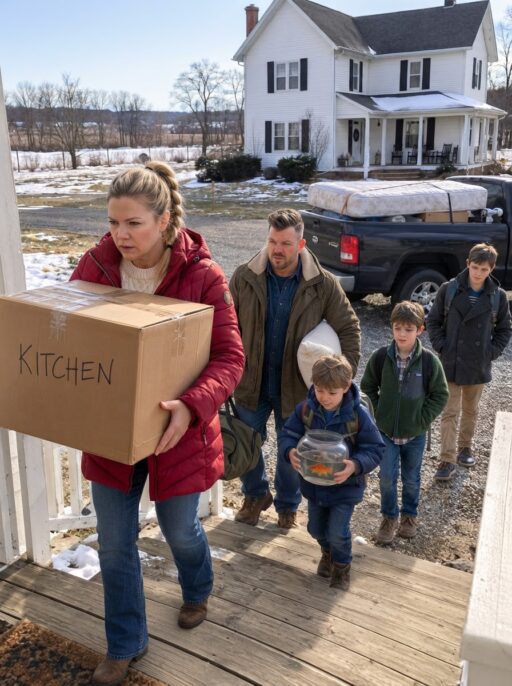
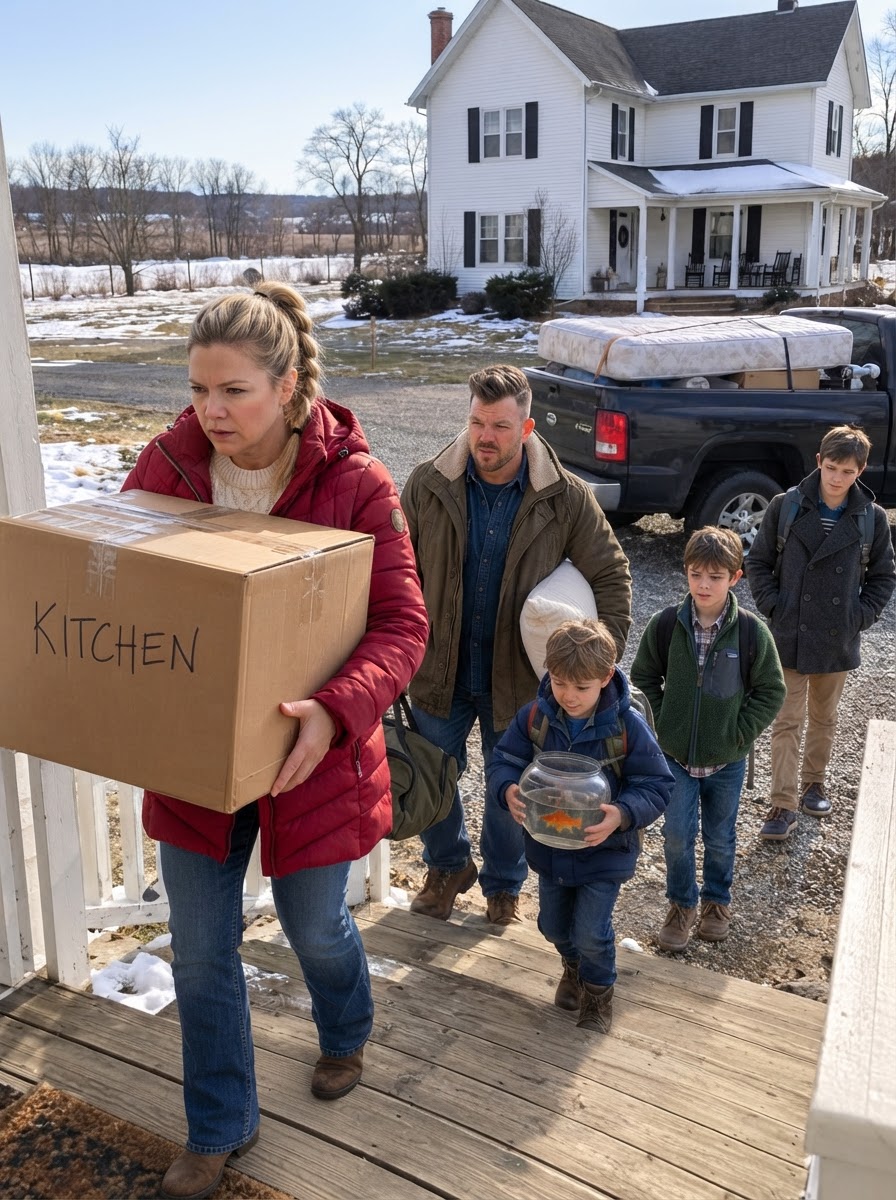
Around noon, Jeff’s pickup appeared in our driveway carrying a mattress, bags of clothing, and nearly everything his family still owned. Brody climbed out looking withdrawn, Kenzie kept her eyes lowered, and little Cole carefully carried a goldfish bowl.
“This is Pickles,” he announced. “Does he get his own room?”
“Pickles gets the dresser with the best view,” I replied.
For the first time that afternoon, Cole smiled.
Jeff stood on the porch studying the repairs Dale and I had made over the years. He quietly remarked that the house looked beautiful, and I reminded him that we’d spent two decades making it that way.
Later, my mother called after learning that Jeff and the children had moved into our upstairs rooms. She sounded genuinely shocked, as though she’d expected me to surrender the property rather than offer my brother somewhere to stay.
“That’s not what your father and I asked you to do,” she protested.
“I’m giving Jeff and the children a home, Mom. Isn’t that what matters?”
She didn’t answer, so I invited both my parents to Sunday dinner. Instead of accepting or declining, she abruptly ended the call, something she’d never done before.
That evening, seven people crowded around our kitchen table, turning an ordinary supper into the liveliest meal we’d shared in years. Brody ate several sandwiches, while Dale happily surrendered his own portion when the boy asked for more.
Beside them, Hannah noticed Kenzie’s tangled hair and gently began braiding it. Kenzie sat completely still as Hannah promised to teach her how to braid her own hair, and I had to excuse myself before anyone noticed my tears.
By bedtime, the children were laughing upstairs, and Jeff finally seemed able to relax. I remained in the kitchen, listening to the unfamiliar sounds of a crowded house and wondering whether my parents would ever understand my decision.
Then I heard footsteps on the stairs.
Jeff appeared holding an old wooden yardstick against his chest, his expression filled with an emotion I hadn’t seen since childhood.