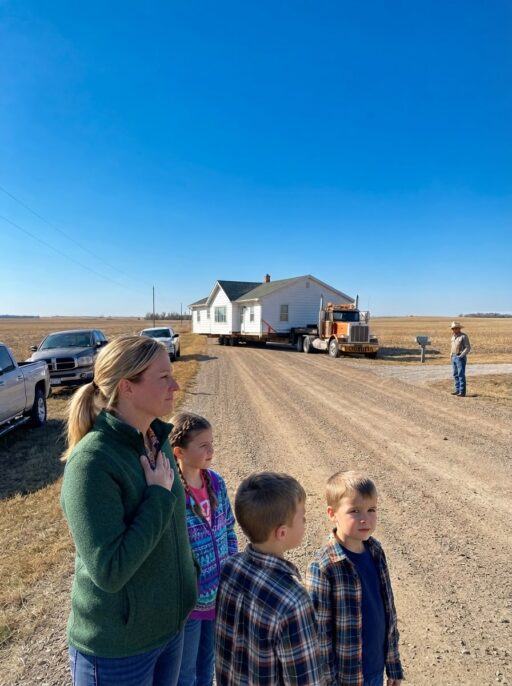
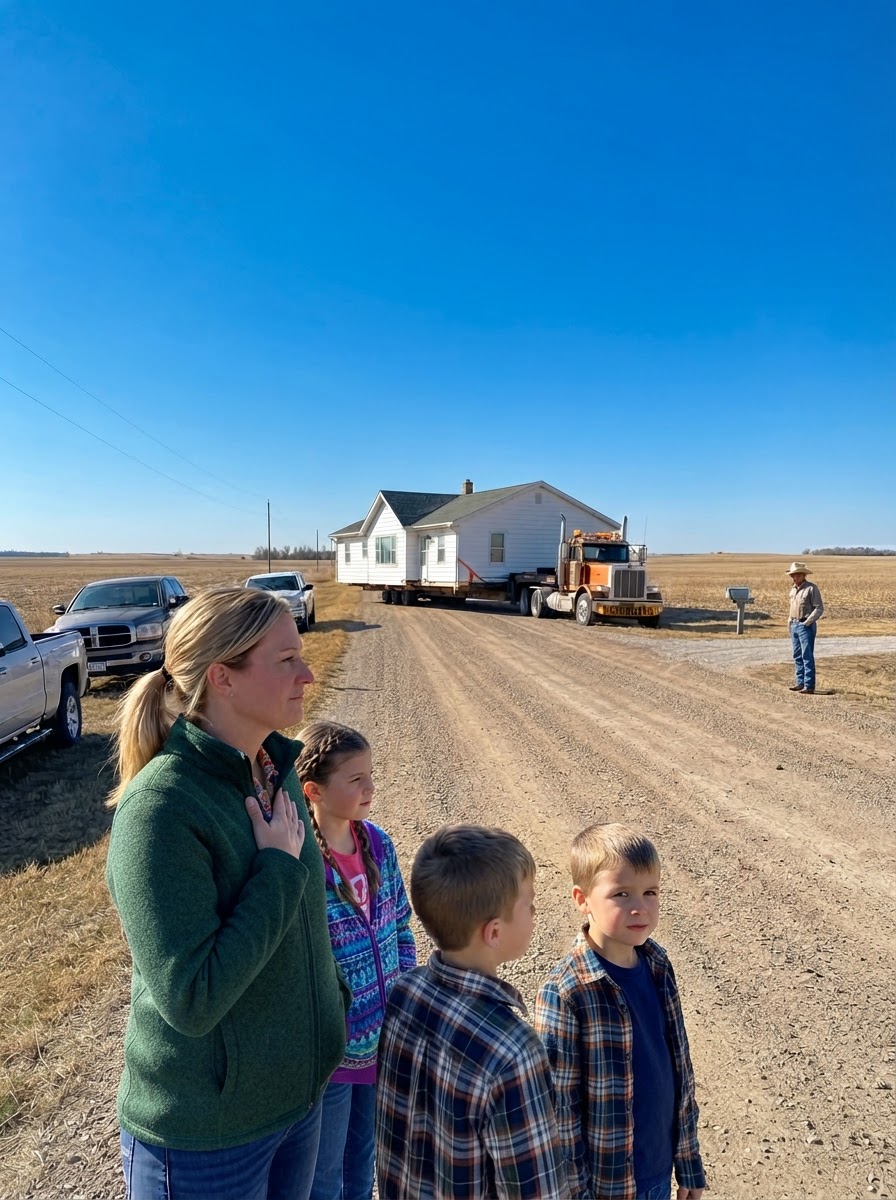

My father-in-law, Gordon Rasmussen, sat at my kitchen table one Tuesday evening in April and calmly informed me that the house my husband and I had spent eleven years paying for wasn’t actually ours. He spoke without raising his voice, explaining that because the building stood on his property, he considered himself its rightful owner.
“Anything built on my land belongs to me, Kayla. That’s how things work around here.”
I stared at him, struggling to understand how he could make such a claim while sitting inside a house we’d constructed with our own savings and labor. My husband, Jake, was upstairs taking a shower after a long shift at the agricultural equipment shop, and our two children were already asleep.
“We paid for every part of this house, Gordon. You watched us build it.”
“I know you did. But the ground belongs to me, and I’ve been discussing my will with Bill Hanson. I figured it was time you understood where things stood.”
He finished his coffee and left as casually as he’d arrived, apparently unaware that he’d just threatened everything my family had worked to create. I remained at the table, looking toward the refrigerator where our children’s schoolwork and drawings were displayed, wondering how someone could treat their home as an item in an inheritance dispute.
My name is Kayla Rasmussen, and I was thirty-nine years old, working as a paraprofessional at an elementary school in Hemingford, Nebraska. Until that evening, I’d believed that although our family wasn’t wealthy, we possessed something far more valuable: a home we’d built together.
Eleven years earlier, Jake and I had been renting a poorly maintained house in Alliance while raising our baby daughter, Hailey. We had little money, and Jake worked long hours repairing agricultural machinery while I helped support our family through my school job.
One Sunday afternoon, Gordon visited our rental and suggested that we build on an unused two-acre corner of his farmland. He described the offer as a way to avoid purchasing expensive property, and Jake’s mother, Ruthann, enthusiastically encouraged us to accept.
“There’s good ground past the shelterbelt, near where the old granary stood. Build your house there and save yourselves the cost of buying land.”
We believed he was offering us an opportunity to establish a secure future, so we invested nearly everything we owned into constructing a modest three-bedroom home. Jake designed the twelve-hundred-square-foot building himself, and my father, Lowell Olson, spent two summers helping him frame the walls.
I worked alongside them whenever possible, installing drywall and handling countless small tasks while we stretched every dollar. We financed the remaining materials through our savings, Jake’s overtime wages, and a small credit union loan secured against his tools and truck.
Because the property legally belonged to Gordon, we couldn’t obtain a conventional mortgage, but we trusted his promise that the land was available for our home. We finally moved in during October, when Hailey was two years old, and Ruthann celebrated by bringing us a homemade cherry pie.
The following month, Gordon unexpectedly demanded $500 in rent for the ground beneath our house. He explained that his own father had charged him for land when he was younger, claiming that financial responsibility was something every man needed to learn.
Jake reluctantly agreed, unwilling to challenge his father after we’d already spent everything on construction. From that point forward, he delivered a $500 check across the yard on the first day of every month, regardless of our financial circumstances.
We continued paying when my car needed expensive repairs, when our son Cole required surgery, and when Jake’s employer reduced everyone’s working hours. Gordon accepted every payment without expressing gratitude, while Ruthann occasionally slipped us groceries or small amounts of money to help with household expenses.
After Ruthann died from a stroke six years earlier, the relationship became even colder. Gordon continued collecting the rent, and we continued paying because Jake believed that honoring his father was more important than questioning an arrangement we’d never put into writing.
One sleepless night, I gathered the carbon copies of our checks and calculated how much we’d paid over eleven years. The total was $66,000 for the use of approximately two acres of rural Nebraska land.
I had kept every payment record in a shoebox, although I wasn’t entirely sure why until Gordon announced that he considered our house his property.
When Jake finally came downstairs that April evening, I repeated his father’s words as accurately as I could. My husband sat down heavily, his face turning pale as he realized that the home he’d built with his own hands might never have been legally secure.
“Mom would never have let him say something like that,” he whispered.
I reached for his hand, unable to offer any reassurance because I didn’t know what rights we actually possessed.
And when Jake finally asked what we were going to do, I realized that eleven years of sacrifice might have left us with nothing but a shoebox full of canceled checks.
The morning after Gordon claimed ownership of our house, Jake and I began discussing whether we had any legal way to protect what we’d built. We had invested our savings, years of labor, and eleven years of monthly payments into that property, yet we had never signed a formal agreement establishing our right to keep the house.
I eventually arranged a consultation with a lawyer in Alliance who specialized in agricultural property and family disputes. She listened carefully as I explained Gordon’s original offer, our construction expenses, and the $66,000 we’d paid him over the years.
“Without a written agreement, this could become a complicated legal battle. Buildings permanently attached to someone else’s land generally become part of that property, although the specific circumstances matter.”
I showed her the carbon copies of every payment, hoping they would prove that Gordon had treated the arrangement as a rental of land rather than ownership of our home. Unfortunately, she explained that those checks could also support his argument that we’d simply been paying to occupy his property.
A lawsuit might take years and cost thousands of dollars, with no guarantee that we’d recover the house. Then the attorney asked whether I was prepared to put my husband in court against his own father, and I realized that the emotional consequences could be even greater than the financial ones.
Jake was an only child, and his mother had died six years earlier, leaving Gordon as his last surviving parent. I couldn’t bear the thought of destroying their relationship completely, so I returned home without pursuing legal action.
For the next several months, we continued living beneath the same roof while pretending everything was normal. Jake still delivered his $500 check on the first of each month, although I noticed how heavily the routine weighed on him.
I went to work, prepared the children’s lunches, and tried to keep our family life peaceful, but the uncertainty followed me everywhere. By August, I had become so overwhelmed that someone noticed me crying in the school parking lot and mentioned it to my father.
Lowell Olson was seventy years old and had spent more than four decades raising cattle and growing wheat just three miles down the county road. He rarely called late at night, so when my phone rang at nine-thirty one Thursday evening, I immediately knew something was wrong.
“Kayla, I heard you’ve been crying at work. Tell me what’s happening.”
I finally told him everything, including Gordon’s declaration, the attorney’s warning, and the shoebox containing eleven years of payments. Dad listened without interrupting, and when I finished, he remained silent long enough that I wondered whether the call had disconnected.
“I’ve got two acres beside the north windbreak,” he finally said. “Your mother always wanted to plant a garden there. I’ll have the land transferred into your names tomorrow.”
I immediately protested because I knew how much his farm meant to him, but he refused to reconsider. He explained that giving his daughter a secure place to raise her family wasn’t a sacrifice, and he wanted us to understand the difference between a genuine gift and an obligation disguised as generosity.
“But Dad, even if we have the land, our house is still sitting on Gordon’s property.”
“Houses can be moved, sweetheart. I watched one travel down this very road back in 1971.”
I couldn’t imagine transporting an entire house across three miles of rural Nebraska, so I spent the night wondering whether his suggestion was even possible. The following morning, Jake came into the kitchen while I was preparing breakfast and told me that Dad had already contacted him.
“He offered us the land yesterday, Kay. He also told me about that house they moved back in the seventies.”
I turned toward him, expecting another conversation about the difficulties of leaving his father’s property. Instead, Jake ran his hand along the pantry doorframe, where we’d recorded our children’s heights every birthday since Hailey was two.
For eleven years, he’d worked to maintain the house and preserve our family’s stability, but now his own father was claiming the right to take it away. Jake looked at me with tears in his eyes before making a decision I knew had cost him dearly.
“Call a house mover, Kay. I want our children growing up in a home that actually belongs to us.”
Within days, we contacted Arnie Kessler, an experienced building mover from Scottsbluff whose family had transported structures across the Nebraska Panhandle for generations. He inspected our one-story house, examined its framing and crawl space, and confirmed that the building could be lifted and relocated.
The price, however, was staggering: $23,800 for the move itself, plus permits, utility work, a new foundation, and connections for water and septic services. When I added everything together, the total exceeded $38,000, nearly twice the savings we’d accumulated over nine years.