
When I was nineteen, my best friend promised that if neither of us was married by sixty, we would find each other and finally get married. I turned sixty last Tuesday, and that evening, my old landline rang for the first time in months.
The man calling wasn’t my best friend.
“My name is Lucas,” he said. “I’m Douglas’s son. My father is in the hospital, and he doesn’t have much time left.”
Then he handed the phone to someone whose voice I hadn’t heard in forty-one years.
“Ruthie?”
My knees nearly gave way.
Douglas was the only person who had ever called me that. Hearing the nickname again made me feel nineteen, standing beneath the football bleachers with his little finger wrapped around mine.
“You remembered,” I whispered.
“I remembered every birthday, Hannah.”
Then he began to cry.
Douglas and I had met when we were seventeen, in a small Ohio town where everyone knew everyone else’s business. We became inseparable almost immediately, although we always insisted we were just friends.
He dated other girls, and I went to prom with another boy. Whenever our classmates teased us about getting married someday, we laughed because neither of us wanted to risk losing the friendship we already had.
But one summer evening, after we’d both endured terrible dates, Douglas made his ridiculous proposal.
“If we’re both still single at sixty, we’ll stop being idiots and find each other.”
I hooked my pinky around his.
“Deal.”
Two months later, he left for college three states away. We exchanged letters at first, sometimes three in a single week, but eventually his replies became less frequent.
By the time I understood that I was in love with him, he’d started mentioning another girl.
In 1986, his final letter arrived.
He told me he was getting married and asked me not to contact him again.
I cried for weeks before putting his letters into an old blue suitcase and hiding it in my bedroom closet. Eventually, I moved away, built a career teaching literature, traveled, and made a life that was good in many ways.
I never married.
Whenever someone asked why, I said I hadn’t met the right person. It was easier than admitting I’d met him at seventeen and spent the next four decades wondering what might have happened.
Now, at sixty, I was listening to him struggle for breath over the telephone.
“Hannah,” Douglas whispered, “there’s something I need to tell you before I die.”
“What is it?”
“I was in love with you when we made that promise. I’d already bought a ring.”
I pressed my hand against my mouth.
“Then why did you marry someone else?”
His breathing grew uneven.
“Please come to the hospital. There’s something you need to see. Once you see it, you’ll understand why I walked away.”
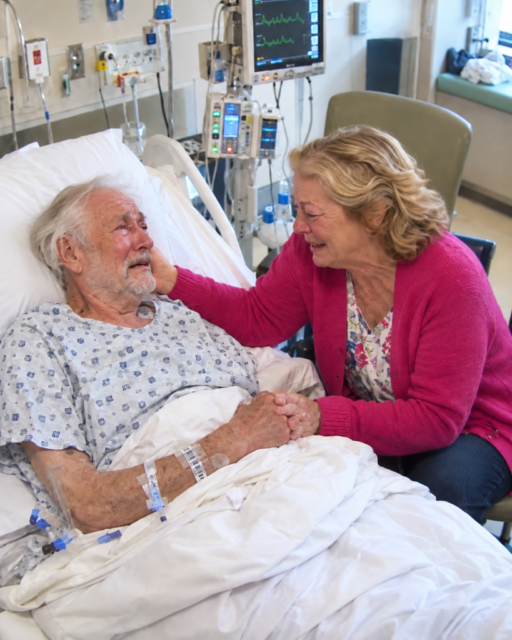
Forty minutes later, I entered his hospital room.
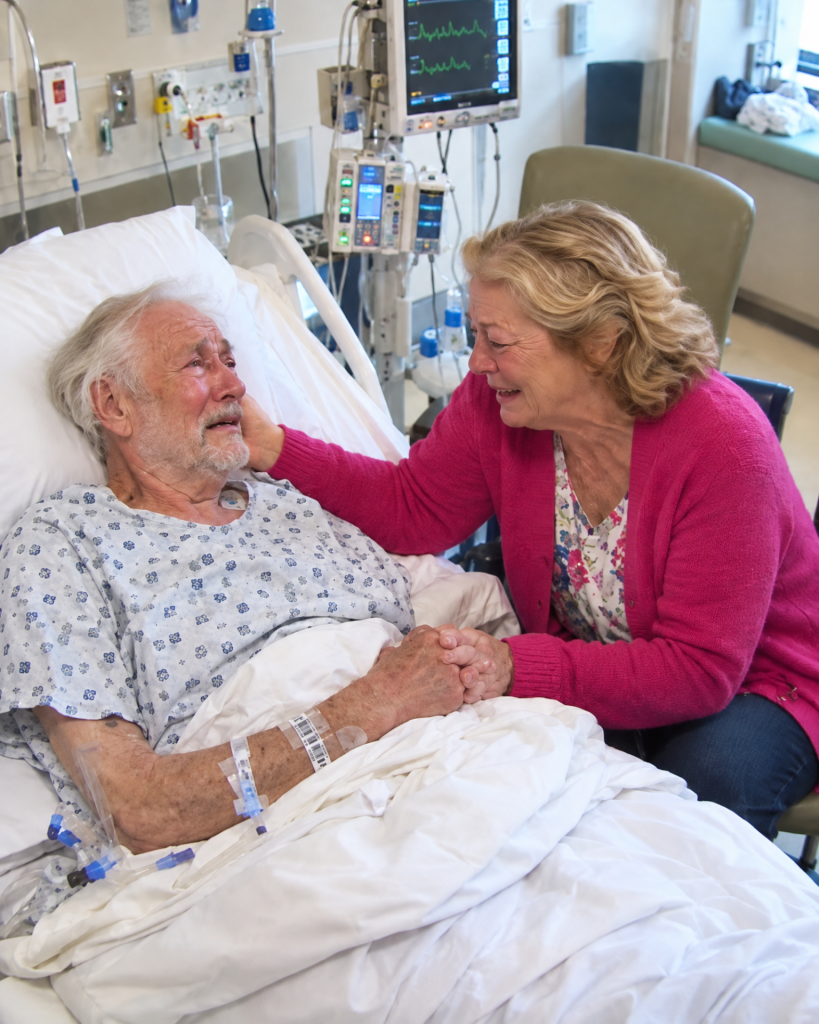
Douglas looked terribly frail beneath the white blanket, but I recognized his eyes immediately. They were the same blue eyes that had watched me steal French fries from his plate when we were teenagers.
He reached for my hand.
“You came.”
“Of course I came.”
His son stood beside a chair near the window. On it sat an old blue suitcase, a small velvet ring box, and a faded photograph.
I recognized the suitcase instantly.
It was the one I’d used to hide Douglas’s letters, the one I’d believed had disappeared when my mother cleared out our family home.
“Where did you get that?” I asked.
Lucas didn’t answer. Instead, he handed me the photograph.
It showed my mother in a hospital room, holding a newborn wrapped in a pale yellow blanket. She looked younger than I remembered, and something about her expression made me uneasy.
I turned the photograph over.
Someone had written a date in blue ink.
September 1987.
Beneath it were two names.
Hannah and Douglas.
I looked from the photograph to the dying man in the bed.
“Douglas, whose baby is this?”
His eyes filled with tears.
Lucas pulled out the chair beside me.
“Before Dad explains why you were separated,” he said quietly, “there’s something you need to understand about what your mother did.”
I looked down at the photograph again.
My mother had spent her entire life telling me that Douglas had chosen another woman.
Now, forty years later, I was beginning to wonder whether she’d been telling me the truth about anything.
I sat beside Douglas’s hospital bed, holding the photograph of my mother with a newborn baby. The date on the back was September 1987, and beneath it were two names that made no sense.
Hannah and Douglas.
“Lucas,” I asked, “why would my mother write our names on a photograph of someone else’s child?”
He glanced at his father before answering.
“We don’t know who wrote those names. But we know your mother was hiding something.”
Douglas reached toward the old blue suitcase.
“Show her the letters.”
Lucas opened it and removed a thick bundle tied with a faded ribbon. I recognized the handwriting on the first envelope immediately.
It was mine.
“Where did you find these?”
“Your mother gave them to my wife, Margaret, years after we married,” Douglas said.
I stared at him.
“Your wife knew about me?”
“She knew I’d loved you. I told her when we first started dating.”
He smiled weakly.
“Margaret said mentioning another woman on our third date was a terrible idea.”
Despite everything, I almost laughed.
Douglas’s expression turned serious.
“She was a good woman, Hannah. We had a happy marriage, and we raised Lucas together. But she always knew there were questions about our past I couldn’t answer.”
Lucas handed me a yellowed letter addressed to Margaret.
I recognized my mother’s handwriting before opening it.
In the letter, she admitted intercepting our correspondence after Douglas left for college. She had hidden some letters, altered others, and deliberately convinced each of us that the other had moved on.
I read the confession twice.
“She told me Douglas wanted me to stop contacting him,” I whispered.
Douglas closed his eyes.
“She told me you were engaged to someone else.”
My chest tightened.
For forty-one years, I’d believed Douglas had simply stopped loving me. Now I was discovering that the woman I’d trusted most had helped separate us.
“Why would she do that?”
“She thought I wasn’t good enough for you,” Douglas replied. “My father worked at the mill, and I didn’t have much money.”
I remembered my mother’s constant warnings about choosing a husband who could provide a comfortable life. She’d always been polite to Douglas, but she’d never considered him ambitious enough for her daughter.
I looked down at her letter.
“She stole our chance to decide for ourselves.”
Douglas squeezed my hand.
“I know.”
For several moments, neither of us spoke.
Then I remembered the photograph.
“But that doesn’t explain the baby.”
Lucas nodded.
“Margaret found that picture among the things your mother returned. She started investigating because she couldn’t understand why your names were written on it.”
He explained that the hospital had closed years earlier, leaving behind incomplete records. An investigator eventually discovered that my mother had volunteered there in 1987, helping young women who needed support after giving birth.
“She never told me that,” I said.
“She apparently worked with a seventeen-year-old named Marianne Webb,” Lucas continued. “Marianne gave birth to a daughter and initially planned to place her for adoption.”
I studied the newborn’s face.
“Is this Marianne’s baby?”
“That’s what Marianne told the investigator.”
“Then why did my mother have the photograph?”
“She was helping Marianne through the adoption process.”
That explanation almost relieved me.
My mother had been capable of extraordinary kindness toward strangers, even while making terrible decisions about my life. Perhaps the photograph was simply another example of that complicated woman.
But Lucas wasn’t finished.
“Marianne changed her mind about the adoption. She wanted to keep her daughter.”
“What happened?”
“According to Marianne, she went to sleep one evening expecting to take her baby home the next day.”
He hesitated.
“When she woke up, the child was gone.”
I looked at him sharply.
“Gone?”
“The baby had disappeared, and your mother stopped coming to the hospital.”
I shook my head.
“My mother wouldn’t steal a child.”
“We don’t know that she did,” Douglas said quickly. “But she was involved somehow.”
Lucas removed another document from the suitcase.
It was a photocopy of an old hospital intake form. The baby’s temporary name was listed as Baby Hannah, and my mother appeared as the emergency contact.
Beside it lay a tiny hospital bracelet bearing the initials D. Carter.
I stared at the papers, trying to make sense of them.
“Did anyone ever find Marianne’s daughter?”
“Not through the hospital records,” Lucas answered.
“Then why did your investigator keep searching?”
He looked toward Douglas.
“Because Marianne eventually told Margaret about a man who visited the hospital shortly before the baby disappeared.”
I felt my stomach tighten.
“Who was he?”
Lucas lowered his voice.
“Thomas Carter.”
I stopped breathing.