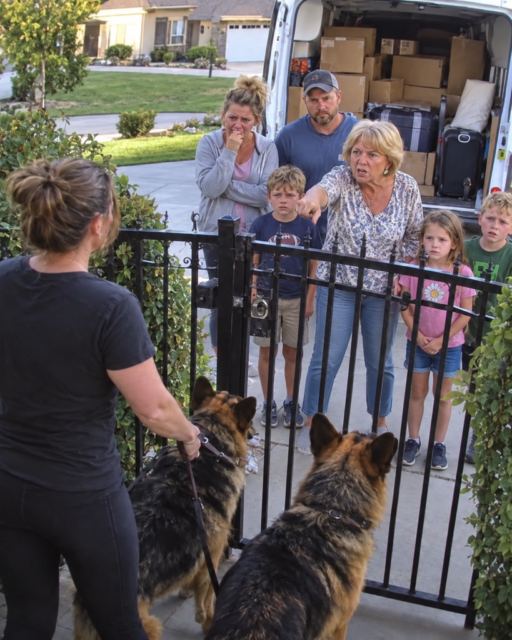
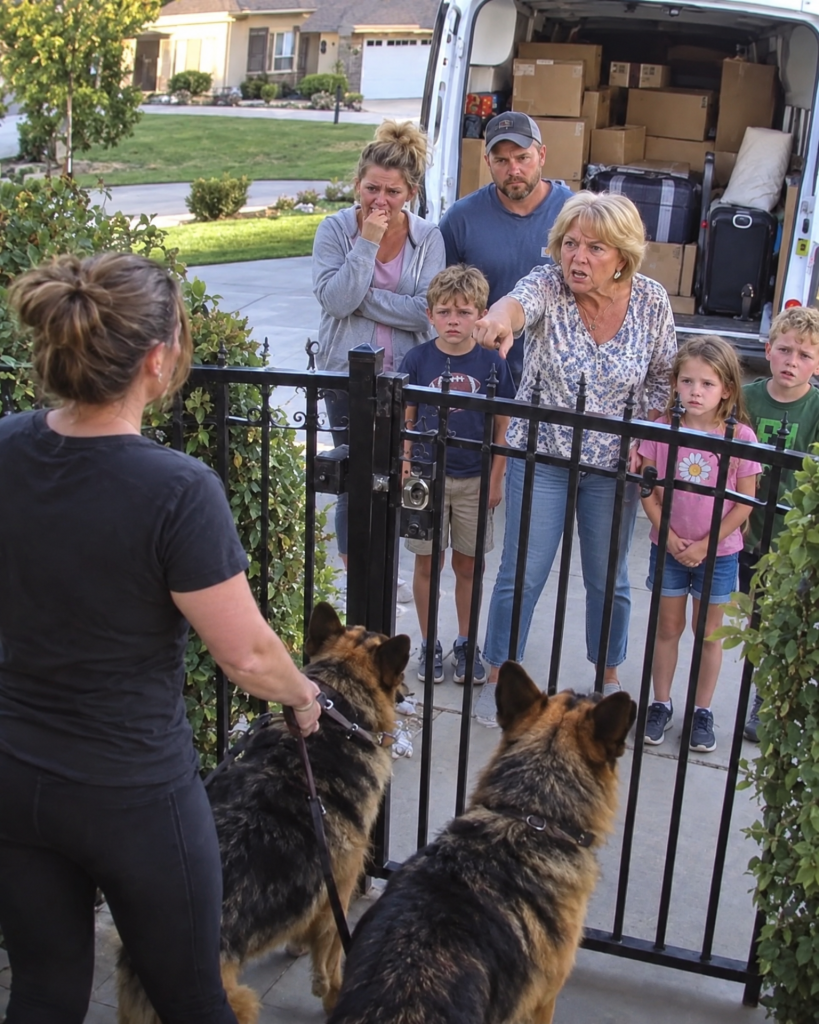

Twelve years after my mother kicked me out to make room for my pregnant twin sister, she showed up at the gate of my property with a moving truck, three grandchildren, and enough boxes to fill several bedrooms. She hadn’t called to ask permission, but she was already telling my sister which rooms they would occupy.
“Open the gate, Paige. We’ve been driving for three hours, and the children are exhausted.”
I stared at the security monitor in my office, where I’d been reviewing payroll for the twelve employees at my furniture restoration company.
My mother, Diane, stood beside my twin sister, Mallory, and her husband, Grant. Behind them, a rented moving truck blocked the driveway, while their three children waited among the luggage.
Mallory leaned toward the intercom.
“We’ll take the downstairs suite. The kids can have the bedrooms across the hall.”
Grant pointed toward my workshop.
“Is that building heated? I could run my furniture business out of there.”
I watched them divide up my property as though I’d already signed it over.
For twelve years, neither my mother nor my sister had asked whether I was alive, where I lived, or whether I needed help. Yet somehow, they’d discovered my address and arrived expecting me to surrender the life I’d built.
Growing up, Mallory had always been my mother’s favorite.
She received new clothes, expensive birthday gifts, and the larger bedroom. Whenever I complained, Mom reminded me that I was the independent twin who didn’t need as much attention.
My grandmother Elaine was the only person who treated us equally. She taught me how to restore old furniture, took me to estate sales, and encouraged me to believe that my interests mattered.
When Grandma died during my senior year of high school, I lost the one person who consistently stood up for me.
A few months after graduation, Mallory announced she was pregnant. Her boyfriend, Grant, moved into our rented duplex, and Mom decided they needed my bedroom for the baby.
“Can I sleep on the couch until college starts?” I asked.
“Grant has back problems. He might need the living room.”
“What about the basement?”
“That’s for the baby’s things.”
Then she looked directly at me.
“You’re nineteen, Paige. It’s time you stopped being my responsibility.”
Mallory stood behind her, resting a hand on her stomach.
“You’ve always said you don’t need anyone. Now you can prove it.”
That evening, I packed everything I owned into two trash bags.
For weeks, I slept on friends’ couches until their hospitality ran out. Eventually, I bought a cheap tent and hid it behind the storage sheds of a flea market outside town.
I worked wherever I could, washed in gas-station bathrooms, and kept my clean clothes sealed in plastic bags.
One rainy afternoon, my mother spotted me collecting shopping carts outside a grocery store.
Our eyes met through her windshield.
She recognized me. I knew she did because she slowed down, looked directly at my soaked clothes, and then drove away with Mallory sitting beside her.
She never called.
That night, shivering inside my tent, I made myself a promise: one day, I would have a home nobody could take away from me.
Now, twelve years later, I owned that home, the land surrounding it, and the successful business beside it.
And the two women who had abandoned me were standing outside my locked gate.
Mom pressed the intercom again.
“Paige, stop being difficult. We’re family.”
I looked at the moving truck, then at the security cameras recording every second.
For the first time in my life, I wasn’t the daughter begging for a place to sleep.
I was the woman who owned the gate.
And I was about to find out just how far my mother was willing to go to get through it.
“Open the gate, Paige. We’re moving in.”
My mother’s voice came through the intercom as though she were giving an ordinary instruction. Behind her, Mallory was already directing Grant toward the moving truck, while their three children waited beside a pile of suitcases.
“Who invited you?” I asked.
Mom frowned.
“Don’t start. Your sister needs somewhere to live, and you have more than enough room.”
Mallory stepped closer to the camera.
“The downstairs suite will work perfectly. Grant can use your workshop until he gets his business running again.”
I looked through my office window at the building where twelve employees earned their living. My sister had apparently decided that her husband’s struggling business deserved the space I’d spent years developing.
“How long are you planning to stay?” I asked.
“Six months, maybe longer,” Grant answered. “We need time to get back on our feet.”
“And you thought bringing a moving truck without asking was appropriate?”
Mallory rolled her eyes.
“We’re family, Paige. Stop acting like we’re strangers.”
That word almost made me laugh.
For twelve years, they’d behaved like strangers whenever I needed them. Now that they needed something, family had suddenly become an obligation I was expected to honor.
“You cannot move into my house,” I said. “Please take your truck and leave.”
Mom’s expression hardened.
“I gave birth to you. You wouldn’t have any of this without me.”
“You gave birth to me,” I replied. “But you weren’t there when I had nowhere to sleep.”
I remembered the freezing nights behind the flea market and the mornings I arrived at work with wet shoes. I also remembered Thomas Reed, the furniture shop owner who’d given me a chance when nobody else would.
He’d taught me the business, eventually sold me his workshop through an affordable payment agreement, and watched me turn it into a successful restoration company.
My mother had contributed nothing to that journey.
She began shouting about respect, but I ended the intercom call. When Grant tried pulling on the gate, I saved the security footage and asked my office manager, Rebecca, to keep the employee entrance secured.
An hour later, Rebecca appeared at my office door.
“Paige, your mother is at reception. Security stopped her before she reached the workshop.”
I walked downstairs and found Mom standing outside the glass entrance, holding a thick envelope.
Her anger had disappeared, replaced by the wounded expression she used whenever she wanted me to feel guilty.
“Your sister is in serious financial trouble,” she said. “They’re behind on their mortgage, and Grant’s business is failing.”
“Then why did you bring a moving truck?”
“Because we thought you would help your family.”
She pushed the envelope toward me.
“There’s another way to settle everything. Mallory needs eighty thousand dollars.”
I stared at her.
“$80,000?”
“It’s only money, Paige. You can afford it.”
I thought about my employees’ salaries, the equipment loans I’d paid off, and the years I’d spent saving every spare dollar. To my mother, those sacrifices apparently meant nothing because the result looked comfortable.
“I’m not giving Mallory eighty thousand dollars.”
Mom’s face tightened.
“Your grandmother would be ashamed of how selfish you’ve become.”
That hurt more than I wanted to admit.
Grandma Elaine had been the one person who believed in me, and Mom knew exactly how to use her memory against me.
“Grandma would have asked why you left me homeless at nineteen,” I answered.
Mom looked away.
“I had your sister to think about.”
There it was again. Even after twelve years, Mallory’s needs still mattered more than mine.
I asked Rebecca to escort my mother outside.
By evening, the moving truck remained at the gate. I arranged dinner for the children and gave Mallory the number of a local organization offering emergency family accommodation, but I refused to let them inside.
At 6:52 p.m., the truck finally drove away.
I thought the confrontation was over.
The following morning, however, my attorney called.
“Paige, your mother contacted my office. She’s claiming you promised your sister housing several months ago.”
“That’s a lie.”
“There’s something else,” he continued. “She’s also making a claim involving your grandmother’s inheritance.”
I sat upright.
“What inheritance claim?”
“She says you received money that should have belonged to Mallory.”
I opened the drawer containing Grandma Elaine’s old estate papers.