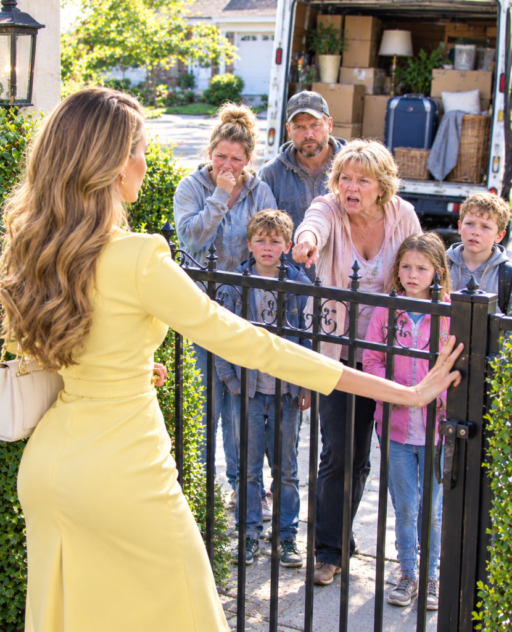
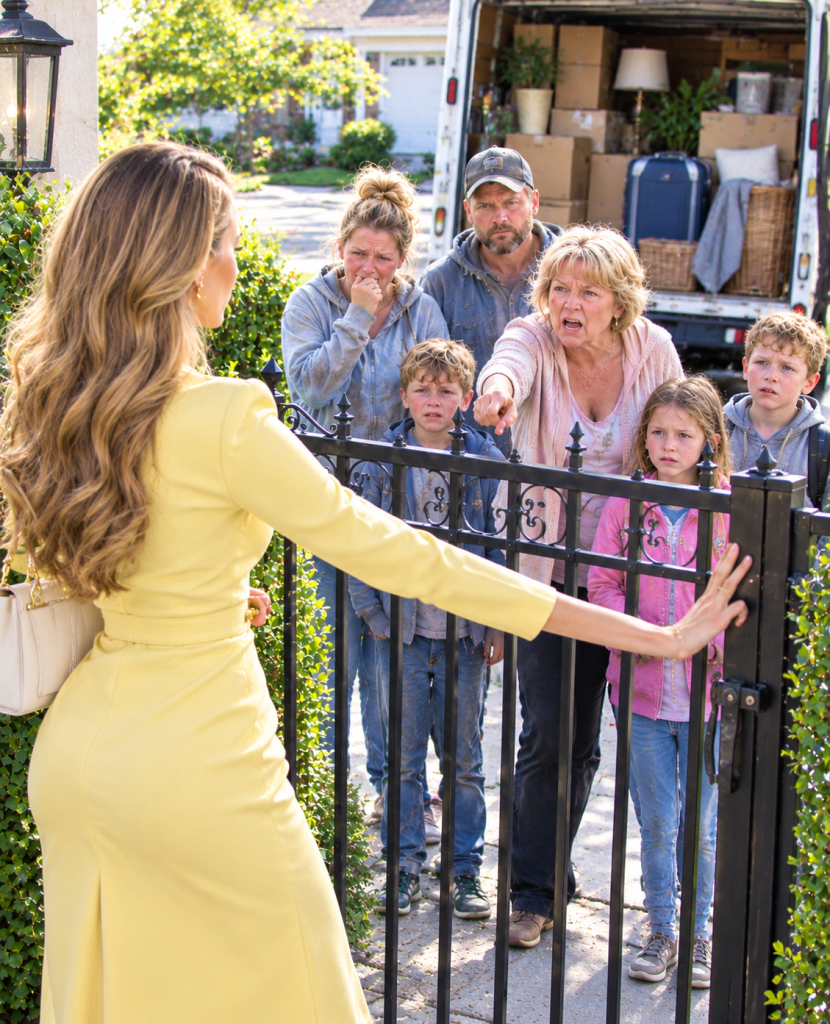

My name is Paige Whitaker, and when I was nineteen, my mother forced me out of our home so my pregnant twin sister could have my bedroom. Twelve years later, the same woman arrived at the gate of the house I owned, accompanied by my sister, her husband, their three children, and a moving truck full of boxes.
“Open the gate, Paige. We’ve been driving for three hours, and the children are tired.”
My mother, Diane, spoke through the intercom as though she still had the authority to decide where I lived and what I was expected to give up. On the security monitor, I watched her stand beside my twin sister, Mallory, while her husband, Grant, examined my detached workshop as if he were already planning to use it.
“The downstairs suite will be perfect for us. The kids can use the rooms across the hall,” Mallory announced.
Grant pointed toward the workshop and asked whether it had heating because he wanted to establish his furniture business there. None of them had asked whether they were welcome, because they had apparently assumed that my property would automatically become theirs whenever they needed something.
To understand why I kept the gate locked, you would have to understand what happened when we were growing up. Although Mallory and I were twins, our mother treated her as the child whose needs mattered most, while I was praised for being independent whenever someone wanted me to sacrifice something.
Mallory received the better bedroom, new winter coats, dance lessons, and birthday celebrations organized around her friends. I wore her hand-me-downs and learned that being called mature often meant nobody intended to help me.
My grandmother, Elaine, was the only person who recognized how unfair things had become. She took me to estate sales, taught me how to inspect old furniture, and showed me how patience and skill could restore something that other people had dismissed as worthless.
“Never be ashamed of a crack. Just pay attention to what caused it.”
At her kitchen table, I could speak honestly without being accused of creating problems. When Grandma died during my senior year, however, the fragile balance in our household disappeared, and my mother became even more determined to put Mallory first.
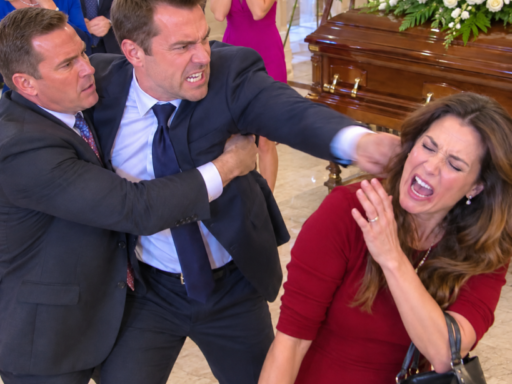
A few months after graduation, Mallory announced that she was pregnant, and Grant moved into our rented duplex without a steady job. My mother decided that my bedroom was the only suitable place for a crib, leaving me with nowhere to sleep because the living room and basement supposedly had other purposes.
“You’re nineteen, Paige. At some point, you have to stop being my responsibility.”
Mallory stood behind our mother with one hand resting on her stomach, insisting that I had always acted as though I needed nobody. I packed two trash bags while they watched television, and before I left, my mother handed me some canned soup and crackers.
“Tell people you chose to move out. It sounds more mature.”
For weeks, I slept on friends’ floors until those arrangements ended, forcing me to buy a cheap tent and hide it behind the storage sheds of a roadside flea market. I washed in gas-station bathrooms, kept my clean clothes inside plastic bags, and worked whenever I could find employment.
One rainy afternoon, I saw my mother’s car outside a grocery store while I was collecting shopping carts. Our eyes met through the windshield, but she drove away without stopping, with Mallory sitting beside her and laughing at something on her phone.
That night, I held my prepaid phone for nearly an hour, wondering whether I should call home. Instead, I made myself a promise that would eventually change the course of my life: I would build a future where nobody could ever make me homeless again.
The promise I made that night became the foundation of everything that followed. The next morning, I walked into a small furniture restoration shop in Ridge Hollow and asked the owner whether he needed an extra pair of hands, even though I had little more than my grandmother’s lessons and the determination to survive.
The owner, Thomas Reed, was sixty-two, with silver hair, thick glasses, and hands permanently marked by years of working with wood. He studied my worn shoes and the grocery bag I carried for lunch before pointing toward a damaged oak dresser in the corner.
“Have you ever restored furniture before?”
“My grandmother taught me.”
“Then show me what you can do.”
I spent six hours repairing the dresser, replacing its broken drawer runners, filling the cracks, sanding the rough surfaces, and revealing the wood grain beneath years of neglect. When I finished, Thomas ran his fingers across the polished surface and remained silent long enough for me to wonder whether I had failed.
Finally, he looked at me and asked a question nobody in my family had thought to ask.
“How much do you need to make to keep coming back tomorrow?”
I nearly cried because he was offering me more than a job. For the first time in months, someone was treating me like a person who deserved an opportunity rather than a burden who needed to be removed.
I started working at the shop the following Monday, cleaning floors, carrying lumber, repairing chairs, and learning how to estimate restoration costs. At night, I studied business management with secondhand textbooks, determined to understand not only how to repair furniture but also how to build a sustainable business.
For months, I survived on inexpensive meals and whatever shelter I could afford. Eventually, I rented a tiny room above a laundromat, where the ceiling leaked during heavy rain and the only window faced a brick wall.
Still, I had a key to the door, and that small fact meant more to me than I could explain. On my first night there, I locked the door three times before sitting on the floor and crying with relief because nobody could suddenly decide that I no longer belonged.
I never contacted my mother or Mallory, and neither of them reached out to me. Later, I heard that my mother had told relatives I abandoned my pregnant sister, while Mallory described me as someone who had always been jealous of her.
I stopped trying to correct their version of the past because I had more important things to accomplish. Every hour I spent arguing about their accusations was an hour I could spend building a future they had never believed I could achieve.
Three years later, Thomas decided to retire and offered to sell me his restoration business through a payment agreement I could realistically manage. The workshop needed repairs, the machinery was old, and the back office smelled of damp cardboard, but I saw an opportunity that I could make my own.
I signed the agreement with trembling hands and began the difficult work of transforming the small shop into a professional restoration company. Over the following seven years, I secured contracts involving historic homes, custom cabinetry, and high-end furniture, gradually hiring employees as the business grew.
I learned to negotiate with suppliers, manage payroll, evaluate contracts, and recognize when an attractive opportunity might become an expensive mistake. Eventually, I purchased an industrial property outside Ridge Hollow, expanded the workshop, and bought the adjoining land.
Then I purchased a house beyond the town’s old stone bridge, with a wide gravel driveway, a detached workshop, and enough space to enjoy the privacy I had always wanted. My company eventually employed twelve people, and I established relationships with an accountant and a business attorney to protect what I had worked so hard to build.
I installed security cameras around my property because I wanted to feel safe in the home I had earned. When Thomas asked whether I expected trouble, I explained that I simply wanted to make sure nobody could decide where I was allowed to live ever again.
For twelve years, my mother and sister remained absent from my life. Then, on an ordinary Tuesday afternoon, I looked at my security monitor and saw them standing outside my gate with a moving truck, several boxes, and three children.
This time, I was no longer the frightened nineteen-year-old waiting for someone to let her stay. I owned the house, the business, and the gate between them and everything I had built.