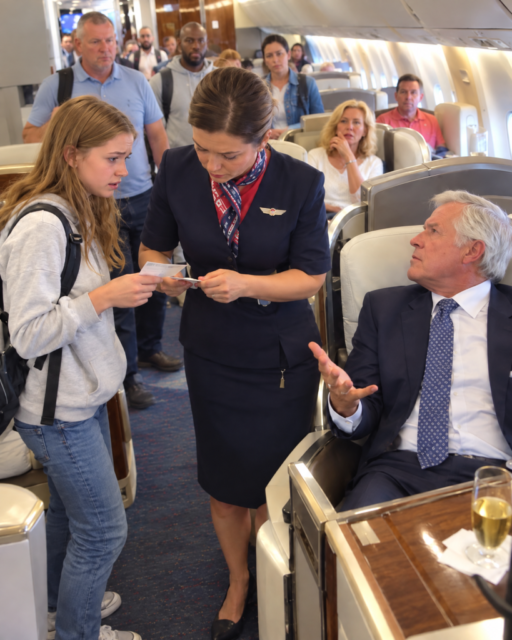
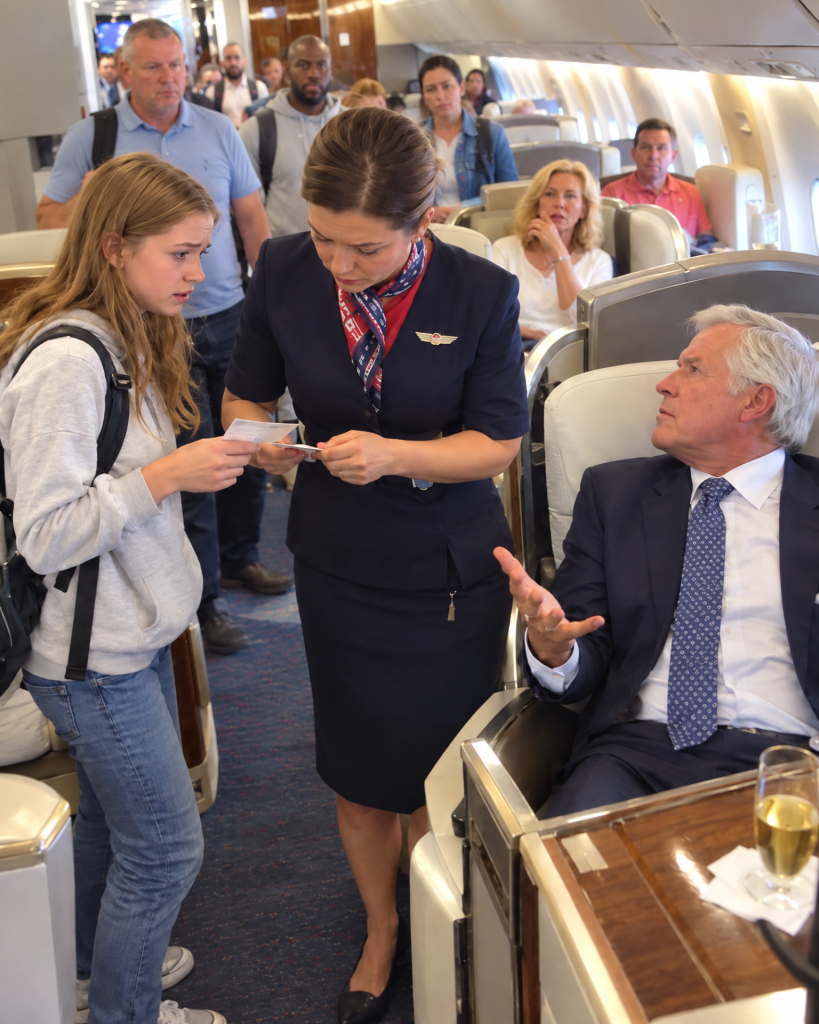

“Marcus? Why are you there?”
“Because someone used internal credentials to alter my daughter’s reservation. Security has also discovered unauthorized equipment near her assigned seat.”
Julian attempted a laugh.
“That sounds like an airline maintenance problem.”
“Then you’ll have no objection to cooperating with the investigation.”
Julian disconnected the call.
Richard lowered his phone.
“He knew,” he whispered. “He knew something was hidden there.”
Dad looked toward Vance Campbell.
“Please preserve the relevant records and inform the investigators about that conversation.”
Vance nodded and contacted the security team.
I stood beside Elizabeth, struggling to understand how a disagreement over a window seat had become an investigation involving someone Dad trusted at work.
“Was Julian trying to hurt me?” I asked.
Dad turned immediately.
“We don’t have evidence of that, Zara. What we know is that someone used your reservation without permission, and we’re going to find out why.”
His answer frightened me more than an easy reassurance would have.
At least he was telling me the truth.
An hour later, investigators confirmed that the maintenance employee who accessed the panel had received a suspicious payment from a consulting company connected to Julian’s business associates.
The device appeared intended to collect wireless communications near the forward cabin. Specialists were still determining what information, if any, it had captured.
Dad explained that Julian had recently been involved in confidential negotiations concerning a transportation infrastructure contract. Bennett Strategic Holdings was also interested in the project.
Richard sank into a chair.
“Julian told me he could arrange an early investment opportunity.”
“That wasn’t his decision to make,” Dad replied.
Richard rubbed his forehead.
“So he invited me onto this flight because he wanted information?”
“That’s one possibility. Investigators will determine what happened.”
Vance then showed Dad another record.
The unauthorized seat-change request had been submitted through credentials associated with Julian’s department. The account had accessed my passenger profile shortly before Richard received his revised travel instructions.
My stomach tightened.
Someone had looked up my travel arrangements and decided I would be easy to move.
Not because I’d done anything wrong.
Because I was fourteen.
Richard looked toward me.
“Zara, I’m sorry. I shouldn’t have spoken to you that way.”
I studied him.
“Would you be apologizing if my father weren’t Marcus Coleman?”
He lowered his eyes.
“I don’t know.”
It wasn’t the answer I wanted, but it was the first honest thing he’d said to me.
The airline decided Richard would not continue on Flight 212 because of his refusal to comply with the crew’s seating instructions and the unresolved questions surrounding his reservation. He was escorted off the aircraft to provide a statement.
Dad stayed beside me while the remaining security checks were completed.
“Do you still want to fly tonight?” he asked.
I looked at Seat 2A.
“Is it safe?”
“The specialists have cleared the area, and the captain will make the final decision about departure.”
“Then yes.”
Dad smiled faintly.
“You don’t have to prove anything.”
“I’m not trying to prove anything. I still want to visit Aunt Claire.”
He squeezed my hand.
Before leaving, he spoke privately with the captain and Elizabeth. Once the aircraft was cleared, the airline confirmed that my original seat assignment would be honored.
I settled into 2A and fastened my seat belt.
Elizabeth brought me hot chocolate.
“Anything else, Miss Coleman?”
“No, thank you.”
As the aircraft prepared for departure, Dad called one final time.
“Zara, investigators have secured Julian’s company access while they review the evidence.”
“Does that mean he’s going to be arrested?”
“Not necessarily. It means the investigation can proceed without him accessing those systems.”
I looked out at the airport lights.
“Will you tell me what happens?”
“Yes. You deserve to know why your information was used.”
The plane finally departed for London, and I spent most of the flight thinking about Richard’s expression when he learned who my father was.
He hadn’t believed I deserved respect until someone powerful stood beside me.
But Dad had taught me something more important than how to make an emergency phone call.
My boarding pass had been enough.
The next morning, when I landed at Heathrow, Aunt Claire was waiting with news from home.
“Your father called,” she said as she hugged me. “The investigators have found another connection between Julian and Richard’s company.”
I pulled back.
“What connection?”
She hesitated.
“Apparently, the hidden device wasn’t the only thing Julian arranged without authorization.”
And from the worried expression on her face, I knew the investigation was far from over.
I had barely reached the arrivals hall at Heathrow when Aunt Claire told me investigators had discovered another connection between Julian Croft and Bennett Strategic Holdings. The unauthorized device near my first-class seat was only one part of a much larger scheme involving confidential business information.
“What else did Julian do?” I asked.
Aunt Claire glanced at my burgundy travel bag.
“Your father wants to explain everything himself. He’s calling us when we get home.”
During the drive through London, I kept remembering Richard Bennett’s expression when he’d learned who my father was. He’d been so certain that a fourteen-year-old girl couldn’t possibly belong in Seat 2A, yet he hadn’t questioned why someone had arranged for him to occupy it.
That evening, Dad called from New York.
“Zara, investigators have found evidence that Julian was secretly sharing confidential information with people connected to Bennett Strategic.”
“Was Richard involved?”
“His company received information it shouldn’t have had. Investigators are determining who knew where it came from.”
Dad explained that Julian had been trying to influence a major transportation infrastructure deal. The unauthorized equipment on Flight 212 appeared connected to an attempt to obtain additional confidential communications.
My reservation had been targeted because someone believed moving an unaccompanied teenager would be easy.
“So they expected me to give up my seat?” I asked.
“That’s what the evidence suggests.”
“And Richard helped them without knowing?”
“He accepted an arrangement he didn’t verify. His conduct toward you was his own responsibility.”
I thought about that distinction for a long time.
Richard might not have known about the device, but he’d still chosen to insult me when I asked for the seat printed on my ticket.
Over the following weeks, investigators examined the electronic equipment, financial transactions, and internal access records. Julian was dismissed from his position after the company’s review, and authorities pursued the suspected unauthorized access and financial misconduct.
The maintenance employee who’d accessed the aircraft panel also became part of the investigation.
Bennett Strategic announced an independent review of its dealings with Julian. Richard stepped down from his leadership position while the company examined how the proposed partnership had been arranged.
Dad refused to discuss confidential details with reporters, even when the story began attracting attention.
“Evidence should determine what happens,” he told me. “Not headlines.”
A month later, a letter arrived for me in London.
It was from Richard.
He apologized for refusing to leave Seat 2A and for suggesting that my age and appearance made me less deserving of a first-class ticket.
I assumed I was entitled to the seat because I was accustomed to getting what I wanted, he wrote. I was wrong before anyone discovered the security problem.
I read the letter twice.
Then I sent a short reply.
Thank you for apologizing. I hope you treat the next person who challenges you with the same respect you would give someone powerful.
I didn’t need anything else from him.
When I returned to New York several weeks later, Dad met me at the airport.
He hugged me before taking my bag.
“How was London?”
“Wonderful. Aunt Claire says I need to come back during the holidays.”
He smiled.
“That can probably be arranged.”
As we walked toward the parking garage, I asked him something that had been bothering me.
“Dad, if you weren’t involved with airline security, what would have happened that night?”
He considered the question.
“The crew still had the authority to enforce your seat assignment. Richard should have complied, and the airline should have handled his refusal.”
“But would anyone have found the device?”
“I don’t know, Zara.”
I appreciated that he didn’t pretend otherwise.
He stopped beside the car and looked at me.
“What matters is that you told the truth, asked for help, and didn’t let someone convince you that you had fewer rights because you were younger.”
I nodded.
“I was scared.”
“I know. Courage doesn’t mean you weren’t.”
Several months later, the airline updated its procedures for handling disputed seat assignments and escalations involving minors traveling alone. Dad told me those improvements mattered more than any public embarrassment Richard had experienced.
By then, the investigations were continuing through their proper channels, and I had returned to school, homework, and ordinary family life.
One afternoon, I found my boarding pass from Flight 212 tucked inside my engineering puzzle book.
NEW YORK — LONDON.
SEAT 2A.
I smiled and placed it in my desk drawer.
The paper wasn’t valuable because my father was influential or because a wealthy businessman had eventually apologized.
It mattered because the seat had been mine before anyone knew my last name.
Richard had looked at my ordinary clothes, my young face, and my lack of an accompanying adult, then decided I didn’t belong beside him.
He hadn’t needed to know who my father was.
He’d only needed to read the boarding pass.
And I hoped that, wherever his life took him next, he’d finally learned the difference.