
At the time, it had seemed like an ordinary disagreement about company records.
Several invoices were vague. One vendor appeared under slightly different names. When I asked for the underlying agreements, Grant said his team would gather them.
Then he suggested the cabin.
From my hospital bed, I gave my attorney the emails I had already saved.
I authorized an independent review and asked that relevant records be preserved.
The chair of the board was brought into the small circle of people who knew I was alive. Grant’s request for additional authority was deferred.
He was told that existing procedures remained in place.
He did not respond well.
I learned that from the board chair, who had heard him.
Other things came to me through Shaw, in careful updates rather than dramatic revelations.
The fire investigators had found evidence consistent with the exits having been obstructed from outside.
The alarm records helped establish when the emergency signal began.
A camera along the access road recorded Grant’s vehicle at a time that conflicted with the account he had given.
It did not reveal every person in the vehicle.
It did not explain the entire night.
But his story was becoming harder to maintain.
Meanwhile, my days revolved around smaller measurements.
How far I could walk.
How much Noah could manage at a feeding.
Whether I could breathe deeply without coughing.
I hated how badly I wanted someone to tell me that everything would be fine.
The doctors gave me information instead.
I learned to ask for it.
Nathan visited when I agreed to see him.
Sometimes I asked about my mother.
Sometimes I asked him to leave after five minutes.
He did both without making me comfort him.
He brought copies of the letters he had written and the messages he had received in response. He also gave the investigators the information they requested about the rescue.
He did not offer to examine Northstar’s finances or confront Grant.
When I asked what he thought had happened at the cabin, he said, “I know what I found. The investigators need to establish the rest.”
On the fourth day after the fire, Shaw told me Brooke had obtained an attorney and begun cooperating.
Grant had claimed that certain arrangements involving the cabin were Brooke’s responsibility.
There were also questions about payments connected to her.
“Is she saying she didn’t know?” I asked.
“She’s giving an account of what she knew and did. We’re checking it.”
Later, I was told that the material she provided included messages about the trip, attempts to coordinate what they would tell authorities, and information about their relationship.
The affair had begun months earlier.
That hurt.
It was also no longer the worst thing I knew about my husband.
I did not see a recording of Brooke’s interview. I was not handed every piece of evidence as it arrived.
Shaw told me what I needed to know and asked questions when my account could help.
When I asked whether Grant would be arrested, she said the investigators were working with the prosecutor.
“As soon as we have the necessary authority and a plan to take him safely into custody, we will act.”
I wanted it to happen immediately.
I also understood that my wanting something did not complete the work.
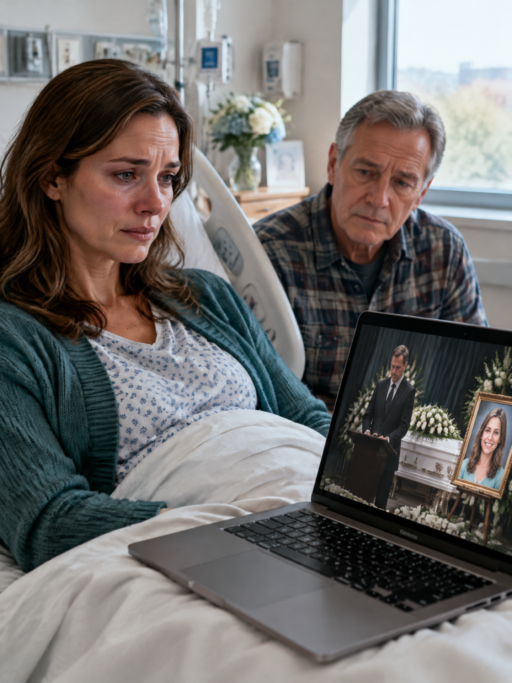
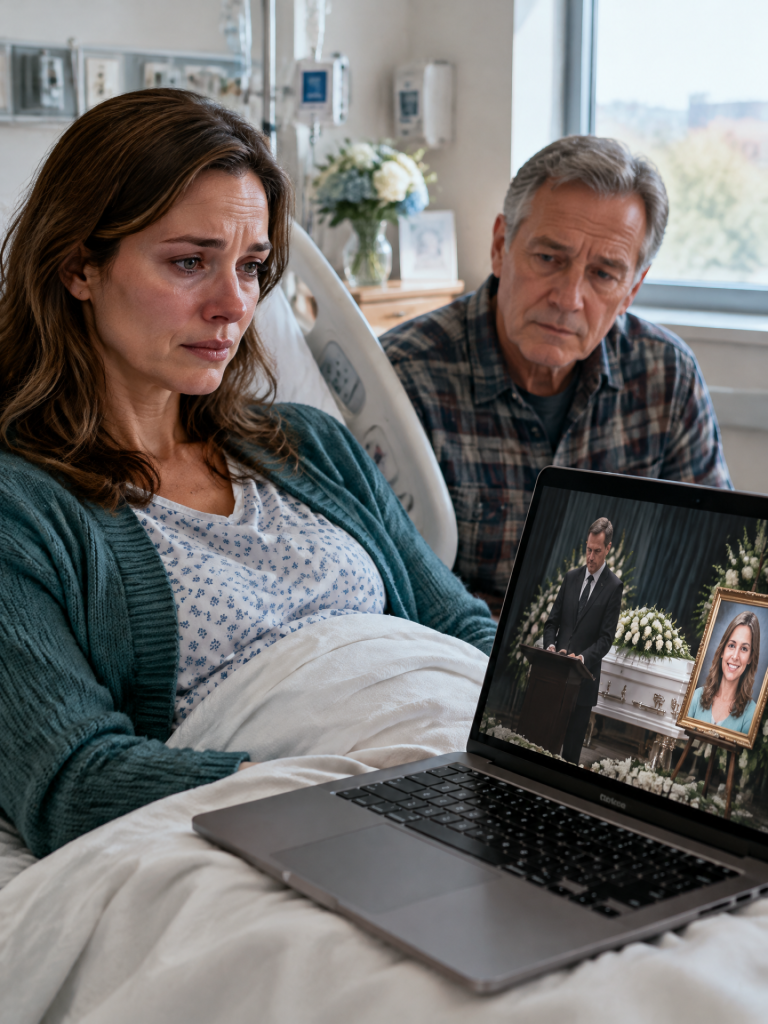
The evening before the memorial, a colleague’s assistant sent my attorney the public livestream link. A test feed briefly showed the chapel.
The flowers were white.
My photograph stood beside an empty casket.
Grant moved a chair, spoke to a technician, and practiced where he would place his hand.
I watched for perhaps thirty seconds.
Then I closed the laptop.
“People are going to sit there and grieve for us.”
My attorney was on the phone.
“We can prepare a statement for when it’s safe to release one.”
“I want them to hear me.”
We discussed a short recording. Nothing about the investigation. No accusations or evidence. Just confirmation that Noah and I were alive, gratitude, and a request for privacy.
It would not be released until the situation allowed it and I gave my permission.
A nurse helped me sit comfortably against the pillows.
Nathan stood near the door.
“Would you like me to wait outside?”
I thought about it.
“You can stay.”
He sat beyond the camera’s view.
On the first attempt, I cried.
On the second, I lost my voice.
On the third, I looked directly into the lens.
“My name is Lena Morgan. My son and I are alive.”
PART 4: THE STORY HE COULDN’T FINISH
The memorial began at eleven.
I watched from my hospital room with my attorney on the phone and Nathan sitting quietly near the window.
Shaw had told me officers were moving to take Grant into custody.
She had not asked when I wanted it done.
I had not asked them to wait for a particular sentence.
On the screen, I recognized pilots, nurses, office staff, and people who had known my mother.
Some were crying.
Grant stood beside the casket.
Brooke was not there. She had been taken into custody separately.
Grant had apparently explained her absence as exhaustion.
He began with my mother.
He spoke about her courage, the company she had built, and the importance of family.
Then he began talking about me.
“Lena trusted me to protect what mattered most to her.”
I felt the words in my chest.
Nathan looked toward me but said nothing.
Grant described the future we had planned for Noah.
The nursery.
The trips.
The little boots he had bought.
I remembered opening that box.
I had believed the man smiling across the kitchen counter was excited to become a father.
At the chapel, someone approached from the side.
Grant stopped.
Two officers moved into view.
There was a brief conversation I couldn’t hear clearly. Grant looked toward the congregation, then down at the hand near his elbow.
For an instant, he seemed to think he could explain.
He straightened his jacket.
Then another officer stepped closer.
The camera shifted.
A woman in the front row stood.
The feed went dark.
I stared at the blank screen.
My attorney said my name.
“Lena. You don’t need to keep watching.”
I realized my hands were clenched so tightly that the dressings hurt.
Nathan reached toward the water pitcher, then paused.
“Would you like some?”
I nodded.
A few minutes later, Shaw called.
Grant was in custody.
I asked her to repeat it.
She did.
The chapel organizer and board chair were being informed that I had survived. My attorney asked whether I still wanted the recording shared once the room was settled.
For a moment, I thought about changing my mind.
I could disappear from public view. Let other people explain. Let someone more composed handle it.
Then I remembered the people in those chairs.
“Yes,” I said. “They should know.”
I did not watch the recording play.
Later, a colleague told me that some people cried harder when they heard my voice. Others simply sat still, trying to understand.
The message was less than a minute.
No explanation of how I had escaped.
No mention of Grant’s guilt.
Just my name, my son’s survival, and the fact that we needed time.
After it was released, I asked the nurse to take me to Noah.
I sat beside his incubator and placed my hand where she showed me.