
I cried when Rachel called with the results.
But she reminded me that confirming parentage was only one part of the process.
The boys were seven years old. They loved Sarah, attended school near her home, and had never been told that their mother believed they were dead.
Any introduction needed to protect them from further harm.
Sarah agreed.
“I won’t lie to them anymore,” she told me. “But please understand that they’re frightened of changes they can’t explain.”
“I do,” I answered. “I don’t want them frightened of me.”
With professional guidance and the necessary arrangements in place, Sarah began explaining my existence to the boys in language they could understand.
Our first meeting took place in a family counseling office.
I brought no expensive presents, only a small picture book I’d used with my students.
Noah sat beside Sarah with his arms folded.
Ethan studied my face.
“Are you really our mother?” he asked.
“Yes,” I answered gently.
“Then why weren’t you here?”
I looked toward the counselor before responding.
“I didn’t know where you were. I was told something that wasn’t true, and I’ve been trying to find you.”
Noah frowned.
“Are you going to take us away from Aunt Sarah?”
“I’m not here to frighten you or make you choose between us.”
He looked down at his shoes.
We spent the rest of the visit talking about school, dinosaurs, and the books they liked. Neither boy hugged me when it was time to leave.
I hadn’t expected them to.
Afterward, I sat in my car and cried, not because the meeting had gone badly, but because I’d finally heard my sons speak to me.
Three visits later, Noah approached me carrying a folded sheet of paper.
He had drawn three people standing beneath a yellow sun.
Two were small boys.
The third was a woman with brown hair.
At the bottom, in uneven handwriting, he’d written three words.
For Miss Emily.
I held the drawing carefully.
For the first time, my son had imagined a place for me in his world.
The first time Noah called me Mom, he didn’t even realize he’d done it.
We were sitting at Sarah’s kitchen table, working on a school project about the solar system. Ethan was carefully coloring Jupiter when Noah reached across the table for a pencil.
“Mom, can you pass me the blue one?”
I handed it to him before the word fully registered.
Then I looked up.
Noah was still concentrating on his drawing, completely unaware that he’d just given me something I’d waited seven years to hear.
I excused myself, walked into the hallway, and pressed a hand against my mouth.
Sarah found me there a minute later.
“He didn’t mean to upset you,” she whispered.
“He didn’t,” I said, wiping my cheeks. “That’s why I’m crying.”
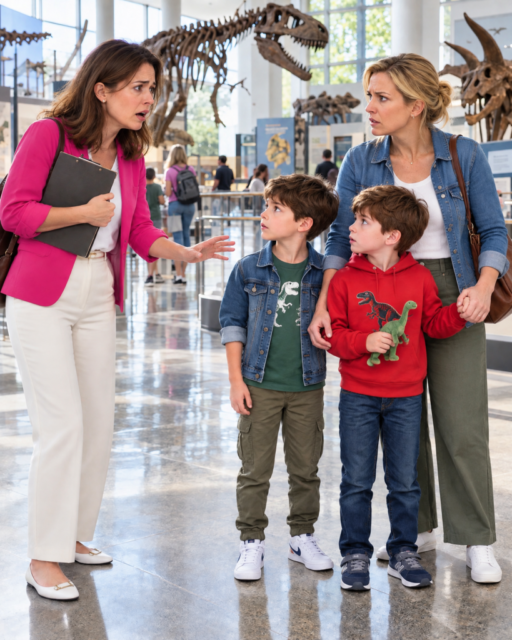
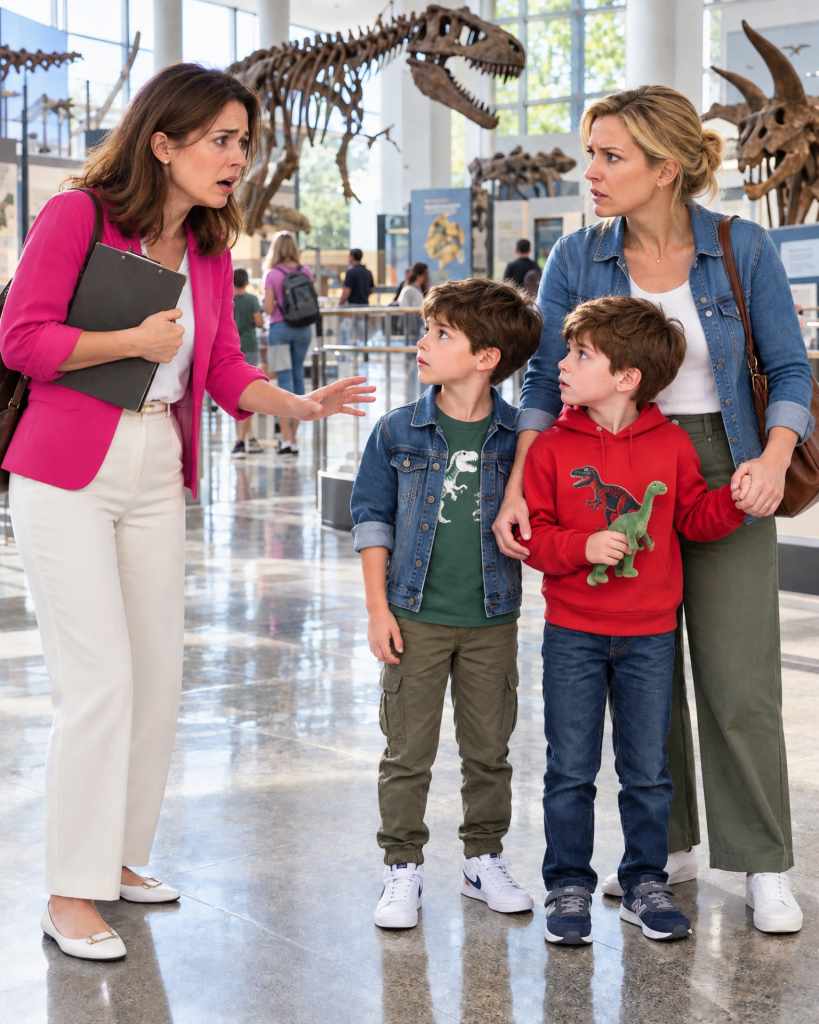
By then, eight months had passed since the day I’d seen the twins at the science museum.
The legal process had been exhausting.
Investigators had examined the disputed documents, interviewed people involved in the boys’ care, and reviewed communications between Daniel and Margaret.
The evidence established that I had never knowingly surrendered my parental rights. The supposed authorization bearing my signature was not accepted as proof that I had agreed to give up my children.
The suspected forgery and related conduct remained under investigation.
Daniel had finally admitted that he’d deliberately concealed the boys’ survival from me. His cooperation didn’t erase what he’d done, but it helped clarify how the deception had continued for so long.
Margaret was no longer allowed to make decisions about the twins’ care.
She called me repeatedly after learning that I was seeking formal recognition of my parental rights.
I answered once.
“Emily, I did what I thought was best for those children.”
“You told their mother they were dead.”
“They needed stability.”
“They needed the truth, Margaret. And you took that away from all three of us.”
She began to argue, but I ended the call.
I had spent enough years allowing that family to decide what I was permitted to know.
With the court’s involvement and guidance from the boys’ counselor, Sarah and I developed a gradual plan for their care.
I began spending afternoons with them, then weekends. Eventually, we established a schedule that allowed the boys to spend more time at my house while maintaining their relationship with Sarah.
There were difficult days.
Ethan sometimes became upset when plans changed. Noah asked questions about why Daniel had lied and whether other adults might disappear from his life.
I answered what I could without making promises I couldn’t control.
Sarah and I learned to work together.
She had raised my sons through their first illnesses, school mornings, and sleepless nights. Whatever Margaret had told her, Sarah had loved those boys.
I couldn’t pretend those seven years hadn’t happened.
And I didn’t want Noah and Ethan to feel they had to stop loving her in order to love me.
One Saturday, Sarah brought over two boxes filled with childhood photographs.
There were pictures of first birthdays, missing teeth, Halloween costumes, and kindergarten graduations.
I sat on the living room floor turning the pages.
In one photograph, Noah was learning to ride a bicycle.
In another, Ethan was asleep with a stuffed dinosaur tucked beneath his arm.
“These are yours too,” Sarah said.
I looked at her.
“Thank you for taking care of them.”
She wiped her eyes.
“I just wish I’d known you were looking for them.”
“So do I.”
A few weeks later, the boys’ school held its annual spring performance.
Noah and Ethan had been practicing their songs for days. They insisted I arrive early because Noah was worried I wouldn’t find a seat.
I was there twenty minutes before the doors opened.
Sarah arrived shortly afterward, carrying a small bouquet of flowers.
We sat together in the third row.
When the boys walked onto the stage, Ethan immediately searched the audience.
He spotted us and waved so enthusiastically that his teacher had to gently remind him to face forward.
Noah smiled, then nudged his brother.
For the next forty minutes, I watched my sons sing, laugh, and occasionally forget their lines.
I had missed their first steps.
I had missed their first words.
I had missed seven birthdays that no photograph could ever give back.
But I was there that evening.
When the performance ended, both boys hurried toward us.
Ethan reached me first and wrapped his arms around my waist.
“Mom! Did you see me?”
I knelt and hugged him.
“Every second.”
Noah stepped closer, holding his paper certificate.
“Are you coming to our soccer game on Saturday?”
I smiled through my tears.
“Of course.”
He slipped his hand into mine.
And as we walked out of the school together, I realized that I no longer had to imagine what my sons’ lives might have been.
I was finally part of them.
Seven years had been stolen from us, and nothing could make that right.
But the years ahead were still ours to build.
This time, when my children looked into the audience, they would know exactly where to find their mother.