
When I was nineteen, my father drove me eleven miles into the snowy mountains of Colorado and abandoned me at an isolated cabin. He called it a fresh start, but I knew the truth: my stepmother wanted me gone, and my father was too afraid to oppose her.
My name is Wren Maddox, and I grew up in Tamarack Falls, a small mountain town where my father, Kenneth, worked as an insurance salesman. Before my mother died, he had been a loving father who coached my baseball team, taught me to ride a bicycle, and filled our car rides with music.
Everything changed when my mother, Laurel, lost her battle with breast cancer. I was only nine, and her death left my father so devastated that he gradually withdrew from everything, including me.
A year later, he met Sandra, a confident mortgage broker who quickly took control of our household. Within months of their marriage, she repainted my mother’s yellow kitchen, removed her photographs, and donated her belongings without asking me.
Sandra also moved me into the small bedroom above the garage so her son, Tyler, could have my old room. Whenever I complained, my father insisted she was simply trying to keep our family organized.
For years, I endured Sandra’s rules while working at the Elk Ridge Diner and saving every dollar I could. By nineteen, I’d accumulated $2,360 toward college and a car, hoping to eventually build a life away from her control.
Then, one evening, I returned from work to find my father and Sandra waiting at the kitchen table.
“Tyler is moving back from Fort Collins,” Sandra announced. “He needs his room, and you’re old enough to support yourself.”
I reminded her that I’d been paying $200 in monthly rent since turning eighteen. She dismissed my argument and explained that my mother’s family owned an unused cabin on Whitfield Ridge.
“You can live there,” my father said quietly. “It’ll be a fresh start.”
When I asked when they expected me to move, Sandra gave an answer that made my stomach tighten.
“Tomorrow.”
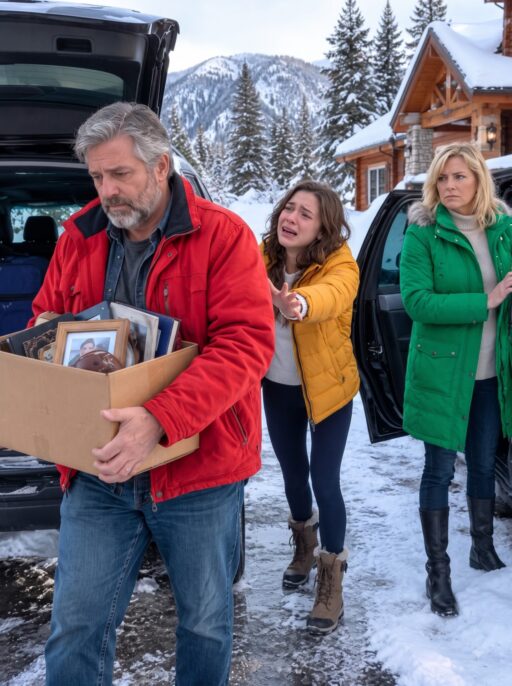
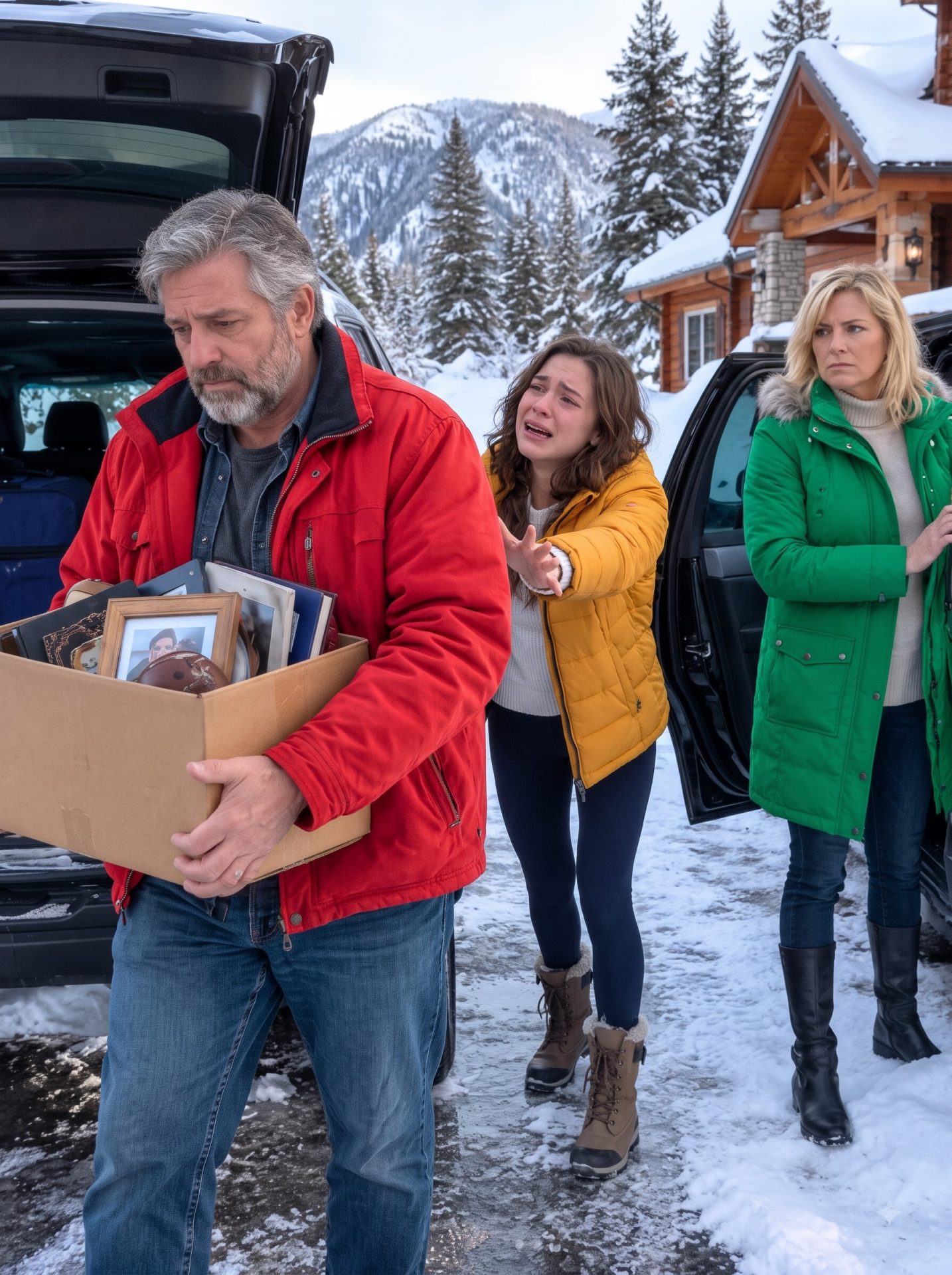
The following afternoon, they drove me through deep snow to a deteriorating cabin with no electricity, telephone, or proper heating. Inside stood a wood stove, an empty bed frame, a wooden table, and a few dusty dishes.
My father pointed toward the woodshed and explained how to operate the kitchen water pump. Meanwhile, Sandra demanded my phone, claiming it would be useless without reception.
She had already confiscated my savings that morning, promising to return the money once I became more responsible. When I protested, my father avoided my eyes.
Then he removed a taped Nike shoebox from the truck.
It contained everything I had left of my mother: eleven photographs, six cassette tapes, her silver earrings, and a tiny blue glass bird she’d treasured. I begged him to leave it with me, but he placed it in the trunk while Sandra insisted the keepsakes would be safer at home.
Minutes later, their truck disappeared down the mountain road, leaving me alone in a thin jacket with almost no food.
That night, I managed to light the wood stove and slept on the floor beside it. I had only two granola bars, and I saved one because I had no idea when I would eat again.
The following morning, I stepped outside to gather firewood and heard a faint whimper behind the shed.
Hidden between two stacks of logs was an elderly German shepherd, dangerously thin, half-frozen, and barely able to move. As I knelt beside him, I noticed a worn brass tag on his collar bearing a single name: DUTCH.
The German shepherd was trembling so badly that I could barely touch him without feeling his bones. His gray muzzle suggested he was old, and his injured back leg made every movement painful.
“Hey, Dutch. It’s okay. I’m not going to hurt you.”
He watched me cautiously as I reached into my pocket and pulled out my last granola bar. Although it was the only food I had left, I broke it in half and offered him a piece.
He swallowed it immediately, so I gave him the rest. Then, struggling to stand, he limped toward me and pressed his entire body against my knee.
I wrapped my arms around him, feeling his heartbeat beneath his thin coat. Somehow, this forgotten dog had decided to trust me, and I couldn’t bring myself to leave him outside.
I helped Dutch into the cabin and settled him beside the wood stove. He lay on the braided rug where I’d slept the previous night, finally protected from the freezing wind.
Unfortunately, neither of us had anything left to eat. I searched every cupboard and drawer, finding only salt, baking soda, and some ancient tea bags.
I considered walking the eleven miles back to Tamarack Falls, but the snow was deep, my shoes were inadequate, and Dutch could barely walk. Leaving him behind felt impossible, so I stayed and concentrated on keeping us warm.
After struggling with the kitchen pump, I managed to collect fresh water and filled a chipped bowl for Dutch. He drank eagerly before settling beside the stove again.
That evening, hunger made my stomach ache as I lay next to him. I was staring at the ceiling when I noticed an unusually cold draft rising through the floor beneath our rug.
Dutch seemed to notice it too. He struggled upright, sniffed the floor, and began pawing urgently at the braided fabric.
“What is it, boy? Did you find something?”
I pulled the rug aside and examined the dusty wooden boards underneath. After brushing away years of dirt, I discovered four straight lines forming a nearly invisible square.
A small iron ring was embedded along one edge. I grabbed it and pulled repeatedly until the heavy wooden panel finally lifted, revealing a concealed trapdoor.
Cold air rushed upward from a dark chamber beneath the cabin. Using a burning piece of wood for light, I discovered a ladder descending into a small stone cellar.
I climbed down carefully, expecting nothing more than an abandoned storage space. Instead, I found shelves packed with preserved vegetables, fruit, rice, flour, canned food, blankets, lanterns, medical supplies, and enough provisions to survive an entire winter.
There was even a forty-pound bag of dog food.
Someone had been preparing this place for years, but I couldn’t understand who would have gone to such trouble.
Then I noticed a small jar of dark purple plum jam sitting separately on a shelf. Its faded handwritten label contained two words that made my heart race.
Laurie Bird’s.
Laurie Bird was my mother’s childhood nickname, a name only my grandmother had used. I hadn’t heard anyone say it since my mother died.
At the back of the cellar, I discovered a gray metal box, a locked iron strongbox, and a bundle of letters tied with string. I carried the metal box upstairs, lit a candle, and opened it.
Inside was a folded sheet of paper addressed to me in my mother’s unmistakable handwriting.
For Wren.