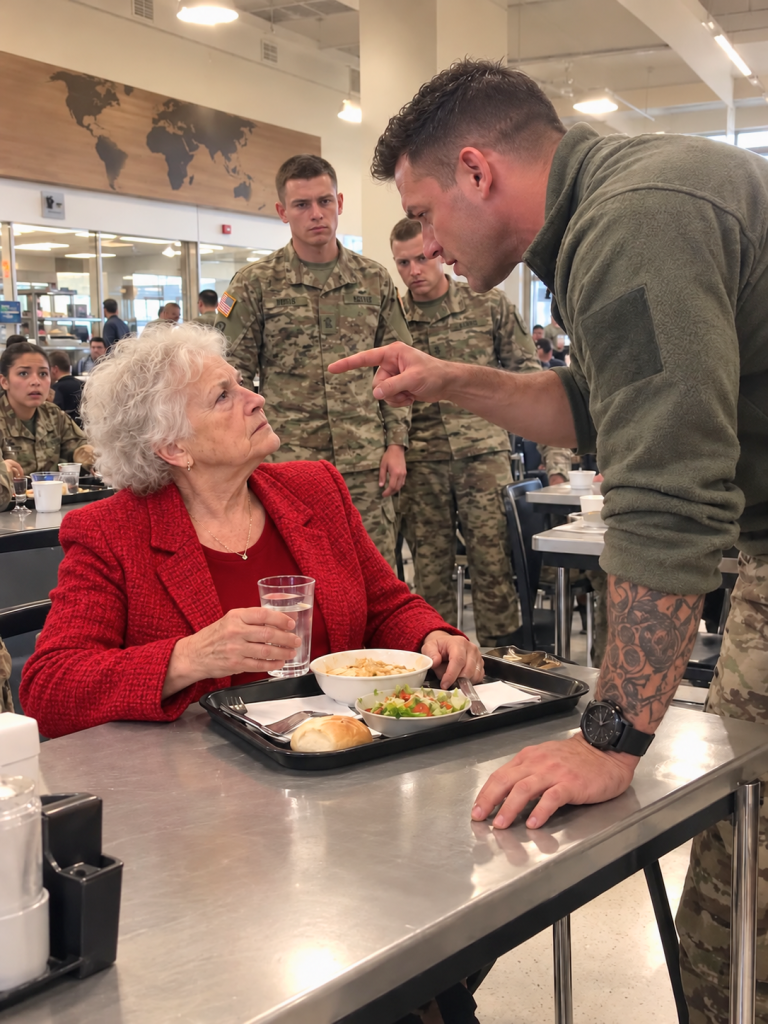

That was why my name appeared on the wall Sergeant Reese had walked past every day.
But when I met with the battalion commander that afternoon, I learned something that changed how I saw the young man who had humiliated me.
His father had served with the Herons.
And after his father died in Afghanistan, a charitable fund had helped keep his family from losing their home.
I knew that fund very well.
I was the woman who had created it.
After lunch, Lieutenant Colonel Ortiz invited me into the battalion headquarters to review the annual report for the Heron Family Fund.
I’d established the fund years earlier, after my husband, Walt, passed away.
We’d owned forty acres of farmland near Ashland City, Tennessee. In 2009, I sold the property for $340,000 and combined the proceeds with $150,000 from Walt’s life insurance.
With help from a bank trust officer, I placed the money into an irrevocable trust.
The purpose was simple: help families who had lost someone serving with the Herons.
The fund covered rent, mortgage payments, education expenses, and college assistance for surviving children.
I never wanted public recognition.
Families received letters from the bank bearing only the words, From the Herons. We Carry Our Own.
Over the years, the fund had distributed more than a million dollars to fourteen families.
That afternoon, I was reviewing the latest statement when Command Sergeant Major Darnell Hayes placed another document in front of me.
“Mrs. Braddock, there’s something you should know about Staff Sergeant Reese.”
I looked up.
“His father was Staff Sergeant Michael Reese,” Hayes explained. “He was killed in Afghanistan in 2008. Tyler was eleven.”
I recognized the name immediately.
Michael had left behind his wife, Angela, and two young sons.
After his death, Angela struggled to support the family while trying to return to school.
The Heron Family Fund paid their rent for three years and helped cover her education.
It later contributed toward Tyler’s college expenses.
I stared at the document.
“Does Tyler know where the money came from?”
“No, ma’am. The families were never told who established the fund.”
I remembered meeting Michael at a battalion family picnic in 2006.
He’d brought his two little boys. The older one wore an oversized shirt with the Herons’ emblem and kept trying to salute everyone.
Michael had laughed proudly.
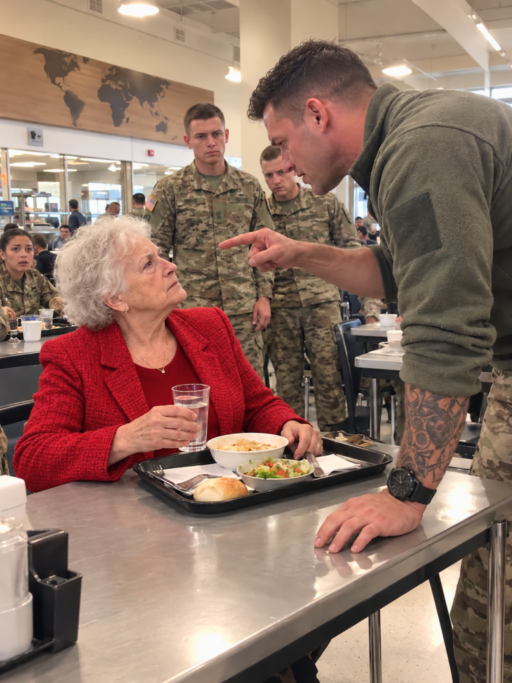
Now that same little boy was a staff sergeant who’d threatened to remove the crest from my coat.
Lieutenant Colonel Ortiz explained that Reese would face formal disciplinary counseling for his behavior.
He had publicly insulted a visitor, demanded identification without proper authority, and threatened to touch me without permission.
His upcoming promotion could also be affected.
I listened carefully.
“I want him held accountable,” I said. “But I’d like to speak with him before you make your final decision.”
At one-thirty, Reese entered the conference room with his first sergeant.
After the others stepped outside, he sat across from me.
“Ma’am, I’m sorry,” he began. “I had no idea who you were.”
“Tyler, why did you approach my table?”
He hesitated.
“I saw someone wearing our battalion crest. I thought you were pretending to have served.”
“And you decided to embarrass me in front of everyone?”
He lowered his eyes.
“Yes, ma’am.”
I touched the old brass pin.
“Your father wore this crest too.”
His head lifted.
“You knew my dad?”
“I met him at a picnic. You were there, wearing a shirt much too big for you.”
Tyler stared at me.
I told him about that afternoon, about his father’s laughter, and about the little boy who kept saluting with the wrong hand.
Tears gathered in his eyes.
“After Dad died, everyone told me I had to be strong,” he whispered. “I thought protecting his battalion meant never letting anyone disrespect it.”
“Respect doesn’t begin with humiliating someone you don’t know,” I replied.
He nodded.
Then I asked him how his mother had managed after his father’s death.
Tyler explained that an anonymous military charity had paid their rent and helped his mother become a respiratory therapist.
“We never found out who helped us,” he said. “Mom tried for years.”
I remained quiet.
His gaze moved from my face to the Heron crest, then toward the bank folder lying on the table.
He slowly understood.
“Mrs. Braddock… was that you?”
I nodded.
“Your family was one of ours, Tyler.”
He covered his face with both hands and began crying.
For a while, neither of us spoke.
Then he apologized again, this time without trying to explain away his actions.
I told him that his conduct still required consequences, and that I expected him to treat every visitor with dignity, regardless of their age or background.
When Lieutenant Colonel Ortiz returned, Tyler stood and requested permission to apologize publicly at the next morning’s formation.
The commander approved.
Tyler also accepted written counseling for his misconduct.
The following morning, I returned to Fort Campbell.
In front of his fellow soldiers, Tyler admitted what he’d done in the dining hall and apologized for his disrespect.
He finished by saluting me.
I returned the salute.
I thought that would be the last time we’d see each other.
But three weeks later, on a Saturday morning, six pickup trucks stopped outside my little yellow house.
When I opened the front door, Tyler was standing at the bottom of my eleven concrete steps.
Behind him were more than twenty soldiers carrying lumber, tools, and bags of concrete.
He looked up at me.
“Mrs. Braddock, we’ve come to build you a ramp.”
I gripped the doorframe, unable to speak.
For years, those eleven steps had made leaving my own home increasingly difficult.
Somehow, the young sergeant I’d met through an act of cruelty had found a way to help me with something I hadn’t even asked for.
Three weeks after Staff Sergeant Tyler Reese publicly apologized for humiliating me, I heard several trucks stopping outside my house.
I looked through the front window and counted six pickup trucks parked along the street. Two were pulling trailers loaded with lumber, concrete, and construction equipment.
More than twenty young soldiers were climbing out.
Tyler stood at the bottom of my porch steps, holding a toolbox.
“Mrs. Braddock, we heard you’ve been having trouble with these stairs.”
I looked down at the eleven concrete steps leading to the sidewalk.
Ever since my hip replacement six years earlier, climbing them had become increasingly difficult. Some days, getting to my mailbox took nearly five minutes.
Other days, I didn’t leave the house at all.
“What are you planning, Tyler?”
“We’re building you an accessibility ramp, ma’am. Handrails, proper supports, everything.”
I shook my head.
“That sounds expensive.”
“The company contributed toward the materials,” he explained. “And Private Kim’s father helped us prepare the plans.”
I recognized Private Kim immediately.
She was the young soldier who’d almost stood up for me when Tyler confronted me in the dining hall.
Now she was standing beside a sawhorse, smiling.
“Good morning, Mrs. Braddock!”
I looked from her to the lumber stacked on the trailers.
“Tyler, you don’t owe me anything.”
He nodded.
“I know, ma’am. That’s not why we’re here.”
Then he smiled.
“We carry our own.”
I stepped aside and let them begin.
The project took three Saturdays.
The soldiers installed the supports, built the wooden walkway, and added sturdy handrails along both sides.
Every Saturday, I made a large pot of chili with cornbread and sweet tea.
They ate in my driveway, sitting on pickup tailgates with sawdust covering their clothes.
My neighbor, Mrs. Delacroix, started bringing pound cake after seeing how many young people were working outside.
On the second Saturday, Tyler arrived with his mother.