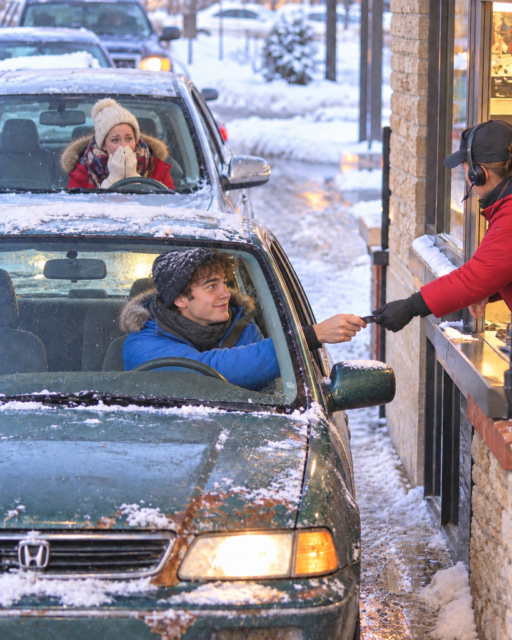
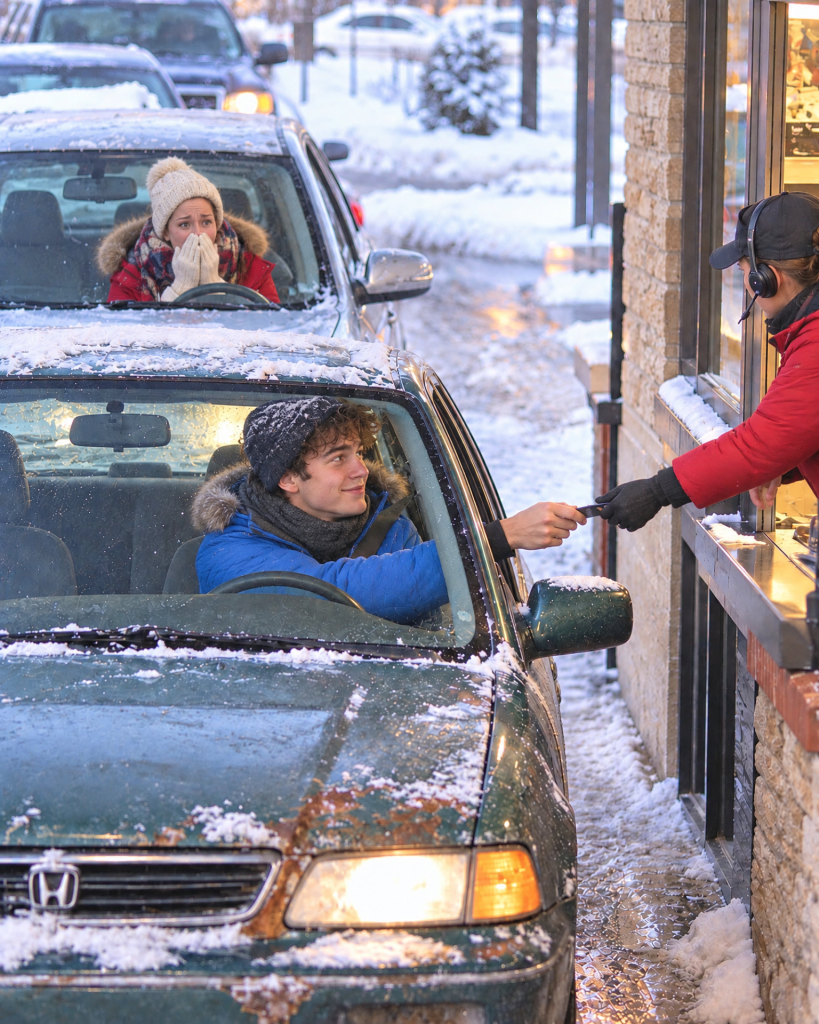

For more than a year, a teenage boy bought coffee for the woman behind him at my drive-thru. He always ordered a small hot chocolate for himself, then paid $4.85 for her vanilla latte. One morning, his rusty green Honda never appeared, and the nurse asked where her boy was. That was when we realized neither of us even knew his name.
My name is Rosemary Delgado, though almost everyone calls me Ro. I’m fifty-eight, and for eleven years, I’ve worked the early window at a small coffee stand on Route 9 in Bangor, Maine.
When your shift starts at five, you recognize customers by their headlights before you recognize their faces. There was the plumber in the white van who wanted two sugars in his black coffee, and the mother whose twins always asked for extra whipped cream.
Then there was the boy in the green Honda. He first showed up in September, wearing a gray hoodie, with a high school parking sticker stuck to his windshield.
He looked seventeen at most, thin enough that his sweatshirt hung loosely around his shoulders. After ordering his hot chocolate, he glanced into his rearview mirror.
“I’ll cover whatever the person behind me orders, too.”
I thought it was a nice gesture and added the next drink to his total. The customer behind him was a woman in navy scrubs, driving a dented silver Corolla.
She had a hospital badge clipped near her collar and the exhausted expression I often saw on people coming off overnight shifts. Her order was a small vanilla latte, exactly $4.85.
When I told her someone had paid, she looked toward the road, but the Honda was already gone. She smiled, thanked me, and went on her way.
The next morning, it happened again. By the third, I started watching more closely.
The boy wasn’t arriving ahead of her by chance. He waited at the gas station across the street until her Corolla approached, then pulled out and entered our line just before she did.
He did it every school morning, through the changing leaves and the first snow. Some days he paid with folded bills; other days, he counted out coins beside his gearshift.
He never stayed to see her reaction. By the time I handed over her latte, he was already heading down Route 9.
“That kid again?” she would ask, smiling whenever I told her.
Once, while taking his money, I finally asked the question that had been bothering me.
“Do you know the woman you keep buying coffee for?”
“Not really.”
He gave me a small smile and drove away before I could ask anything else. After that, I began noticing how carefully he watched the road while he waited across the street.
Whatever his reason was, those mornings mattered enough for him to keep coming back.
By the following September, the boy’s routine had become as familiar as unlocking the window. I would see his Honda across the street, spot the silver Corolla approaching, and reach for a hot chocolate cup.
One morning, he arrived holding a little cupcake with a candle tucked into the frosting. He kept it balanced on his palm while searching his pocket for money.
“It’s her birthday,” he said. “Could you give her this with her coffee?”
The sight of him standing there with that cupcake made me smile. I took a quick picture through the window before accepting it, never imagining I would need that photograph for anything.
The nurse looked stunned when I passed it to her. She held it carefully, shaking her head as she smiled.
My manager, Kurt, didn’t share our affection for the arrangement. He had started watching the Honda whenever it appeared across the road.
“He’s sitting there waiting for her every morning,” he complained. “That isn’t normal.”
“He buys her coffee,” I told him.
“Kids don’t do that for no reason.”
He threatened to contact the school, then said he might call the police if the boy kept waiting at the gas station. But the next morning, the Honda returned, and Kurt stayed inside, glaring through the glass.
Once, he leaned over my shoulder while the nurse was at the window.
“You ought to report that kid. For all you know, he’s watching your car.”
She looked straight at him.
“He buys me a coffee, Kurt. Nobody’s done that for me in years.”
That ended the conversation. The boy continued coming, and I continued taking his money without asking him to explain himself.
Then, on a Tuesday in February, his parking spot across the road stayed empty. Snow was falling heavily, and I assumed school had been canceled.
The Corolla arrived at its usual time. Before reaching for her drink, the nurse glanced toward the road.
“Where’s my boy?”
She tried to make it sound casual, but she kept looking past me.