
“Yes.”
I reminded him of the words he’d used that night.
“You said you didn’t want another sick daughter. You compared me to Mom.”
His face crumpled.
“And you turned off the porch light,” I continued. “I stood there waiting for you to let me back inside.”
Dad began crying again.
He told me he’d convinced himself I would find shelter nearby. When Officer Daniels called and explained that I hadn’t been breathing, he finally understood what he’d done.
“I’m sorry, Hannah. I’m not asking you to forgive me.”
Part of me wanted to reach for his hand.
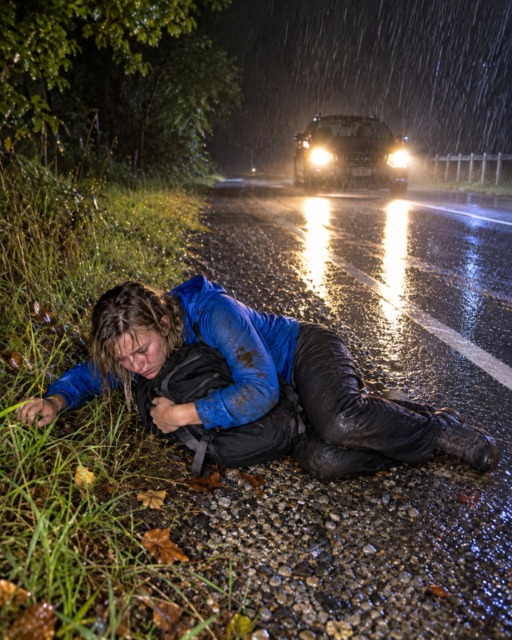
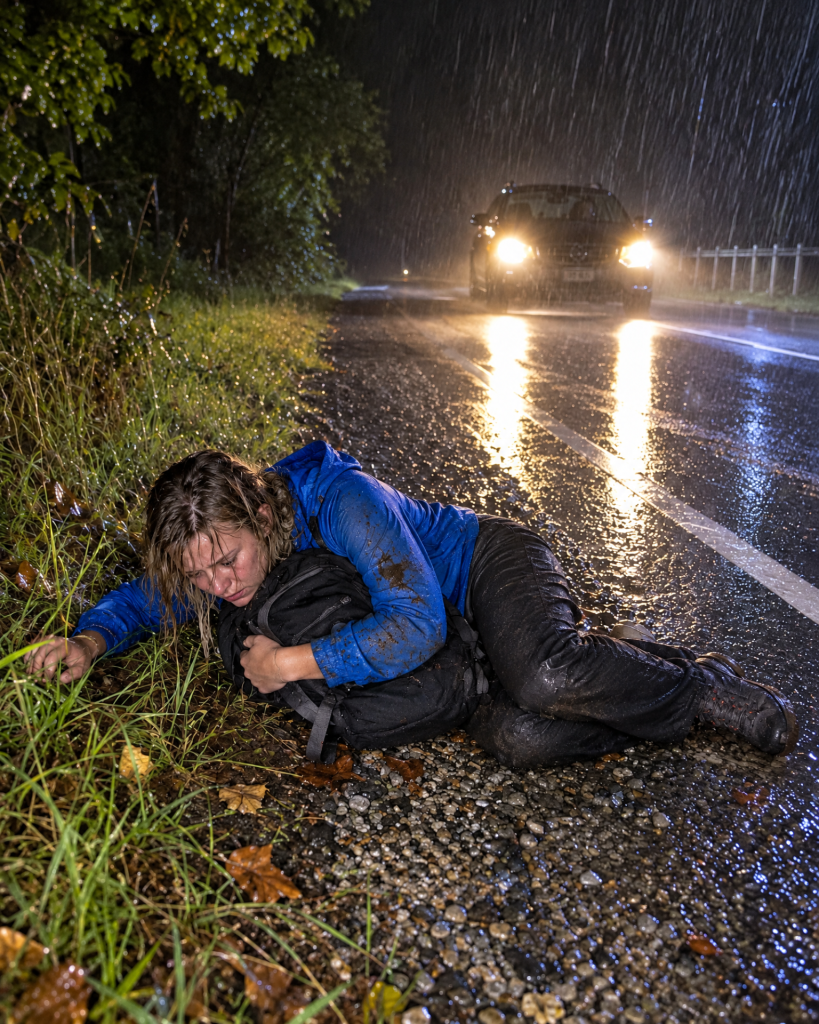
But I still remembered the cold road, the passing headlights, and the moment my legs stopped supporting me.
“I can’t forgive you yet,” I whispered.
Dad nodded.
He promised to attend counseling and cooperate with whatever the court required.
I didn’t answer.
A week later, after sixteen days in the hospital, I was discharged into Aunt Diane’s care.
She drove me to Columbus with the car heater turned up high.
For the first time since the storm, I slept through an entire night without wondering whether someone might lock me outside.
In early December, we returned to my hometown for the dependency hearing.
The courtroom was small, with wooden walls and a flag beside the judge’s bench.
Aunt Diane sat beside me. Officer Daniels was there, along with my caseworker, Mrs. Bell, and my guardian ad litem, Mr. Hutchins.
Roz sat quietly in the back.
Dad arrived wearing an unfamiliar suit.
Karen couldn’t attend because she was receiving treatment in Dayton, but she’d submitted a letter accepting responsibility for using my identity to obtain the prescriptions.
The judge reviewed the evidence.
Dad had pleaded guilty to a misdemeanor child-endangerment charge and received a suspended sentence, probation, parenting education, and required grief counseling.
Reports showed that he had begun attending his sessions.
Then Judge Harlan turned toward me.
“Your attorney says you’d like to speak.”
I stood, holding the index card on which I’d written my thoughts.
The judge asked me to state my name.
For a moment, I remembered lying beside County Road 9, unable to call for help.
Then I looked toward Roz.
She gave me an encouraging nod.
“My name is Hannah Grace Walls,” I said.
My voice trembled, but I continued.
I told the judge that my father had made a terrible decision, one that nearly cost me my life. I also explained that I didn’t believe he was beyond change.
But I wasn’t ready to return home.
“I want to stay with Aunt Diane through the school year,” I said. “I feel safe there.”
I asked to see Dad through supervised visits at first, provided he continued counseling and participated in family therapy.
Then I added one more request.
“I want him to help me with algebra on Saturdays. I missed weeks of school, and he used to be good at math.”
Someone in the courtroom laughed softly.
Dad covered his mouth.
Judge Harlan reviewed my requests and ordered temporary custody to Aunt Diane, supervised visits that could be reconsidered as Dad made progress, and continued counseling and family therapy.
She also approved the Saturday tutoring arrangement.
When the hearing ended, Dad approached me carefully.
He didn’t ask for a hug.
He simply promised he’d be there on Saturday.
I didn’t know whether our family could ever become what it had been before Mom died.
But for the first time, rebuilding it wouldn’t depend on me pretending nothing had happened.
My father kept his promise.
Every other Saturday, he drove ninety minutes to Aunt Diane’s house in Columbus to help me catch up on the schoolwork I’d missed while recovering in the hospital.
At first, our conversations were awkward. My caseworker supervised the visits, and Dad rarely spoke unless we were discussing algebra.
But he never arrived late.
When I struggled with an equation, he patiently showed me how to solve it. He didn’t raise his voice or criticize me when I made mistakes.
It was a small change, but I noticed.
In January, we began family therapy at Karen’s treatment center in Dayton.
Our first session was uncomfortable. Karen cried, Dad barely spoke, and I spent most of the hour staring at the floor.
Gradually, we learned how to discuss Mom’s death and the years we’d spent avoiding our grief.
By February, Karen had completed her residential treatment program and moved into a sober-living home.
She found a job at a coffee shop and continued attending recovery meetings.
She also began repaying the insurance company for the prescriptions she’d obtained using my information, as required by her legal agreement.
We spoke on Sunday evenings.
Sometimes we talked about ordinary things, like her work or my classes. Other times, we discussed what she’d done and how much it had hurt me.
I didn’t forget her betrayal, but I could see that she was working to change.
In April, Dad sold our old house on Linden Street.
He told me he couldn’t walk past the front door without remembering the night he’d locked me outside.
He purchased a smaller home closer to Columbus.
It had two bedrooms.
“One is yours,” he told me. “Whenever you’re ready. Even if you never use it.”
I appreciated that he left the decision to me.
Roz came to my sixteenth birthday party in May.
She brought a homemade pie and a card containing fifty dollars.
Inside, she’d written that the money was for a warm winter coat.
I hugged her tightly.
The woman who’d found me beside the road had become someone I considered family.
At our six-month court review in June, the judge examined the reports from my caseworker, Dad’s counselor, and our family therapist.
My grades had improved, including a B-plus in algebra.
When Judge Harlan asked where I wanted to live next, I explained that I hoped to spend weekends with Dad during the summer before deciding whether to return more permanently.
The court approved a gradual transition with continued oversight.
Dad didn’t celebrate or pressure me.
He simply nodded.
By the following October, almost a year after the storm, I was living with him most of the time.
Karen had maintained her recovery and was considering nursing school. Aunt Diane remained an important part of my life, and I still spent weekends at her house.
I had a bedroom in Dad’s new home, complete with glow-in-the-dark stars on the ceiling.
Karen had helped me put them up, just as she’d done when I was little.
Then, one Tuesday evening, another storm arrived.
Rain struck the windows, and the wind bent the maple tree outside.
I was sitting at the kitchen table working on geometry when Dad came into the room.
He sat across from me with his newspaper.
Neither of us mentioned the storm from the previous year.
He stayed there while I finished my homework.
Around nine-thirty, I remembered leaving my geometry book in Aunt Diane’s car.
I went to the closet and pulled out the dark green winter coat I’d purchased with Roz’s birthday money and my babysitting savings.
I zipped it up, slipped my phone into one pocket, and checked for my house key in the other.
Dad had given me that key in June.
Attached to the key ring was a small tag with two words written in his handwriting.
Hannah. Always.
I stepped onto the porch.
The light above the front door was shining brightly.
Dad had installed a timer so it would remain on throughout the night.
I hurried through the rain, retrieved my book, and returned to the house.
But when I reached the porch, the door was closed.
For a moment, I couldn’t move.
My fingers began aching, the way they sometimes did in cold weather.
Suddenly, I remembered standing outside our old house in a soaked sweatshirt, waiting for someone to let me back inside.
Then I heard the deadbolt turn.
Click.
My heart raced.
But this time, the door opened.
Dad stood in the doorway, wearing socks and holding it wide.
“Come inside, sweetheart. It’s freezing.”
I stepped into the warm hallway.
He closed the door behind me.
And he left it unlocked.
I stood there for a moment, holding my geometry book against my chest.
The sound of that lock would always remind me of what happened on County Road 9.
I still had occasional pain in my fingers, and some memories were harder to face than others.
But I was no longer the frightened fifteen-year-old who believed she had nowhere safe to go.
My name is Hannah Grace Walls.
A year earlier, a nurse named Roz Okafor had noticed a white sneaker beside a dark road and stopped to help a girl she’d never met.
Her decision saved my life.
My father couldn’t undo the night he locked me outside, and I couldn’t pretend it hadn’t happened.
What mattered now was that he understood forgiveness wasn’t something he could demand.
It had to be earned through the choices he made afterward.
I placed my geometry book on the kitchen table and hung my coat beside the door.
Outside, the storm continued.
Inside, the porch light stayed on.
And for the first time in a long while, I felt safe coming home.