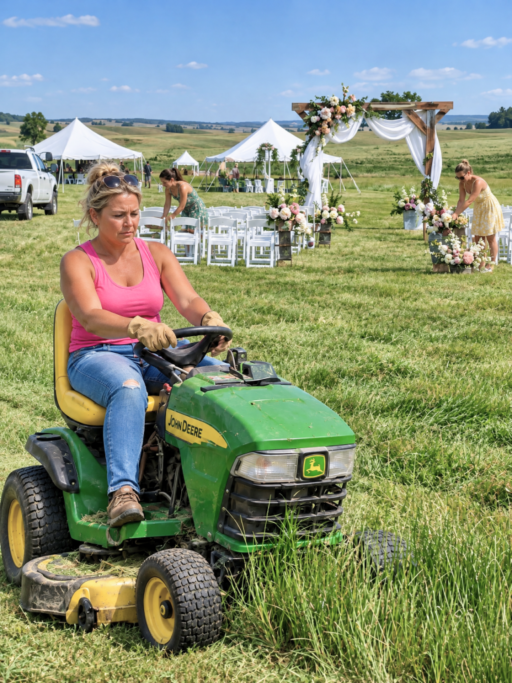
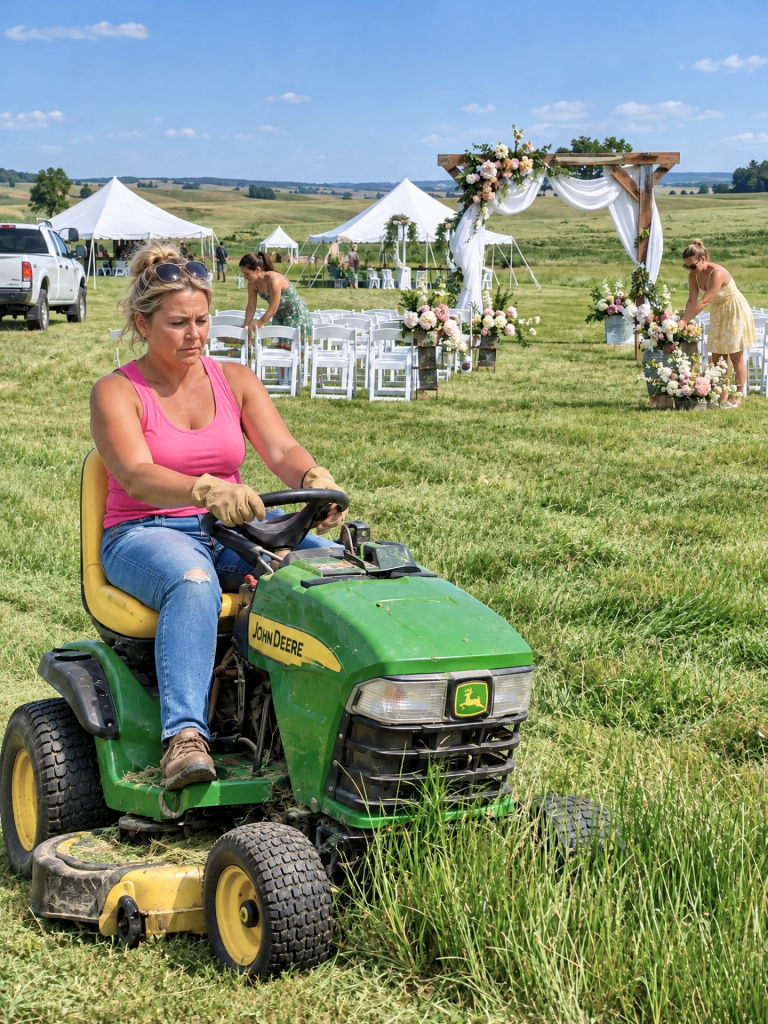

My grandfather left me his eighty-acre farm in Tennessee, and when my younger sister asked to hold her wedding there, I agreed without hesitation. I even sacrificed my most profitable hay harvest to give her the beautiful setting she wanted.
But when I asked her to cover the $1,400 rental fee for her reception tents, she accused me of charging family for the privilege of standing on Grandpa’s land.
Then our mother called.
“Your sister says you’re making her pay for dirt.”
That one word hurt more than either of them could have imagined.
My name is Laney Tidwell. I’m thirty-four, and I own eighty acres outside Shelbyville, Tennessee. I grow hay for local horse farms and cattle owners, and I teach agriculture at Cascade High School to keep the bills paid.
Fourteen months earlier, the property belonged to my grandfather, Earl Tidwell.
Grandpa bought the land in 1972 with money he’d saved driving a milk truck. He spent fifty-one years clearing brush, repairing fences, improving the soil, and building a farm that supported our entire family.
When my father abandoned us, I was nine and Megan was six.
Mom couldn’t afford rent or childcare on her wages from the Walmart deli, so Grandpa opened his farmhouse to us. He gave us the bedrooms and moved himself into a small room beside the kitchen.
He never complained.
I followed him everywhere. By eleven, I was learning to drive his old Ford tractor. By fourteen, I could help rake and bale hay, and I knew how to tell whether a field was ready for cutting.
Megan was different.
She stayed indoors with Mom, preferring books, shopping trips, and time with friends. I assumed she simply wasn’t interested in farming.
Grandpa died at eighty-seven, leaving Mom the farmhouse, Megan his savings of $11,000 and his treasured gold Hamilton watch, and me the eighty acres.
His will explained why.
Laney will keep the land in hay. She won’t sell it to developers. She’ll take care of it.
Megan accepted her inheritance quietly, although she barely looked at me afterward.
That October, she became engaged to Scott Hendricks, a pharmacist from Murfreesboro.
A month later, she called.
“Laney, would you let us get married in the field behind the farmhouse?”
“Of course,” I answered. “Grandpa would’ve loved that.”
I spent the following spring preparing everything. I cleared an old cedar tree, filled holes, mowed access paths, and prepared the ceremony area.
More importantly, I postponed cutting forty acres of premium timothy hay.
That first harvest normally produced roughly two thousand square bales, selling for around twelve dollars each. Waiting until after the June wedding meant the hay would lose quality and much of its value.
I estimated the sacrifice at eleven or twelve thousand dollars.
I never mentioned it to Megan.
Then the tent rental company called about two large white reception tents. The total was $1,400, and because the event was on my property, they needed my signature on the delivery agreement.
I called Megan and asked her to arrange payment.
“I thought the tents would be your contribution,” she replied.
“I’ve already provided the property and prepared the field. I think you and Scott should cover the tents.”
She said a cold, reluctant “Fine” and ended the call.
Two days later, Mom accused me of charging my sister to use the farm.
When I explained the difference between renting tents and renting land, she dismissed it.
“Be the bigger person, Laney. You’re the one who inherited everything.”
I looked across the field Grandpa had worked his entire life.
That land had paid for our groceries, school clothes, electricity, and Megan’s first car.
To them, apparently, it was just dirt.
I paid the $1,400 myself that evening. I wasn’t going to let a disagreement ruin my sister’s wedding.
But afterward, sitting at my kitchen table, I remembered something Grandpa used to say whenever someone took advantage of his kindness.
“Being decent is one thing. Being a doormat is another.”
Beyond my window, the tall June hay stretched toward the farmhouse where Megan would exchange her vows.
I looked at the slope behind the ceremony site and remembered exactly where her photographer planned to stand.
For the first time, I began to imagine what that field could say without anyone speaking a word.
For a week after paying the $1,400 tent bill, I tried to forget what my sister had said about Grandpa’s land.
But every time I drove past the hayfield, I remembered Mom’s accusation.
You’re charging family for dirt.
Grandpa had spent fifty-one years turning those eighty acres into something valuable. He’d worked through droughts, broken equipment, and winters when there was barely enough money to cover the electric bill.
Calling it dirt felt like erasing everything he’d done for us.
Still, I didn’t want to embarrass Megan or ruin her wedding.
I loved my sister. When our father abandoned us, she used to crawl into my bed at night and ask whether he was coming home. I’d hold her until she fell asleep, promising we’d be okay.
Those memories mattered more than an argument about tents.
But Grandpa’s words kept returning to me.
Being decent is one thing. Being a doormat is another.
One evening, I stood behind the farmhouse, studying the slope where the wedding ceremony would take place.
The white arbor would stand at the bottom, with two hundred chairs facing it. Behind the arbor, the untouched timothy hay stretched uphill toward the tree line.
Megan had shown me the photographer’s planned position months earlier.
Almost every wedding picture would include that field.
And suddenly, I knew what I wanted to do.
I wasn’t going to write an insult. I wasn’t going to accuse Megan of being ungrateful or turn her wedding into a public argument.
I wanted everyone standing on that land to remember the man who had made it possible.
Four letters.
One name.
I spent several evenings measuring the slope with a hundred-foot tape and sketching the design on graph paper, just as Grandpa used to do when planning fence lines.
Each letter would stand approximately forty feet tall.
On Thursday evening, after the rental company installed the tents, I placed small orange survey flags deep in the standing hay to mark my cutting lines.
Nobody noticed.
At Friday’s rehearsal dinner, I sat beneath one of the tents I’d paid for and watched Megan laugh with Scott.
She looked happy.
I wondered whether I should abandon my plan.
Then Mom walked over and thanked me for finally being reasonable about the expenses.
I smiled politely, but the decision was already made.
At four the next morning, I pulled on Grandpa’s old brown barn coat and walked to the equipment shed.
His 1968 Ford 3000 tractor waited inside, blue and gray paint worn thin along the fenders.
I attached the narrow sickle mower, checked the blades, and drove toward the field.
The Tennessee sky was still dark. Dew soaked my jeans, and the tractor headlights illuminated narrow strips of golden hay.
I started at the bottom of the first letter.
Slowly, I drove uphill, cutting one straight line before turning and making another pass beside it.
The mower laid the hay flat behind me.
When the first letter was finished, I moved to the second.
Then the third.
The work took longer than I’d expected. Wet grass tangled in the equipment, forcing me to stop repeatedly and clear it.
By sunrise, my hands were stained green and my boots were soaked.
I switched to Grandpa’s smaller John Deere riding mower to sharpen the edges and make the letters visible from below.
At 7:45 a.m., I finally shut off the engine.
I walked halfway up the slope and looked back toward the arbor.
There, cut into the standing hay, was the name of the man who had raised us.
EARL.
I reached into Grandpa’s coat pocket and found one of the peppermints he’d always carried.
For a moment, I was eleven again, sitting beside him on that old tractor.
I returned the coat to its hook, showered, and changed into a navy-blue dress.
By one o’clock, wedding guests began arriving.
I stood behind the reception tent as the first families walked around the farmhouse.
A woman in a blue dress stopped suddenly.
Then her husband stopped.
Within minutes, dozens of guests were staring toward the hillside, lifting their phones to photograph what I’d done.
Even Scott, waiting beside the arbor, stood motionless.
Then Mom stepped onto the farmhouse porch.
She saw the letters, covered her mouth, and began to cry.
But Megan was still inside getting ready.
And I had no idea how my sister would react when she finally saw Grandpa’s name stretching across the field behind her wedding altar.