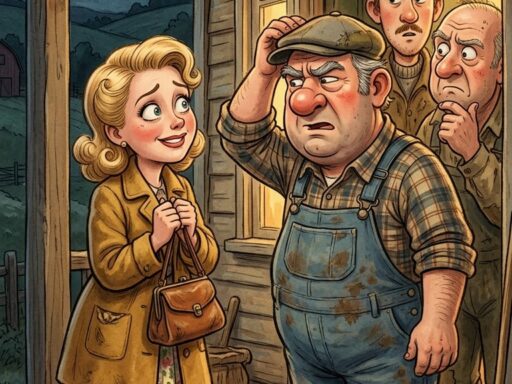


My former mother-in-law called me at 5:06 on a Saturday morning, exactly four weeks after her son and I signed our divorce papers.
“Get up, Elena,” she said. “Harold’s birthday dinner is tonight, and I expect you in my kitchen by six.”
For a moment, I lay still beneath the white duvet in my hotel suite, staring at the unfamiliar ceiling. Then I looked at the packed garment bag beside the chair, the presentation folder on the desk, and the welcome card bearing the logo of the Ashford Grand.
I was not in the cramped apartment above Victor’s restaurant anymore.
I was not his wife anymore, either.
“Who is this?” I asked.
The silence that followed was almost satisfying.
“Don’t be stupid,” Marjorie snapped. “It’s Marjorie. Your father-in-law is turning seventy. There will be twenty-five guests, and you know exactly what he likes.”
I remembered. I remembered every holiday spent on my feet while the rest of the Sloan family drank wine and praised themselves for being close. I remembered preparing roast beef, hand-rolled pastries, sauces from scratch, and the walnut cake Harold requested every year.
I also remembered Marjorie standing behind me whenever I paused.
“A wife who truly values her family doesn’t need to sit down,” she would say.
Victor never defended me. He would scroll through his phone and tell me not to turn ordinary requests into “another emotional episode.”
That was how ten years disappeared: one unpaid favor, one swallowed insult, one silent dinner at a time.
“I won’t be coming,” I told her.
Marjorie gave a sharp laugh. “You are not in a position to make demands. Victor said you’re barely surviving in some cheap rental.”
“I’m busy.”
“Busy doing what? Pretending you still have a career?”
Before I could answer, I heard Victor take the phone from her.
“Elena, stop embarrassing yourself,” he said. His voice was smooth, arrogant, and painfully familiar. “You spent a decade depending on me. Show up, help my mother, and maybe we can discuss whether you deserve another chance.”
I looked across the room at the black suit I had chosen for the morning meeting. At nine o’clock, I would be introduced to the board of a national hospitality group as its new vice president of culinary development.
The position was built on work Victor had spent years dismissing as “just recipes.”
“I have an appointment,” I said.
“With who?” he scoffed. “A diner manager?”
“With people you’ve been trying to impress for the last three years.”
He laughed loudly. “Sure. And I’m opening a restaurant in Paris.”
I ended the call.
At six-thirty, a car collected me outside the Ashford Grand. As we pulled away, my phone lit up with a message from Marjorie.
If you don’t come now, Victor and I will visit your father’s workshop ourselves.
My stomach tightened.
My father, Rafael Morales, made custom kitchen knives in a small forge outside Richmond. Victor had always treated it like an embarrassment, despite using my father’s work in his restaurant and claiming the craftsmanship was part of his own brand.
I called Dad immediately.
“Victor is on his way to you,” I said.
“I know,” Dad replied calmly. “But sweetheart, Chef Whitaker is here too.”
Chef Daniel Whitaker was one of the most respected names in the country—and one of my father’s oldest clients.
Then my phone vibrated again.
This time, it was a video from Dad’s apprentice.
Victor stood outside the forge, shouting at someone off camera. Behind him, Marjorie crossed her arms with the smug certainty of a woman who believed I would always come running.
Then Victor kicked a wooden case near the doorway.
The lid flew open.
A hand-forged ceremonial knife slid across the pavement.
And just as a black sedan pulled up beside him, Victor looked down at the blade and said the one thing that would change everything.
“Who cares?” he sneered. “It’s just a piece of metal.”
The video ended with Victor’s shoe resting beside the knife case, but another voice came through before my father’s apprentice stopped recording.
“Please move away from that blade,” a man said evenly. “It was made for me.”
Victor turned toward the camera, visibly irritated. He had no idea he was speaking to Daniel Whitaker, the chef whose endorsement had helped place restaurants on magazine covers across the country.
My father had forged Whitaker’s knives for more than twenty years.
Victor squinted at him. “It’s a kitchen knife. You can buy ten of them online.”
Chef Whitaker’s expression changed, though he did not raise his voice. “You can buy an object online. You cannot buy forty years of skill.”
Then Victor saw the executive stepping out of the second car parked outside the forge. Adrian Cole, purchasing director for the very hotel group Victor had spent months trying to persuade into a supply agreement, walked toward the damaged knife with a look of disbelief.
Victor’s face lost color.
“Mr. Cole,” he said quickly, “this is a misunderstanding.”
Adrian did not look at him. He crouched beside the blade, inspected the chipped handle, and asked my father whether it could be repaired.
“It can,” Dad replied. “But it will never be the piece Chef Whitaker waited for.”
Victor tried to laugh. “Rafael is exaggerating. He makes basic tools in a small shop.”
“That small shop,” Chef Whitaker said, “makes the knives used in three of my kitchens.”
My father remained calm behind the doorway, but I knew what Victor’s cruelty meant to him. Dad had never cared about luxury cars or expensive titles. He cared about the work of his hands, and he had quietly given Victor more support than Victor ever admitted.
The knives in Victor’s restaurant had not been borrowed decorations.
They had been gifts from my father to me.
My phone rang again. Victor’s name appeared across the screen, but this time I answered.
“Elena,” he said, his voice noticeably lower, “tell your father to calm these people down. I made a mistake.”
“You came to his property to threaten him.”
“I came because you refused to act like an adult.”
“You called his life’s work worthless.”