
At 3:18 in the morning, my telephone rang inside my apartment above Ostrander’s Bakery in Port Alder, Minnesota. Outside, a relentless winter storm was sweeping across Lake Superior, burying roads beneath enormous snowdrifts and driving temperatures dangerously low.
My name is Andrea Kowalski, although most people call me Andie. Before becoming a heavy crane operator at the local ore docks, I spent eight years serving as a staff sergeant in an Army combat engineer battalion.
The caller was Sergeant Jerome Daniels, a police officer who had known me since childhood. His unusually strained voice immediately told me something was terribly wrong.
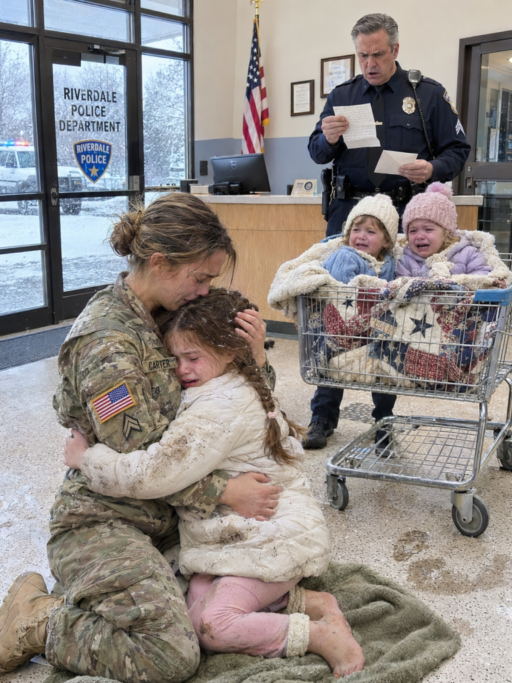
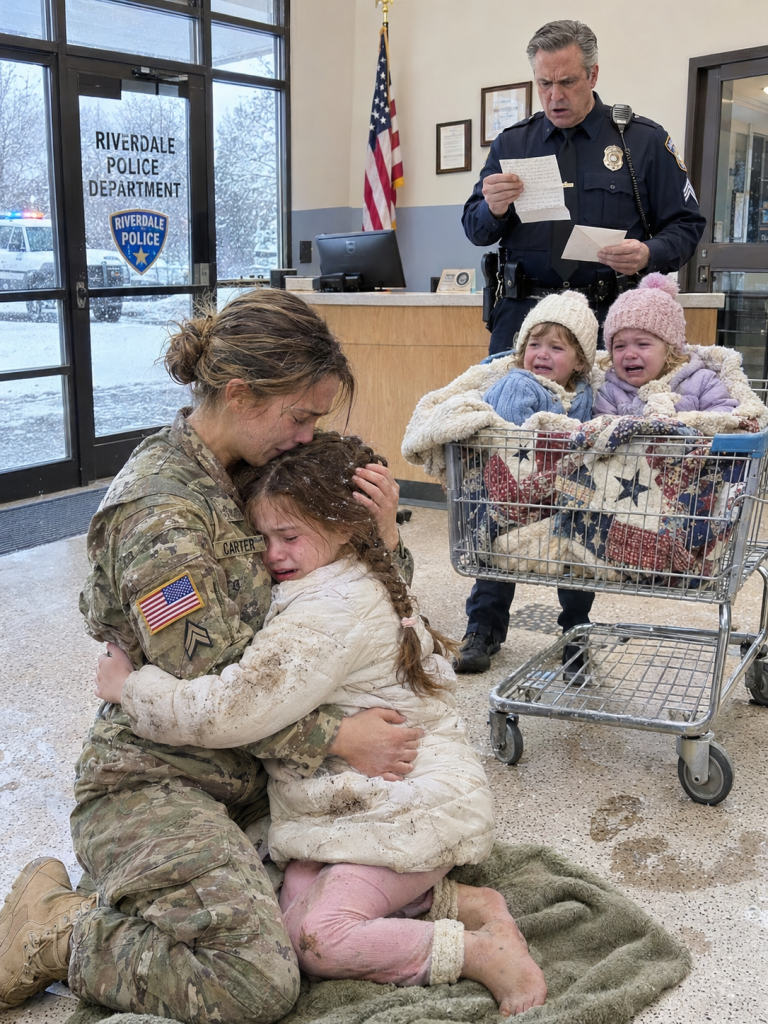
“Andrea, your nine-year-old daughter just walked into our precinct pushing a shopping cart. There are two toddlers inside, wrapped in an old winter coat.”
I gripped the telephone, struggling to comprehend what he was telling me. Ruby was supposed to be staying with my ex-wife, Maddie, at a farmhouse five miles outside town.
“She’s suffering from severe cold exposure. She also gave me an envelope she had hidden inside her shoe, but she refuses to explain anything until you get here.”
Daniels instructed me to come immediately without informing anyone of my destination. When he mentioned that the entire precinct was under lockdown, my confusion turned into genuine fear.
“Jerome, why would you lock down a police station because of a child?”
“Because the detective who closed the missing children’s case fourteen months ago is sitting upstairs right now.”
I hurried downstairs, where the bakery owner immediately handed me the keys to his four-wheel-drive delivery van. As I struggled through the snow-covered streets, I remembered a disturbing conversation Ruby and I had shared the previous Sunday.
Following our divorce, Maddie had received primary custody because of my demanding work schedule and documented post-deployment therapy. She was now engaged to Sean Tate, a respected local contractor whose aunt, Deborah, had supervised County Family Services for thirty-one years.
While driving Ruby back to the farmhouse after our weekend together, she had asked me an unusual question.
“Mom, if you hear a baby crying underneath someone’s house, but nobody living there has a baby, who are you supposed to tell?”
Distracted by work responsibilities and financial concerns, I had dismissed her question as something inspired by her mystery books. Ruby had remained completely silent for the rest of our journey.
Now, as I approached the precinct, the memory filled me with unbearable guilt.
Daniels unlocked the entrance and immediately secured it behind me. Ruby was sitting beneath several thermal blankets while a paramedic treated her cold-exposed feet.
“Mom, I took Aunt Deb’s church coat. I know stealing is wrong, but the little boy wouldn’t stop shaking.”
I dropped to my knees and pulled her into my arms.
“You did nothing wrong, sweetheart. You’re safe now.”
Beside her stood a damaged shopping cart containing two sleeping toddlers in matching dinosaur pajamas. Lieutenant Tina Gregory approached me holding a faded missing-person flyer featuring photographs of two infants.
She explained that Riley and Tyler Wilder had disappeared fourteen months earlier. Detective Lester Gray had closed their case after their father died in a vehicle accident, declaring both children presumed lost.
“These boys never left Minnesota, Andrea. They’ve been hidden beneath Deborah Tate’s farmhouse.”
Before I could respond, a smartphone concealed beneath the blankets inside the shopping cart began vibrating. The caller’s name appeared on its illuminated screen, revealing exactly why Daniels had locked the station doors.
It was Detective Lester Gray.
Lieutenant Gregory immediately ordered everyone to leave the smartphone untouched. After instructing Sergeant Daniels to secure the precinct’s communications, she escorted Ruby, the paramedic, and me into a private conference room.
The phone belonged to Deborah Tate, whose retired County Family Services identification card was tucked inside its leather case. Several incoming messages appeared on the screen, revealing arrangements for an early morning meeting with a wealthy couple from Scottsdale, Arizona.
One message confirmed that the couple had brought a cashier’s draft worth $42,000. Another requested that the children be dressed and ready for transportation by six o’clock.
“They’re selling those children,” I whispered.
Gregory explained that Deborah appeared to be operating an illegal private adoption network. Her extensive experience in child welfare had given her the knowledge and connections necessary to fabricate documents, while Detective Gray concealed missing-person reports and prevented legitimate investigations.
The prospective adoptive parents, Isaiah Orr and his wife, probably believed they were participating in a lawful private adoption. They had apparently been provided with fraudulent documents claiming that the children’s biological mother had voluntarily surrendered her parental rights.
I turned toward Ruby, who was still wrapped in a thermal blanket.
“Sweetheart, I need you to tell us everything you remember.”
Ruby explained that five weeks earlier, Deborah had installed a lock on the basement cellar door. She claimed the area was unsafe because of furnace problems and instructed everyone to stay away.
However, Ruby began hearing strange noises through the heating vent beneath her bed. One evening, she recognized Deborah’s voice singing a church hymn downstairs, accompanied by the unmistakable sounds of young children.
On the Sunday before New Year’s Day, Ruby remained home while the others attended church. She entered the cellar and discovered two toddlers confined inside an old wooden crib with inadequate bedding, food, and water.
“They didn’t even cry when they saw me, Mom. Riley just lifted his arms because he wanted someone to hold him.”
Over the following weeks, Ruby secretly brought them portions of her lunch and read library books to keep them company. She also attempted to report what she had discovered to her teacher and Pastor Lindquist, but both dismissed her concerns because of Deborah’s respected reputation.
Then Ruby overheard a conversation revealing that the children would be transported on Saturday morning. Deborah mentioned Detective Gray, the buyers from Arizona, and a red folder containing documents that would be destroyed after the transaction.