
The first lesson my mother ever taught me about belonging was that I hadn’t earned it yet. I was nine years old, standing at my own birthday party in front of a lemon cake with pink frosting when she stopped my hand in front of eight girls from my class.
“Don’t be greedy, Olivia. You didn’t pay for that.”
I didn’t understand what those words meant at nine. By twelve, I understood that the lesson had never really been about cake.
My mother, Patrice Doyle, had taught me that the person who produced something was not necessarily entitled to enjoy it, and the person who kept everything functioning was rarely the person who received recognition. Over the next twenty-five years, I became exceptionally good at living according to that rule.
I’m Olivia Doyle, thirty-four years old and an accountant. The profession suits me because accounting isn’t really about numbers to me; it’s about maintaining an accurate record of what happened, regardless of what someone claims happened.
My family rarely operated that way.
Patrice was sixty-four, confident, beautiful, and accustomed to occupying the center of every room. My thirty-seven-year-old sister Camille inherited both her appearance and her talent for being seen, while I became the dependable daughter who organized, solved, funded, and completed whatever needed doing.
My father, Gerald, was sixty-six and had retired from civil engineering four years earlier. He loved me, but in the distracted way people sometimes love the person they assume will always be fine.
Camille’s twelve-year-old daughter Hannah was different. She had a quiet way of observing things that reminded me uncomfortably of myself, as though she could recognize when something was wrong even when nobody around her acknowledged it.
I had been twenty-two when my mother first asked me to arrange hotel rooms for relatives attending a cousin’s wedding.
“Olivia, you’re so good with these things.”
I booked everything. At the wedding, Mom publicly thanked Camille for helping the event come together so smoothly.
That pattern followed me into adulthood.
So when my parents’ fortieth anniversary approached and Mom called in August, I already knew what she wanted.
“You’re so good with these things. You’ll handle it, won’t you?”
“Yes.”
I booked the Hearthstone private room at Alderwood, met with the manager, Daniel, selected the menu, paid the deposit, and left my credit card on file for the remaining balance. I ordered intimate floral arrangements, coordinated fifteen relatives, collected dietary requirements, arranged seating, and prepared anniversary cards for every table.
Every expense came from me.
Then I bought myself a red dress.
I normally dressed in practical navy, gray, and dark green, colors that allowed me to move through rooms without attracting attention. But this time I wanted to be visible inside something I had created.
Three weeks before the anniversary, Camille announced that she wanted to “help.”
Her help meant adding eight guests, upgrading the flowers at my expense, ordering two extra cases of champagne, and changing the seating plan so she could sit beside our parents near the fireplace.
I looked at the revised chart.
“Where am I sitting?”
Camille barely glanced at it.
“You can float. You’re so good at taking care of everyone. You don’t really need a seat.”
Mom nodded approvingly.
“That’s perfect, Camille. You have such an eye.”
I had booked the room.
I was paying for the party.
And somehow, once again, I was the only person who didn’t have a place at the table.
After Camille removed me from the seating plan, I went home and sat alone in my carefully organized apartment. I wasn’t angry so much as exhausted, feeling the particular kind of fatigue that comes from carrying something for years and suddenly becoming aware of its weight.
A week before the anniversary, Camille posted online about the party she was supposedly planning, describing the flowers she had chosen, the menu she had curated, and the private room she had imagined. Friends and relatives praised her for all the work, and Mom proudly commented beneath the post.
“My girl. So proud of you.”
I almost responded, even typing something before deleting it and putting my phone down. I had been doing some version of that for twenty-five years, noticing what was happening but deciding that keeping quiet was easier than challenging it.
The day before the party, my seventy-eight-year-old great-aunt Ruth joined us at my parents’ house while I finalized the headcount. She had spent forty years teaching elementary school, which seemed to have given her an unusual ability to recognize performance without being impressed by it.
After watching me work for a while, she finally spoke.
“They’ve gotten so used to you carrying everything that they’ve stopped seeing you carry it.”
I looked at her, surprised that someone had finally said aloud what I had spent years refusing to name.
“I see it. I have seen it for years. But I want you to know I see it.”
“Thank you, Aunt Ruth.”
“What are you going to do about it?”
“I don’t know.”
“Yes, you do.”
Ruth returned to the living room, leaving me alone in the kitchen with the final headcount in my hand. Her question stayed with me until the following evening, when I arrived at Alderwood in my red dress and discovered that Camille had placed me at an extra table near the service door with Ruth, two cousins I barely knew, and a great-uncle who was hard of hearing.
Camille, meanwhile, sat beside our parents near the fireplace, exactly where she had wanted to be, in what she called the best light. From my table, I quietly studied the room I had created, remembering that I had personally selected the rosemary sourdough and sea-salted butter, chosen the candles, researched the florist, arranged the menu, addressed the cards, coordinated the guests, and paid for everything around us.
Before dinner, Camille stood and began her toast by describing the anniversary celebration as something she had created.
“When I decided to throw this party for Mom and Dad…”
She proceeded to claim the room, flowers, candles, food, and arrangements while the guests applauded. Mom placed a hand over her chest with obvious pride, and Dad smiled beside her.
“Camille always takes care of this family.”
“What would we do without her?”
I stood near the edge of the firelight in the red dress I had deliberately bought because, for once, I wanted to be visible inside a room I had built. Yet nobody mentioned my name, and the only person who wasn’t applauding was twelve-year-old Hannah, who was watching me with the same quiet awareness I had carried since childhood.
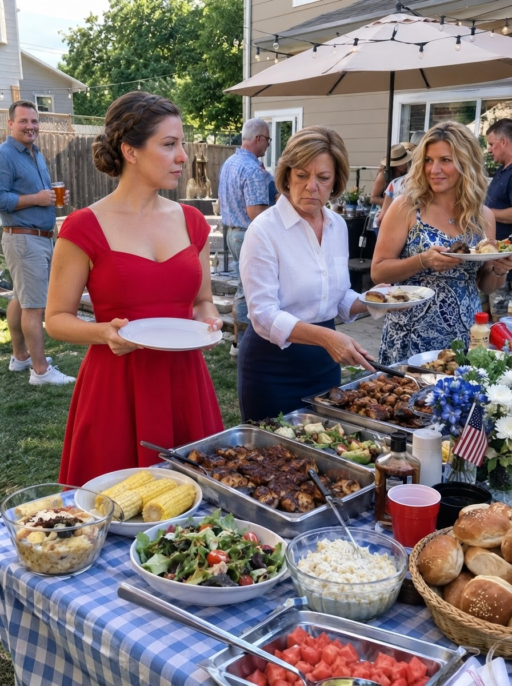
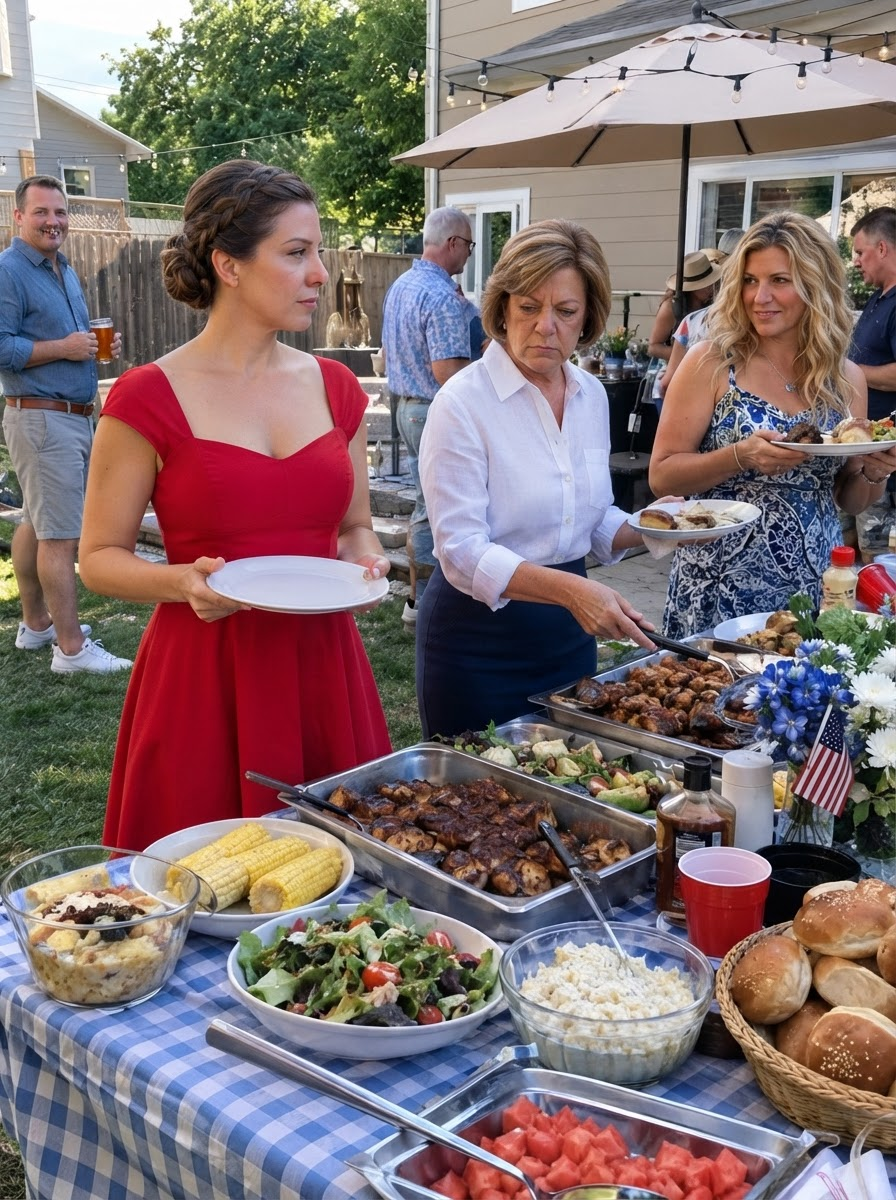
When dinner was announced, I joined the others and picked up a plate. Before I could serve myself, Mom’s voice carried across the room.
“Olivia, don’t fill your plate. You didn’t pay for this. Let the guests go first.”
For an instant, I was nine years old again, reaching toward my own birthday cake while eight girls watched my mother stop my hand. Camille looked down at her plate with a faint smile at the corner of her mouth, almost identical to the expression she had worn twenty-five years earlier.