
For six years, I’d believed I was secretly protecting Ada’s dignity.
All along, she had quietly been protecting mine too.
The Parcel Street Heritage Project eventually took ownership of Ada’s house, exactly as she had arranged. Their director, Diane, inspected every room carefully, and when she reached the front room, she stopped beside the crooked pottery bowl Leonard had made nearly fifty years earlier.
“That belonged to the original owner?”
“Leonard made it in 1975.”
Diane examined it for another moment.
“We’re keeping it.”
I laughed because I could almost imagine Ada’s reaction.
“Ada would be very pleased.”
The organization planned to preserve the property as a living-history home rather than turn it into a traditional museum. They wanted visitors to encounter enough of Ada and Leonard’s belongings to understand that the house hadn’t merely survived for decades; real people had built a marriage, raised a child, lost friends, grown old, and lived thousands of ordinary days inside those rooms.
Eventually, Diane asked me to help with the restoration.
“You knew Ada.”
I thought carefully before answering. I knew the stories she shared beside the mailbox, her habit of cheating at gin rummy, the morning she’d fallen, and the difference between the days when she wanted company and those when she preferred silence.
“I knew her as a neighbor.”
“Which is its own kind of knowing.”
That spring, Philip returned just as he’d promised. He spent several Saturdays helping the restoration crew repair the porch, gutters, railing, and window trim, and although he wasn’t particularly talented with tools, he worked hard.
One afternoon, I saw him working from across my yard. He noticed me, raised one hand, and I returned the gesture without walking over.
There were still things between us that might eventually need to be said, but neither of us needed that conversation yet. Ada had left both of us truths that required time to understand.
After the workers went home, I crossed into her yard and filled the bird feeder. The shutters had recently been repainted the same blue Leonard had chosen decades earlier, and I remained there until the evening light began fading.
Back home, I opened another box of Ada’s Christmas cards. I’d reached 1979, the year Philip was born, and nearly every card celebrated the arrival of their new baby and the future that seemed to be opening ahead of Ada and Leonard.
In the early years, most cards were addressed to both of them. Decades later, Leonard’s name disappeared, followed slowly by the names of friends and relatives who had also passed away.
You could trace an entire lifetime through those boxes: marriage, parenthood, friendship, aging, and loss. Ada had preserved all of it, including one final box from the year she died, although I still wasn’t ready to open that one.
That Christmas, Philip sent me a card.
“Thank you for what you were to her. I mean that plainly.”
I placed it inside a new shoebox of my own. Perhaps traditions sometimes began that simply.
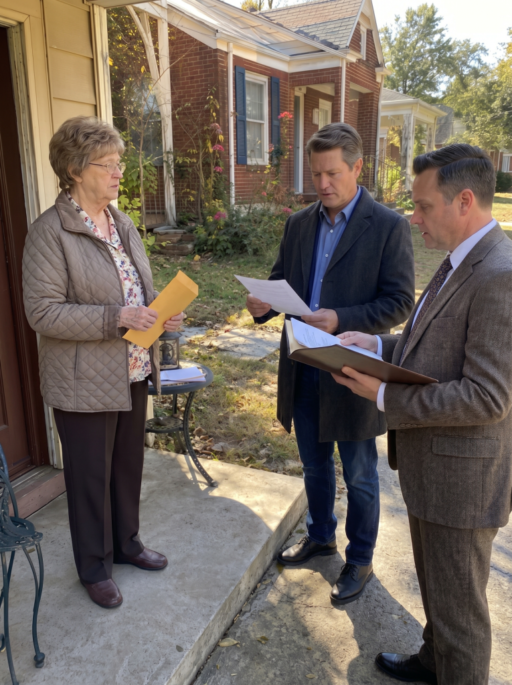
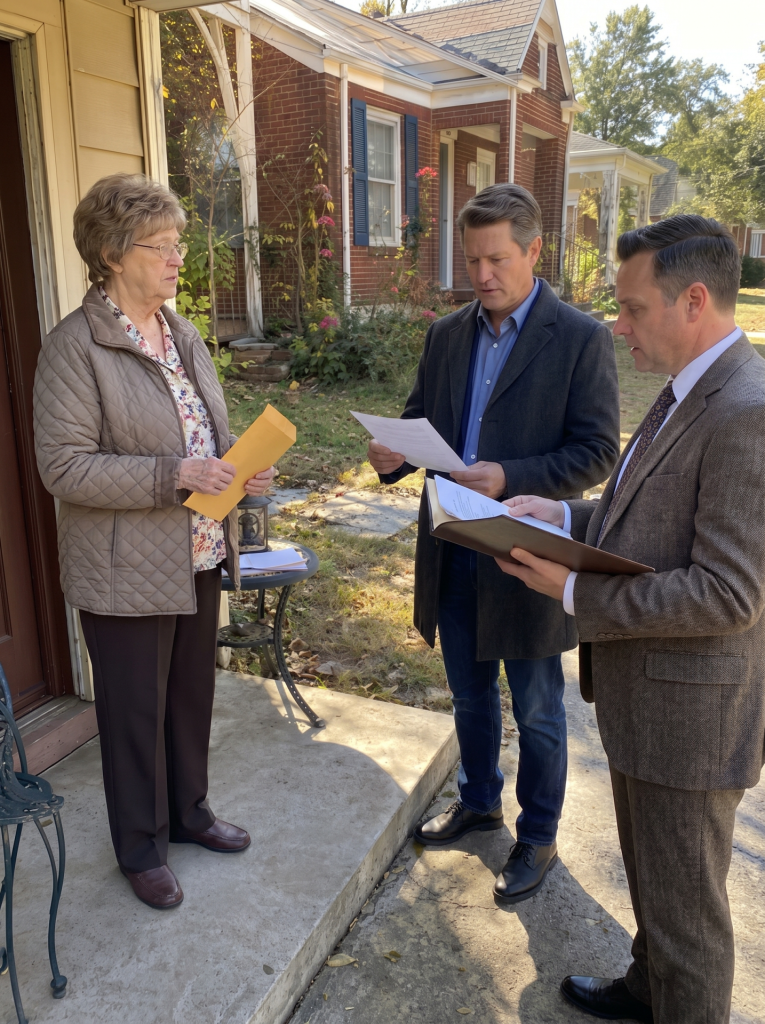
I often thought about the afternoon Ada had handed me that manila envelope two weeks before she died. She’d been sitting outside in her good gray coat when she asked me to join her.
“Sit with me.”
We remained quietly on the porch for several minutes because Ada understood silence better than almost anyone I’d known. Eventually, she went inside and returned carrying the envelope.
“I need you to hold this.”
“What is it?”
“An envelope.”
“Ada.”
She gave me her familiar impatient look.
“Philip will hire a lawyer when he sees the new will.”
“Why would he think I had anything to do with it?”
“Because he won’t want to think his own behavior caused it.”
She instructed me not to open the envelope and to hand it only to whatever attorney Philip brought with him. I still didn’t understand why she was so certain that confrontation would eventually come.
“And if he never comes?”
“Then keep it.”
“What’s inside?”
“What needs to be.”
I told her I wanted no part in a dispute between her and her son.
“You won’t be. The envelope will do the arguing.”
Then Ada leaned back against her chair and sighed.
“I’m tired.”
“Are you all right?”
“I’m not dramatically tired, Helen. I’m eighty-four-years-old tired.”
I laughed, and she smiled. We stayed outside for another hour, neither of us realizing it would become one of our last long conversations.
Only after Ada died did I understand what she’d been doing during those final months. She hadn’t been arranging revenge against Philip or trying to control what everyone did after she was gone; she had simply been placing things where the right people would eventually discover them.
The house. The financial records. Philip’s letter. The water bill. The envelope. The Christmas cards. Even Leonard’s ugly pottery bowl.
That was how Ada loved people.
She remembered things, preserved them, and quietly left them waiting to be found.
She kept evidence of Philip’s financial wrongdoing without publicly humiliating him, then wrote him a letter condemning what he’d done while reminding him that he still had time to become better. She preserved a card from an old love for more than fifty years, kept Leonard’s ridiculous bowl for nearly half a century, and saved the water bill that proved she’d known about my secret kindness all along.
And she left me the peppermint tin.
It sits on my mantel now, and I keep it filled. Whenever someone arrives at my door upset or worried, I offer them one because Ada always believed some problems became slightly easier to carry when there was something sweet in your mouth.
Her bird feeder remains outside the house. Philip fills it whenever he visits, and I take care of it when he doesn’t.
The shutters are still blue.
The preservation society continues restoring the house carefully.
And I continue reading Ada’s Christmas cards one box at a time.
Sometimes I think the greatest thing she left behind wasn’t the house, the inheritance, or even the letter that prevented Philip from challenging her final wishes. It was the realization that the smallest acts of presence can carry more weight than we understand.
A kitchen light coming on every morning. A conversation beside the mailbox. A twenty-nine-dollar water bill quietly paid. A peppermint offered without demanding an explanation. A bird feeder kept full after the person who loved watching the birds is gone.
Philip once summarized it better than I ever could.
“She wasn’t dependent on you. You were just present.”
That sentence has never left me because Ada had been exactly that for me too. We had witnessed each other’s ordinary lives, including the days when absolutely nothing important seemed to happen.
Perhaps that is what being a good neighbor truly means. Not rescuing someone or taking ownership of their problems, but staying close enough to notice when their kitchen light doesn’t come on and knowing when you should knock.
And, just as importantly, knowing when you shouldn’t.
For six years, I believed I had secretly been looking after Ada Holloway.
Only after she was gone did I finally understand the truth.
Ada had been looking after me too.