
My nine-year-old son was lying unconscious on my brother’s bathroom floor, his lips tu:rning blu:e, when my brother looked at him and said something I will never forget.
“He’s just sleeping it off. Stop making such a big deal out of it.”
Forty minutes earlier, that same man had encouraged my little boy to drink four sh0ts of vo0dka while a room full of adults laughed and recorded videos.
My name is Rosalyn. I work as a dental assistant in Kansas City, Missouri, and I’m raising my nine-year-old son, Bastian.
Bastian is small for his age, weighing just sixty-one pounds. He loves football, building elaborate Lego structures, and spending time with his uncle.
Until that Sunday, his uncle Xander was practically his hero.
Xander is my younger brother. At thirty, he still behaves like the loudest teenager in any room. He loves parties, practical jokes, and being the center of attention.
To Bastian, however, he was the coolest person alive.
Every year, Xander hosted a huge Super Bowl party at his house. He had an enormous television, plenty of food, and enough guests to fill his living room.
When Bastian heard about the party, he begged me to take him.
“Please, Mom! Uncle Xander promised I could sit beside him during the whole game!”
I finally agreed.
That afternoon, everything seemed normal. Guests crowded around the television, eating chicken wings and cheering. Bastian sat beside Xander, happily wearing his favorite football jersey.
He looked completely content.
During the third quarter, Xander’s girlfriend asked whether I could help her bring more food from the kitchen.
I agreed, leaving Bastian in the living room with his uncle.
I was away for approximately fifteen minutes.
When I returned, the atmosphere had changed.
Several men were laughing uncontrollably. Others had their phones raised, recording something happening near the coffee table.
Then I saw Bastian.
He was standing unsteadily in the middle of the room. His face was flushed, his eyes looked unfocused, and he seemed unable to keep his balance.
Four empty shot glasses sat on the table.
“What happened?” I demanded.
Xander grinned.
“Your boy wanted to hang out with the grown-ups. He just knocked back four shots!”
I stared at him.
“Four sh0ts of what?”
“Vodka. Relax, Ros. Everybody was having fun.”
For a moment, I couldn’t process what he was telling me.
“He’s nine years old!”
Xander laughed.
“Man up, little dude! Your mom needs to loosen up!”
Several guests joined in.
I grabbed Bastian’s hand and told him we were leaving immediately.
But before we reached the hallway, he stopped.
“Mom, I feel s:ick.”
His voice was unusually slow.
“I need the bathroom.”
He hurried down the hall and locked the door.
I followed and knocked.
“Bastian? Are you okay?”
“I’m okay, Mom.”
Something about his answer frightened me.
I went to collect our coats while Xander continued insisting that four small drinks couldn’t possibly hurt anyone.
When I returned to the bathroom, I knocked again.
“Bastian, sweetheart, open the door.”
There was no answer.
I knocked harder.
Still nothing.
Then I began shouting his name.
Xander’s girlfriend rushed over and managed to unlock the door.
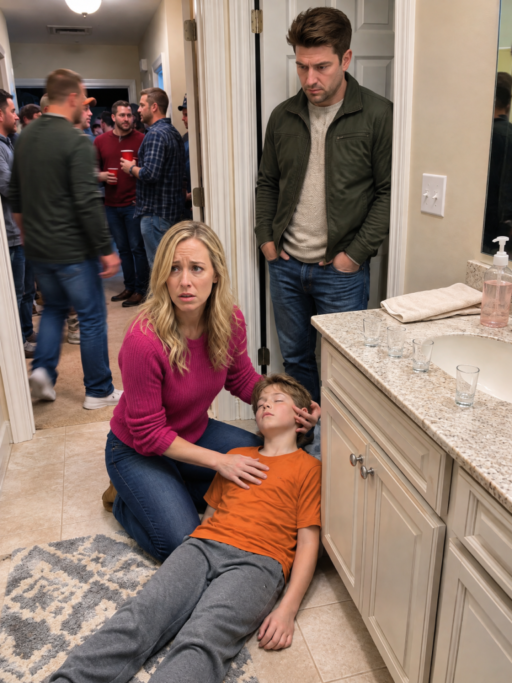
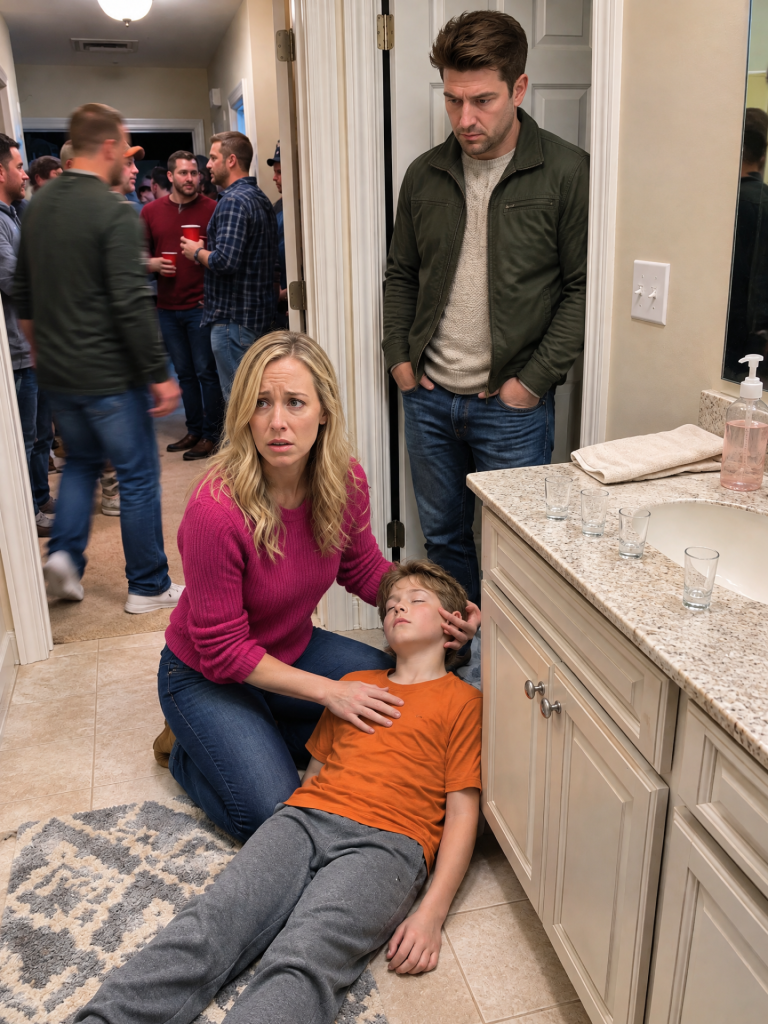
My son was lying motionless beside the toilet.
His face was gray, his lips were blue, and his breathing was frighteningly shallow.
I dropped to my knees.
“Bastian! Baby, wake up!”
He didn’t respond.
Behind me, Xander casually suggested moving him to the couch.
But I knew something was terribly wrong.
And I wasn’t going to let my brother decide what happened next.
“He is not sleeping!” I shouted. “He can barely breathe!”
My brother stood in the bathroom doorway, looking irritated rather than frightened.
“Rosalyn, you’re overreacting. He’s just had too much to drink.”
I couldn’t believe what I was hearing.
My nine-year-old son was unconscious on the floor, and the person responsible was still treating the situation like an amusing party story.
Because of my work as a dental assistant, I receive regular emergency-response training.
I knew that someone who was unconscious after drinking alcohol needed immediate medical attention.
I checked Bastian’s breathing, carefully positioned him on his side, and called 911.
“My son is nine,” I told the dispatcher, struggling to keep my voice steady. “An adult gave him four shots of vodka. He’s unconscious, his lips are blue, and he’s barely breathing.”
The dispatcher instructed me to monitor his breathing and remain beside him until help arrived.
She told me an ambulance was on its way.
I kept one hand near Bastian’s shoulder, watching his chest rise and fall.
Every shallow breath felt like a small miracle.
Behind me, Xander was complaining.
“Seriously? You called an ambulance? Now everybody’s going to think something terrible happened.”
I turned toward him.
“Something terrible did happen. You gave alcohol to a child!”
He rolled his eyes.
“I had beer when I was eight. I survived.”
I didn’t waste another second arguing.
The living room had gone strangely quiet. The television was still showing the game, but nobody was cheering anymore.
Several guests began gathering their belongings.
Only minutes earlier, those same people had been laughing as my son struggled to stand.
Now they wanted to leave before the police arrived.
When the paramedics entered the house, they immediately recognized the seriousness of Bastian’s condition.
They assessed his breathing, provided oxygen, checked his blood sugar, and prepared him for transport.
One paramedic looked directly at me.
“Are you his mother?”
“Yes.”
“You did the right thing calling us. We’re taking him to the hospital now.”
I followed them outside, barely noticing the cold air.
During the ambulance ride, Bastian remained unresponsive. His breathing became dangerously weak, and the medical team had to intervene to support him.
I sat nearby, terrified that I might lose him before we reached the emergency department.
At the hospital, a pediatric physician named Dr. Amara took charge.
Blood tests revealed that Bastian’s blood alcohol concentration was approximately 0.28.
His blood sugar had fallen dangerously low, and his body temperature was dropping.
Dr. Amara explained that children are especially vulnerable to alcohol poisoning because of their smaller bodies and developing systems.