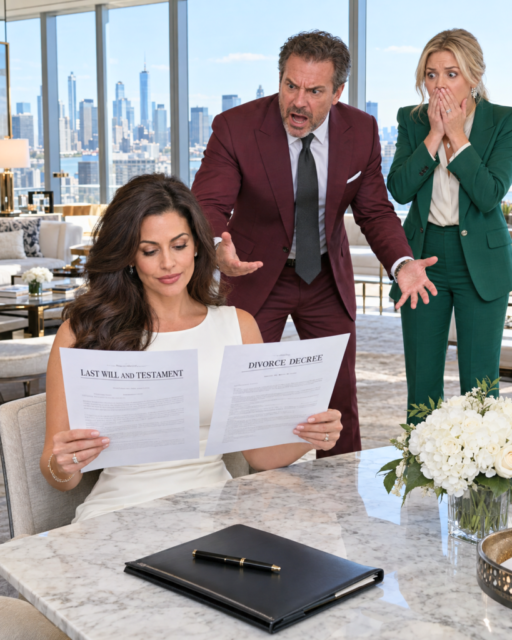
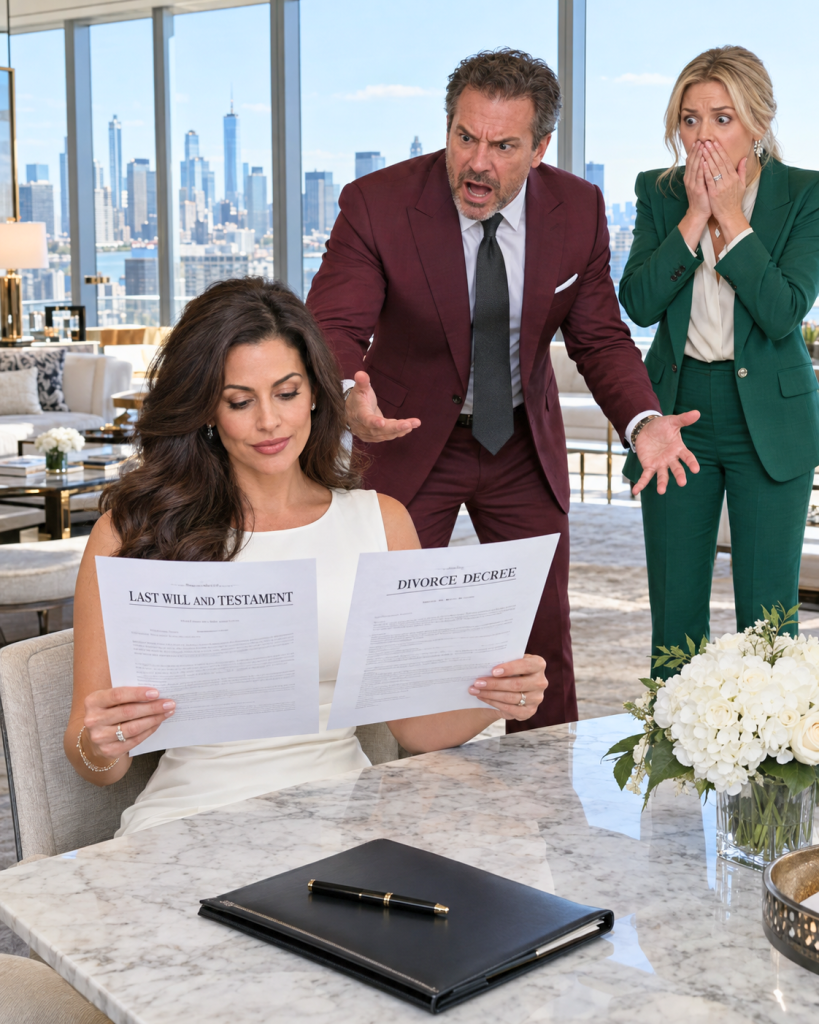

The divorce papers were waiting for me on the kitchen table when I came home from work.
They were arranged beside a handwritten note in my husband’s thick, impatient handwriting, as if our eight-year marriage were nothing more than a package he had decided to send back.
Sign these. Take what belongs to you. You have two hours.
I stood in the doorway with my laptop bag still over one shoulder and stared at the house we had once painted together. We had hosted holidays there, argued there, and talked about filling the spare room with children before life took that possibility from us.
Every light was on.
That was how I knew Owen had not been alone.
The hallway smelled faintly of expensive perfume, sweet and unfamiliar. It lingered over my furniture and made the whole house feel like someone had already begun replacing me.
My phone rang before I could touch the papers.
Owen.
“Did you find them?” he asked.
His voice was almost cheerful. Behind him, a woman laughed softly.
I did not ask who she was.
Lindsay Hale had worked with him at his uncle’s development firm. She wore soft cream sweaters, called cruelty honesty, and had smiled at me in the grocery store two weeks earlier with the strange confidence of someone who already knew the ending.
“I found them,” I said.
“Good. I want this handled cleanly.”
Cleanly.
It was the word men like Owen used when they wanted someone else to clean up the damage they had caused.
“You gave me two hours.”
“You do not need more than that.” He paused. “Most of the furniture belongs to my family, and the house will be mine once probate clears. Grandma’s estate is moving forward, and I cannot have complications.”
There it was.
Not love.
Not regret.
Money.
Beatrice Merritt, Owen’s grandmother, had died six weeks earlier. She had been elegant, sharp-tongued, and almost impossible to impress, yet she had treated me with more warmth than the rest of Owen’s family combined.
She remembered that I hated coconut cake. She sent soup when I had the flu. After Owen ignored me through an entire Christmas dinner, she pulled me aside and said something I had never forgotten.
“Clara, never make yourself smaller so a selfish man can feel tall.”
At the time, I thought she was giving me advice.
Standing in my hallway with divorce papers on the table, I began to wonder if she had been trying to warn me.
“Do not make this uglier than it needs to be,” Owen continued. “Lindsay is pregnant, and I need to build a stable life before the baby arrives.”
For a moment, I could not speak.
Not because I still loved him enough for the betrayal to destroy me. Love had been fading for a long time.
But betrayal always knows exactly where to press.
“You are telling me this over the phone?” I asked.
“I did not want a scene.”
I heard Lindsay say something in the background. Owen lowered the phone as if I was already no longer entitled to hear what happened in the life he had built behind my back.
“Sign the papers, Clara,” he said. “Leave the keys on the counter.”
Then he hung up.
I did not sign anything.
Instead, I opened my purse and found the business card Beatrice had tucked inside months earlier. She had written a name on the back in blue ink.
Martin Wells. Call him if you ever need to.
Martin had handled Beatrice’s estate planning for more than twenty years. When he answered, I told him about the divorce papers, Owen’s demand, and the two-hour deadline.
He listened without interrupting.
Then he said, “Do not leave the house permanently. Bring those papers to my office tomorrow morning, and do not speak with Owen alone again.”
My hand tightened around the phone.
“Why?”
There was a pause.
Long enough to make fear rise in my chest.
“Because,” Martin said, “Beatrice anticipated something like this.”
Martin Wells’s office occupied the ninth floor of an old building in downtown Minneapolis. Dark shelves lined the walls, rain streaked the windows, and every surface seemed designed to make people speak more carefully.
Martin read Owen’s note first.
Then he read the divorce papers.
Finally, he opened a thick folder marked with Beatrice Merritt’s name.
“Your husband believes the estate belongs to him,” he said.
“He said the house would be his after probate.”
Martin looked at me over his glasses.
“Then he either failed to read the will, or he assumed you never would.”
He slid a page across his desk.
At first, the language looked like ordinary legal wording—formal, dense, and impossible to absorb in one glance. But one paragraph had been highlighted in yellow.
I read it once.
Then again.
Owen would receive the primary estate only if he remained legally married to his current spouse for ninety days after probate opened. If he initiated divorce, abandoned the marital residence, forced his spouse out, hid marital property, or tried to create a false separation before that period ended, the inheritance would transfer to an alternate beneficiary.
My throat went dry.
“Who is the alternate beneficiary?”
Martin turned the page.
My full name appeared beneath the clause.
Clara Whitman Merritt.
For several seconds, I could not speak.
“Beatrice left it to me?”
“Only if Owen violated the conditions,” Martin said. “Based on the note, the prepared papers, and his demand that you leave your home within two hours, he has likely done exactly that.”
A stunned laugh escaped me.
“He did not read the will.”
“Or he read enough of it to panic.”
I thought about Owen’s confidence on the phone. Lindsay’s laughter. The way he had spoken as though I were an inconvenience standing between him and a fortune.
Beatrice had known her grandson.
Maybe better than anyone else.
“Do not sign anything else,” Martin said. “Do not move out. Preserve every text, note, receipt, and recording. Owen may try to claim you left voluntarily or pressure you into confirming a separation.”
That evening, I returned to the house.
Not because I wanted to sleep beneath a roof where my husband had planned my removal, but because Martin made it clear that it was still my legal home.
The scent of Lindsay’s perfume still hung in the hallway.
Using evidence sleeves Martin had given me, I preserved Owen’s note and photographed every room. I filmed empty drawers, missing photographs, and a wineglass near the sink marked with lipstick I did not wear.
Then I found a receipt from a jewelry store beneath a pile of mail.