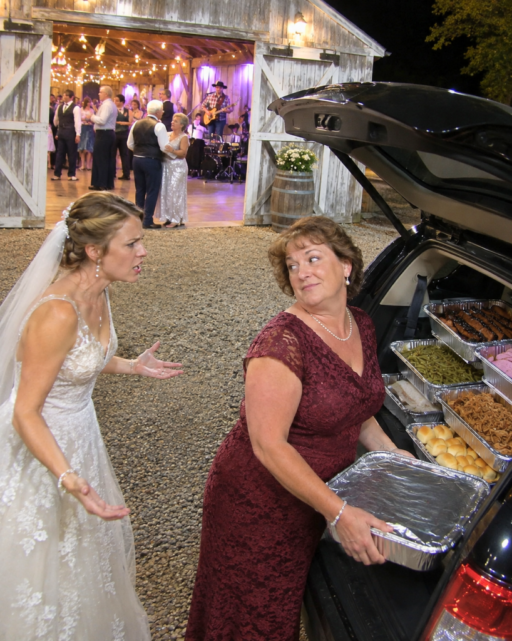
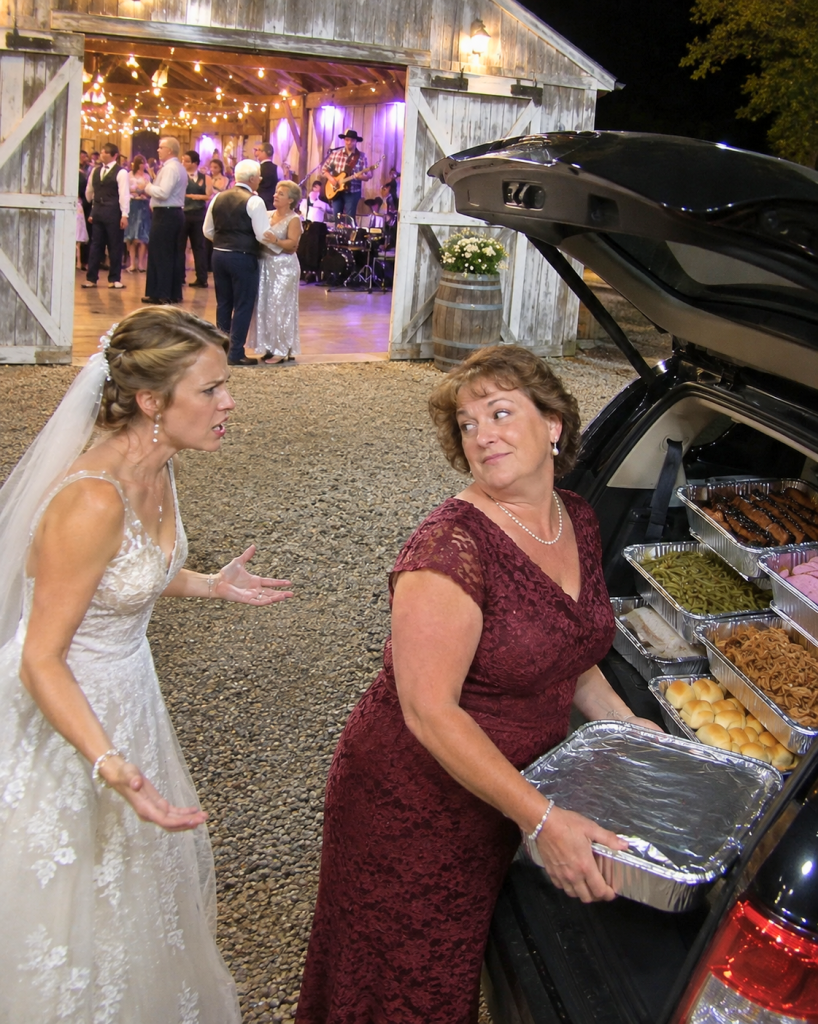

“They’re getting paid, sweetheart. They can buy their own dinner.”
My husband’s aunt, Verlene, casually dismissed my concerns as she loaded another enormous tray of smoked brisket into her silver Chevrolet Tahoe. My mother had spent three days preparing our wedding supper, and now nearly everything remaining was disappearing into the back of that vehicle.
It was 9:15 on a warm June evening outside the Pawnee Creek Community Building in Oklahoma. Inside, my parents were dancing together, completely unaware of what was happening in the parking lot.
My name is Josie Calloway. I’m twenty-four, and I had married Reed Calloway, a twenty-six-year-old welder, just six hours earlier.
My mother, Bonnie Lambert, had managed the kitchen at our local elementary school for twenty-six years. My father, Wendell, delivered propane for a living, and together they had spent their entire savings of $11,200 on our wedding.
Since we couldn’t afford professional catering, Mom insisted on preparing the reception meal herself. With help from my aunts and several women from the local Homemakers Club, she spent three days working in the kitchen at First Baptist Church.
She smoked brisket overnight, prepared two hams, and made enormous trays of pulled pork, green beans, potato salad, and macaroni and cheese. She even baked four hundred homemade dinner rolls.
When I suggested buying rolls from Walmart to save her some trouble, she refused.
“People can taste the difference, honey.”
Now, six or seven large trays of that carefully prepared food were sitting inside Verlene’s Tahoe.
“What are you doing?” I asked.
“Putting everything somewhere cooler before it spoils.”
I knew that wasn’t true. The food had been properly arranged in warming dishes inside the reception hall.
“The musicians haven’t eaten yet. Neither have Mateo and Brody.”
The two teenage boys had been setting up chairs, clearing tables, and carrying dirty dishes since three that afternoon. My father was paying them fifty dollars each, but neither had managed to sit down for supper.
Verlene shrugged and reached for my mother’s homemade rolls.
I glanced through the reception doors and saw Mom resting her head against Dad’s shoulder as they danced. After three exhausting days, she was finally enjoying a moment for herself.
I wasn’t going to ruin it.
Without raising my voice, I reached into the Tahoe and retrieved the brisket.
“Excuse me! What do you think you’re doing?” Verlene protested.
“Making sure the people working at our wedding get something to eat.”
Still wearing my wedding dress and stocking feet, I carried the heavy tray across the gravel parking lot toward the musicians’ blue Ford truck.
All five band members stared when I placed the brisket on their tailgate.
“We don’t want to inconvenience you, ma’am,” their young bassist said. “We can find somewhere to eat afterward.”
“My mother made this food to feed people. Please help yourselves.”
Just then, I heard familiar footsteps approaching.
Reed stood beneath the string lights, studying the open Tahoe, the trays of food, and the grease stains on my wedding dress.
His expression wasn’t one of surprise. It was recognition.
As he approached his aunt, I realized he had witnessed something like this before.
And what he was about to reveal would make me question everything I thought I knew about Verlene.
Reed stopped beside Verlene’s Tahoe and examined the trays stacked inside. His aunt still had one hand resting on the homemade dinner rolls.
“Grandma isn’t here to stop you anymore, Aunt Vee. So I’m going to.”
Verlene immediately withdrew her hand.
“Reed, sweetheart, I was only trying to keep everything from spoiling.”
“You did this at every reunion, every Christmas, and every funeral. I was ten when Dad died, and I remember Grandma making you unload the food you’d taken from his funeral.”
I stood beside the musicians’ truck, stunned by what I was hearing.
“Grandma’s been gone for two years,” Reed continued. “This is my wife’s mother’s cooking, and people are still waiting to eat. Put everything back.”
Verlene insisted that she intended to return the food the following morning. Instead of arguing, Reed reached into the Tahoe and retrieved the ham.
Together, we carried every tray across the parking lot. Verlene watched silently as we emptied her vehicle, recovering even a large pan of macaroni and cheese I hadn’t noticed earlier.
Reed went inside and returned with paper plates, plastic forks, and the two teenage boys who had been clearing tables.
“Mateo, Brody, take a break and eat.”
Mateo looked uncertain.
“Are you sure, Mrs. Calloway?”
It was the first time anyone had addressed me by my married name.
“Absolutely. Help yourself.”
Brody ate four dinner rolls, while Mateo quietly slipped two into his pocket. When he noticed me looking, his cheeks turned red.
“They’re for my little sisters. They really like bread.”
I wrapped a dozen rolls in paper towels and handed them to him.
Soon, my aunts and several women from the Homemakers Club joined us. They had spent the entire reception serving guests and washing dishes without eating anything themselves.
Across the parking lot, Verlene stood beside her empty Tahoe. Reed approached her and attempted to speak privately, but she brushed his hand away, closed the hatch, and drove home.
When the musicians returned to the stage, their lead singer, Sonny, addressed the wedding guests.
“We’ve performed at hundreds of weddings, but hardly anyone remembers to feed the band. Tonight, we enjoyed some of the finest brisket we’ve ever tasted.”
He located my mother near the cake table and dedicated their next song to her.
Amos, their elderly fiddle player, began playing “Amarillo by Morning.” Dad took Mom’s hand, and the guests cleared the dance floor so they could dance together.
Standing beside Reed in my stained wedding dress, I couldn’t stop crying.
Later that night, inside our modest hotel room in Tulsa, Reed explained that Verlene had been taking food from family gatherings for as long as he could remember.
Nobody had ever seriously questioned her behavior. His grandmother would simply instruct her to return everything, and the family would laugh it off.
“I always wondered what she’d do when Grandma wasn’t around anymore,” he admitted.
He reached for my hand and told me how proud he had been when he saw me carrying that brisket toward the musicians.
Neither of us realized that his grandmother’s behavior concealed a secret of its own.