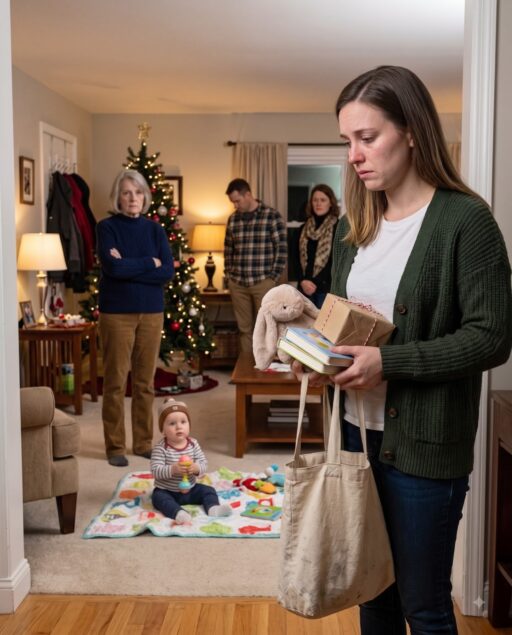
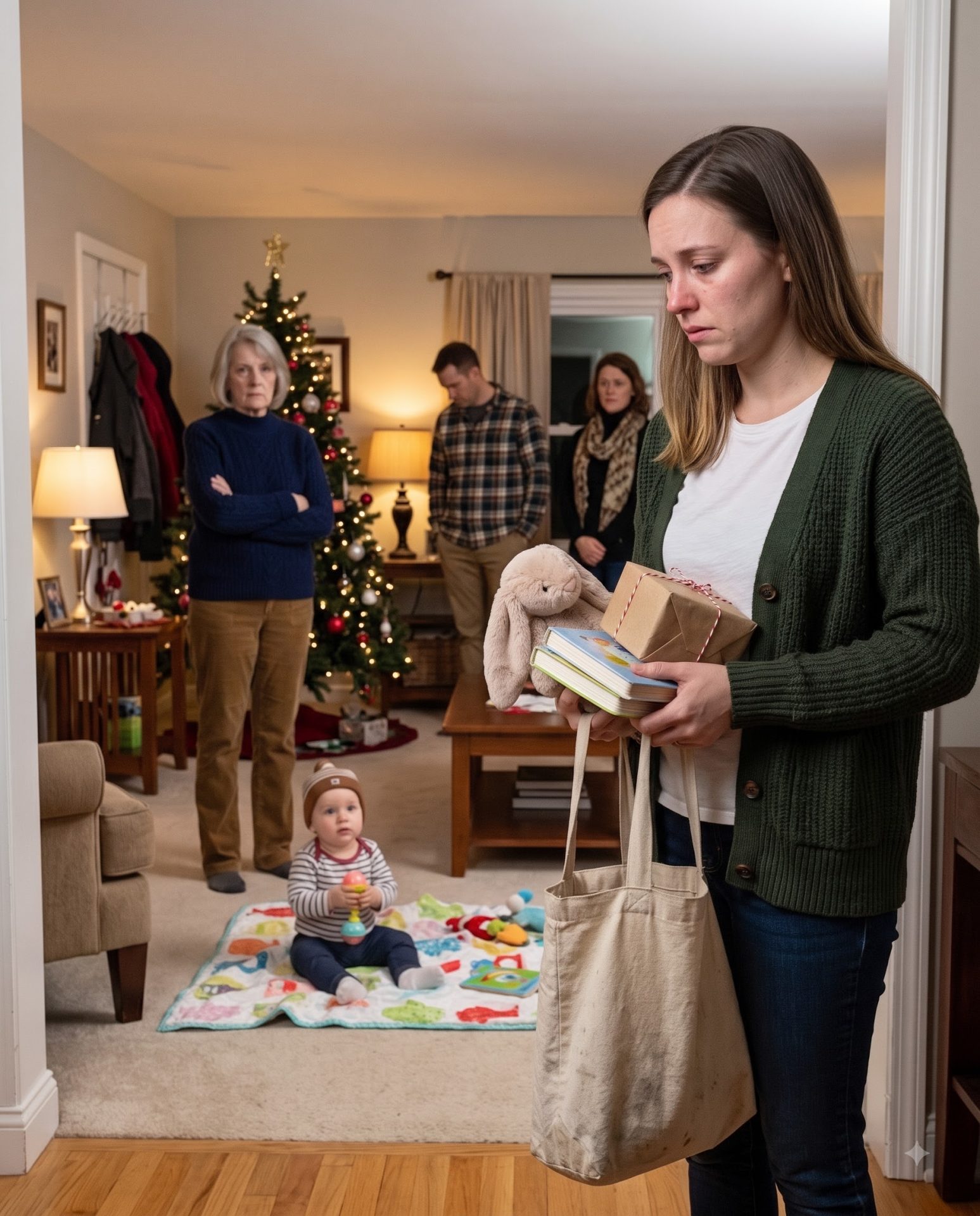

I stopped explaining. Anyone who defended Margaret without knowing what she had done received the same response: Lily and I were safe, we would not return, and I would discuss the matter only after Christmas.
Hannah stayed on the couch while I put Lily to bed. When I returned, she admitted that our mother had spent years teaching us that disagreement was cruelty whenever she was the person being challenged.
“I knew the letter was wrong,” Hannah said. “But I promised not to tell you because I was afraid she would turn on me next.”
“She turned on you anyway.”
“I know.”
At nine that evening, someone tried to unlock my front door. The deadbolt shifted once, then stopped because I had secured the interior chain.
Margaret called my name from the hallway. She said she had come to check on Lily and demanded that I open the door.
Hannah stood beside me and asked our mother to leave. Margaret responded that I was too emotional to be alone with a baby after “destroying Christmas.”
“You sent her ex-husband a key,” Hannah said through the closed door. “You told him you could enter the apartment.”
“I was offering to help.”
“You copied my key without permission.”
Margaret became quiet for several seconds. Then she pushed the door again, making the chain tighten against the frame.
I called the building’s security desk. The guard arrived and informed her that she was not permitted inside my apartment and would have to leave the property.
Margaret finally stepped away from the door, but she did not apologize. She warned that refusing a welfare check would only make me look as though I had something to hide.
“This is not a welfare check,” I said. “You are not a doctor, a social worker or Lily’s parent.”
“You can keep me outside tonight,” she replied. “You cannot stop people from asking questions.”
The elevator doors closed behind her. Hannah sat at my kitchen table afterward and began crying, but I remained focused on practical decisions.
We photographed the lock and saved the hallway camera footage. I also emailed Daniel the letter and asked him to preserve every message Margaret had sent.
The next morning, the locksmith replaced the cylinder and documented that Margaret’s copied key opened the old lock. I changed my banking, email and medical-portal passwords, then called Lily’s pediatric clinic.
I asked them to note that only Daniel and I could receive information or change appointments. The receptionist became silent after checking Lily’s account.
Someone had called the clinic four days earlier claiming to be an authorized caregiver. The caller asked for Lily’s appointment history and tried to move the January evaluation to an earlier date.
The staff had refused because the person was not listed on the consent form. However, she left a name and telephone number when requesting a callback.
It was Margaret.
Before ending the call, the receptionist mentioned something else. My mother had not simply asked for appointment information.
“She said she was gathering records for a custody concern,” the woman explained. “And she gave us the name of an attorney who supposedly represented Lily’s father.”
Daniel answered my call immediately. When I repeated the attorney’s name, he went quiet.
“That lawyer does not represent me,” he said. “But I know exactly who she is.”
“Who?”
“She represented your mother during a private consultation three weeks before Christmas.”
Daniel recognized the attorney because Margaret had mentioned her during one of their calls. He contacted the office only to clarify that she did not represent him and had no permission to use his name regarding Lily.
The attorney could not reveal confidential advice given to Margaret. She did confirm in writing that her office did not represent Daniel, Lily or me and had never been authorized to request medical information.
I scheduled a consultation with my own family-law attorney and brought the letter, Margaret’s messages, the copied key and the hallway recording. She explained that my mother’s document had no authority over Lily’s custody and contained no professional evidence that I was an unsafe parent.
Still, the pattern mattered. My attorney advised Daniel and me to preserve everything, keep medical access restricted and communicate clearly about who could care for Lily during either parent’s time.
Daniel and I added that agreement to our parenting plan voluntarily. Our marriage had ended, but neither of us was willing to let Margaret use the divorce to place herself between us.
Lily attended her scheduled developmental evaluation on January 8. Daniel came with me, and the specialist found that she was progressing within an acceptable range, although she recommended simple exercises to strengthen the muscles that helped Lily sit independently.
There was no alarming diagnosis and no evidence that I had ignored her needs. More importantly, the appointment reminded me that asking a qualified professional was responsible parenting—not proof that my mother deserved control.
Margaret did not accept the boundary gracefully. Her first messages accused me of poisoning Daniel against her and using Lily as punishment for an argument.
She told relatives I had banned her because she expressed concern. She omitted the staged Christmas gift, the private screenshots, the letter, the copied key and her attempt to obtain medical records.
Some family members believed her. Others asked what had really happened, and I sent them one brief explanation without beginning another campaign against my mother.
Hannah and Aunt Susan supported me openly. Anyone who pressured me to “move on” received the same answer: contact with Lily would resume only if Margaret acknowledged what she had done and demonstrated that she could respect our boundaries.
Three months passed before her messages changed. She finally admitted that excluding Lily from the photograph was cruel and that presenting parenting books in front of the family had been designed to embarrass me.
She also acknowledged reading my messages, copying the key and contacting Daniel because she believed she knew what was best. Her apology did not erase those decisions, but it was the first one that did not blame my reaction.
I did not invite her back immediately. We began with several conversations in a counselor’s office, where Margaret had to listen without calling my boundaries dramatic or describing her control as love.
Her first supervised visit with Lily happened almost six months later at a public park. It lasted one hour, and Margaret was not permitted to discuss medical concerns, custody or my divorce.
Rebuilding trust was slow and incomplete. I no longer confused access to my daughter with a grandmother’s automatic right, and Margaret learned that every visit depended on how she behaved rather than how guilty she could make me feel.
The following Christmas, I celebrated in my apartment with Lily, Hannah and Aunt Susan. Our tree was smaller than Margaret’s, dinner came from mismatched dishes, and no one arranged the room to impress a photographer.
Lily was twenty months old and had recently begun walking with determined, unsteady steps. She carried the worn stuffed bunny Hannah had given her the previous year and repeatedly dropped it beneath the tree.
After dinner, Hannah placed her phone on a shelf and set the timer for a family photograph. Lily stood between us, one hand gripping my dress and the other holding her bunny by an ear.
No one moved her aside. No one compared her with another child or asked us to wait until we discovered what was “wrong” with her.
Just before the camera flashed, Lily looked up at me and laughed. The photograph captured my eyes closed, Hannah leaning sideways and Aunt Susan reaching to keep a serving bowl from falling.
It was imperfect and completely honest. Margaret had wanted one proper family picture without my daughter, but a year later, I finally understood that Lily had never been the person who did not belong.
She was the reason I stopped standing in rooms where love came with humiliation. She was also the reason I learned that protecting peace did not mean staying silent—it meant choosing which people were allowed inside it.