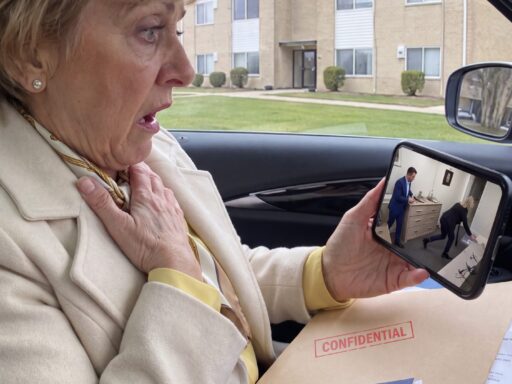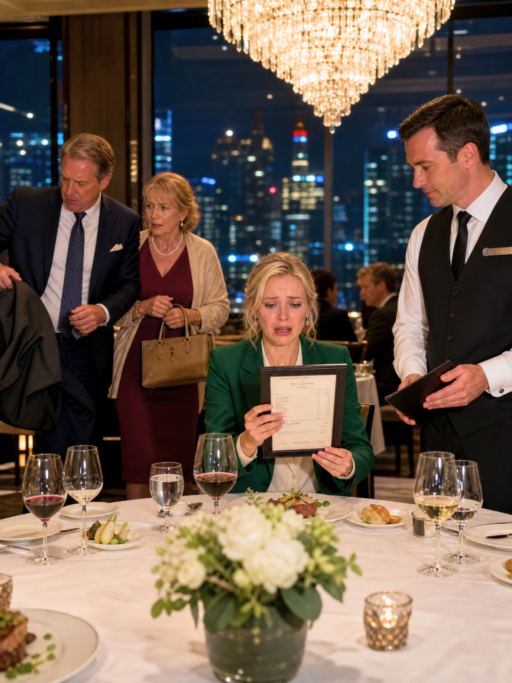
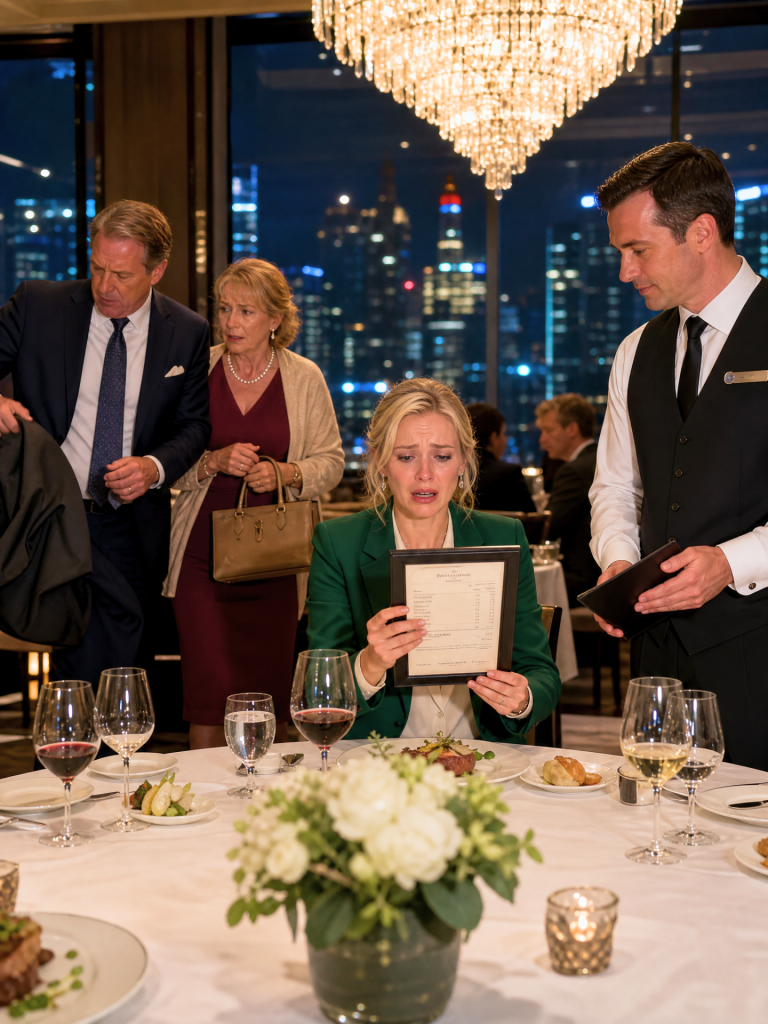

The leather folder containing the check sat in the center of the table as though it had been placed there for a ceremony.
$12,486.72.
I read the total once, then twice, then a third time. Sometimes, when something is too absurd to accept, your mind assumes the number must be wrong. But the total did not change.
Around me, the private dining room at Lucille’s was nearly empty. Fourteen chairs stood pushed back from the polished table, half-finished glasses of wine were scattered beneath the chandelier, and a pianist near the bar continued playing softly as if nothing unusual had happened. Twenty minutes earlier, my father had been sitting at the head of that table, celebrating his sixtieth birthday with our relatives.
At the beginning of dinner, he had raised his glass and smiled.
“Tonight, nobody looks at the prices.”
Everyone had laughed. Now I understood why.
My phone buzzed beside my plate. In the family group chat, my sister Madison had posted a picture from the parking lot: Dad with an arm around Mom, our aunt laughing beside them, and Madison grinning behind his shoulder. Her caption read, GOOD LUCK, AVA.
Then my father added, Let’s see how our independent little failure figures out how to pay.
My mother followed with, Don’t be dramatic. It’s only a joke. You’re always saying you don’t need us.
I turned my phone face down. Strangely, I was not angry yet. What I felt was clarity—the kind that arrives when a blurry picture suddenly becomes sharp.
My name is Ava Carter, and according to my family, I have been a disappointment for approximately twelve years. My father, Richard Carter, found ways to say it without always using the same word. At holidays, birthdays, business events, and family dinners, I was the daughter who chose finance instead of joining his construction company.
Dad built Carter Development from almost nothing into a respectable regional business. He was proud of that achievement, and he had every reason to be. But somewhere along the way, the company stopped being something he ran and became the only definition of success he accepted.
My sister joined Carter Development after college. Her titles became more impressive every few years, while Dad paid for her car and approved her expenses without looking too closely. At family dinners, Madison told stories about clients and projects, and Dad listened as though she were carrying the future of the company.
I chose a different path. I became a restructuring specialist, working with distressed commercial businesses whose debt, cash flow, and assets had become too complicated for ordinary solutions. By thirty-two, I was a director responsible for hundreds of millions of dollars in troubled assets, but Dad still introduced me to people by laughing, “She does something with spreadsheets from home.”
Eventually, I stopped correcting him.
When I bought my first property, he said I had chosen the wrong neighborhood. When I became a partner, he asked when I planned to find a real executive role. The year my income exceeded Carter Development’s annual profit, I told him nothing because I knew there was no version of that conversation that would make him see me differently.
Still, I showed up whenever my family needed help. I reviewed contracts, covered Madison’s rent after a careless vacation, and handled Mom’s frozen credit card while she was stranded in Florence. I had grown up believing that being needed meant being loved.
Then a waiter named Daniel approached my table.
“My family left,” I told him.
He looked sympathetic, but not surprised.
“Did they say anything before leaving?” I asked.
Daniel hesitated.
“Your father told the host you would be paying the bill.”
“Before they walked out?”
“Yes.”
“How long before?”
His answer made everything clear.
“Before dinner started.”
Daniel’s answer changed the entire night. My father had not decided to abandon me with the bill after too much wine or a family argument. He had planned it before we ordered, before he made his cheerful speech about prices, and before anyone arrived in the private room.
He wanted me to panic.
I studied the check again. Two bottles of wine costing more than a thousand dollars each, champagne I had not ordered, caviar, steaks, desserts, and sides selected with the confidence of people certain someone else would cover the cost. They had designed the dinner around an image of my financial helplessness, then waited to see whether I would beg to be rescued.
“May I speak with the manager?” I asked Daniel.
A few minutes later, Rebecca Shaw joined me at the table. She listened calmly while I explained that my family had left, that my father had placed the reservation, and that I had never agreed to become responsible for the bill. I asked whose name appeared on the booking.
“Richard Carter,” she said.
“Whose card was provided when the reservation was made?”
“Mr. Carter’s.”
“Did I sign anything accepting responsibility for the event?”
“No.”
Rebecca reviewed the restaurant’s records more closely. The confirmation included Dad’s signature, phone number, credit-card authorization, and deposit for the private room. I pushed the leather folder toward her and explained that I was not refusing to pay something I owed; I was simply refusing to accept a debt that did not belong to me.
She nodded. “Please give me a few minutes.”
While she was gone, my phone continued lighting up. Madison wrote, You better not call Dad, followed by a laughing emoji. Mom messaged, Please do not embarrass everyone by making a scene, and Dad sent only three words: Consider it motivation.
That message nearly made me laugh.
For years, Dad had claimed I was too comfortable, too independent, and too unwilling to admit that I needed my family. He probably imagined me calling from the restaurant in tears, asking how I could possibly pay twelve thousand dollars. Then he could swoop in, settle the bill, and restore the hierarchy he believed existed between us.
But Dad had misunderstood me for a very long time.
Rebecca returned with a composed smile. “The remaining balance has been charged to the card connected to the reservation.”
I thanked her. She apologized for the situation, but I told her it was not her fault. Then I went home, took off my earrings, placed my phone on silent, opened my laptop, and made a decision.
I was not going to punish anyone. I was not going to start a fight or explain myself in the family chat.
I was simply going to stop.
Three years earlier, Carter Development had come dangerously close to collapse. My father had taken on two major commercial projects at once, then faced supply delays, rising costs, and a client who sharply reduced its commitment after contracts were signed. The company’s debt agreements were threatened, and the bank was preparing to demand repayment.
For the first time, Dad called me not as his daughter, but as a businessman who needed help. I connected him with independent counsel and investors, but there was one obstacle neither of them could solve without creating another burden.
Carter Development owned valuable industrial land where its headquarters operated. The best solution was to sell the property and lease it back, giving the company cash without interrupting operations.
So I bought it.
Through an entity called Northbridge Holdings, I purchased the property and leased it back to Dad’s company at $28,500 a month—far below market rent, with flexible terms during slow quarters.
Dad’s lawyer approved the arrangement. Dad never asked who owned Northbridge.
The next morning, I called the property manager.
“From now on,” I said, “Carter Development will be treated exactly like every other tenant.”
I did not raise Carter Development’s rent. I did not cancel the lease, evict anyone, or change a single sentence of the agreement my father’s lawyer had reviewed three years earlier. I simply removed the favors they had never known existed: no more unofficial extensions, no more calls answered because someone knew my name, and no more invisible protection whenever the company fell behind.
Then I returned to work.
Tuesday passed without incident. On Wednesday morning, I stepped out of a client meeting and checked my phone. There were thirty-five missed calls from Dad, Mom, Madison, and my uncle Peter.
The first message from Mom read: AVA, PLEASE CALL YOUR FATHER.