
“Caleb, I’m more grateful than I can possibly explain, but we need to talk about what happened this year.”
He looked up from the scholarship letters, and his expression immediately became serious. I reached across the table and took his hand, wanting him to know that I wasn’t angry about his desire to help me.
“I never wanted you to make yourself sick trying to take care of me. Your health and education should never have been put at risk because you were worried about my finances.”
Caleb lowered his eyes and admitted that he’d known I would object to his working so many hours. He explained that seeing me exhausted after long workdays had made him feel helpless, especially after overhearing my conversation with Aunt Linda.
“I just hated seeing you so tired, Mom. I wanted to do something that would make your life easier.”
I understood his intentions, but I needed him to recognize the difference between caring about someone and assuming responsibility for their entire life. He was my son, and I wanted him to experience the freedom to study, spend time with friends, and discover what kind of future he wanted.
“Your responsibility was to be my son, Caleb. You were never supposed to carry the responsibility of being my parent.”
His eyes filled with tears, and he admitted that he’d been afraid of disappointing me if he couldn’t solve our financial problems. I reminded him that his worth had never depended on how much money he earned or how many sacrifices he made.
I also explained that although my disability had changed how I managed everyday tasks, it hadn’t taken away my ability to make decisions about my own life. If I needed assistance, I could ask for it, just as he needed to tell me when he was struggling.
“I’m still your mother, sweetheart. I can make decisions about my own future, and you don’t have to protect me by keeping important things secret.”
Caleb nodded slowly, acknowledging that he’d handled the situation poorly. He admitted that he should have told me about his declining grades, excessive work hours, and the warnings he’d received from his teachers.
“I’m sorry I kept everything from you. I thought I was helping, but I understand why you’re upset.”
I assured him that I forgave him and appreciated the love behind his actions. Nevertheless, I made him promise that we would communicate honestly whenever either of us faced a problem that seemed too difficult to manage alone.
“No more hiding things like this, Caleb. Whatever happens, we’ll talk about it together.”
He smiled and agreed, visibly relieved that our conversation hadn’t damaged our relationship. We returned to the scholarship letters, and for the next hour, we compared universities and discussed the opportunities each one offered.
One particular college seemed especially appealing because of its academic programs and the generous scholarship package. However, I noticed that Caleb kept setting its letter aside whenever we discussed the distance between the university and our home.
“Caleb, is this the school you really want to attend?”
He hesitated before admitting that it was one of his favorite choices. When I asked why he seemed reluctant, he confessed that he was worried about moving so far away and leaving me alone.
“I want to go there, Mom, but I don’t know how you’ll manage without me.”
His answer made me realize that even after everything we’d discussed, he still felt responsible for my well-being. I gently pushed the letter back toward him and reminded him that I’d spent years learning to live independently.
“Then don’t turn down an opportunity you want because you’re worried about leaving me. I want you to choose the future that’s right for you.”
Caleb studied the letter again, and I saw his uncertainty begin to fade. For the first time that evening, he seemed to be considering college as an exciting opportunity rather than another responsibility he needed to manage.
As we continued comparing his scholarship offers, I realized that helping Caleb move forward would require one more important change: teaching him that he could love me deeply without being afraid to build a life of his own.
In the weeks following graduation, Caleb and I continued discussing his college options, carefully comparing the opportunities offered by the twenty universities that had awarded him full scholarships. Although we still had important decisions to make, the fear that had surrounded his education for years had finally begun to fade.
I wanted him to choose a university because it offered the education and experiences he genuinely wanted. After everything he’d endured during his senior year, I was determined that his next chapter wouldn’t be shaped by guilt or anxiety about leaving me behind.
One evening, Caleb returned to the kitchen table with several scholarship letters and asked whether I was certain he should consider schools far from home. I could tell that he was still struggling with the idea of moving away, even though some of his most promising opportunities were located in other cities.
“Mom, I know you said you’d be fine, but what if something happens and I’m not here to help?”
I reminded him that I’d been managing my disability for years and that I had people I could contact whenever I needed assistance. His concern came from love, but I didn’t want him to confuse caring about me with being responsible for every challenge I might face.
“Caleb, I want you to build a life you’re excited about. You don’t have to stay close to home just because you’re worried about me.”
He listened quietly before admitting that leaving would feel strange after everything we’d experienced together. Since Daniel had abandoned our family, Caleb and I had depended heavily on one another, and the idea of living apart represented a major change for both of us.
I understood his feelings because I would miss him terribly. Nevertheless, watching him become independent was something I’d hoped for since he was a little boy sitting beside my hospital bed with his homemade paper airplanes.
Our circumstances hadn’t suddenly become perfect after graduation. I still worked remotely managing customer accounts, and we continued watching our expenses carefully because financial stability required planning and discipline.
However, knowing that Caleb could attend college without overwhelming educational debt changed how I viewed our future. For the first time in years, I could imagine making decisions about my own life without constantly calculating how much money his education might require.
I also began thinking differently about the sacrifices I’d made while raising him. I’d always considered them part of being his mother, but his graduation speech helped me understand how closely he’d watched my efforts and how deeply they’d influenced him.
At the same time, I wished he’d never believed he needed to repay those sacrifices. His success and happiness were enough for me, and I wanted him to understand that he didn’t owe me his health, freedom, or future.
Last weekend, we went out for breakfast together, enjoying a quiet morning without rushing to school or work. We talked about college, his friends, and the possibilities ahead, and I noticed how much more relaxed he seemed now that graduation was behind him.
When we finished eating and approached the restaurant exit, Caleb instinctively reached for the handles of my wheelchair. He’d developed that habit over the years, always wanting to make things easier whenever we went somewhere together.
“I’ve got you, Mom.”
I smiled and gently stopped him, reminding him that I was perfectly capable of moving my wheelchair myself. He stepped beside me instead, accepting that I didn’t always need assistance simply because he wanted to provide it.
“I can manage, sweetheart.”
“I know, Mom.”
That brief exchange meant more to me than he probably realized. Caleb had spent so much of his childhood worrying about how to help me that I wanted him to become comfortable allowing me to do things independently.
We continued toward the exit together, talking about ordinary things as we always had. Yet I couldn’t stop thinking about how much our relationship had changed since the day he carried me onto the graduation stage.
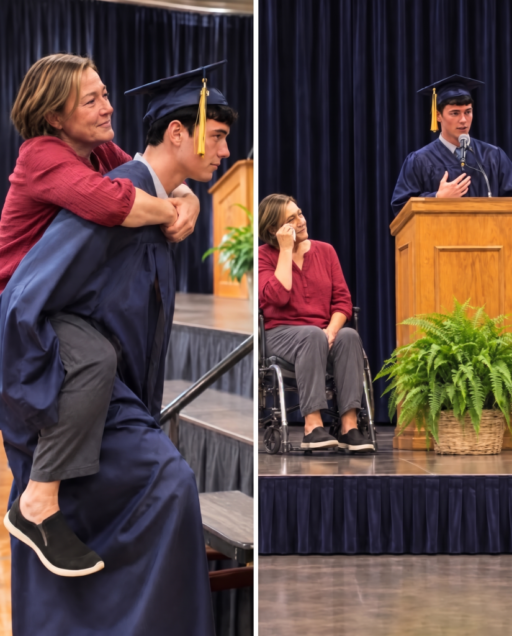
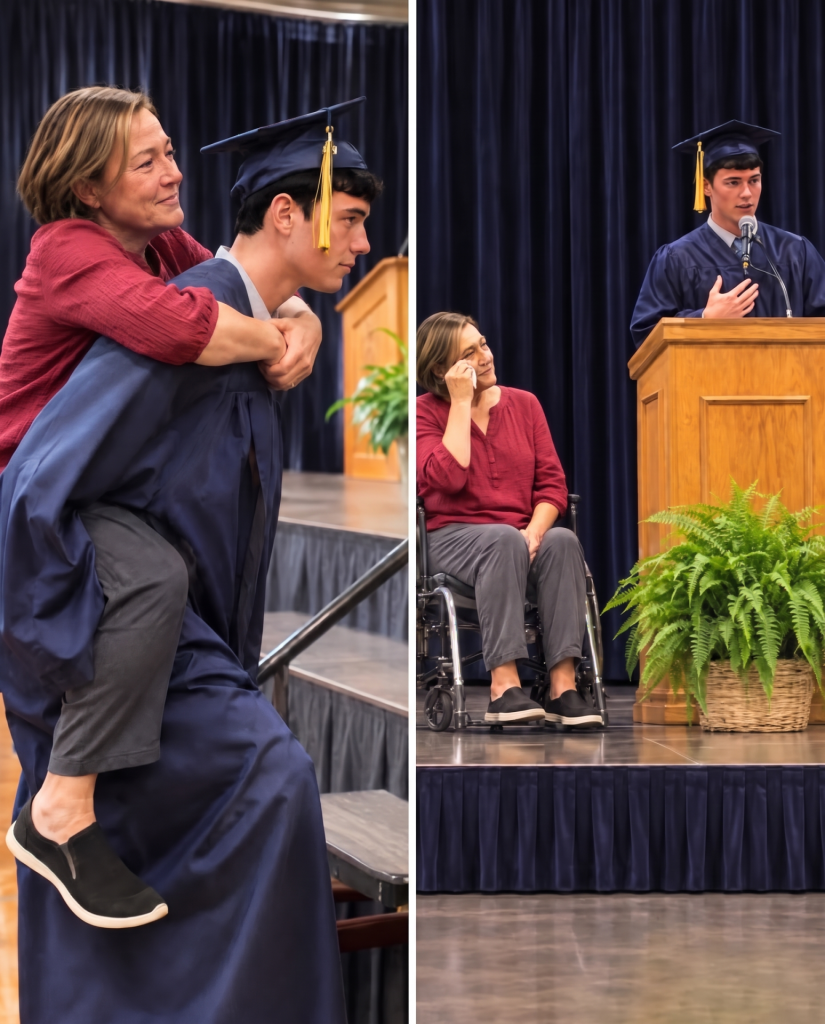
That morning, he’d lifted me from my wheelchair because he wanted us to share one of the most important moments of his life. In front of an entire auditorium, he’d revealed his struggles, acknowledged his mistakes, and expressed gratitude for the years we’d spent supporting each other.
His twenty scholarships were an extraordinary achievement, and the money he’d saved represented genuine generosity. Nevertheless, neither of those things was the greatest gift he gave me that day.
What mattered most was knowing that my son had opportunities ahead of him that once seemed financially impossible. He could pursue his education, discover his interests, form new friendships, and eventually build a future that reflected his own ambitions.
I had spent years worrying that my accident and Daniel’s departure had deprived Caleb of the childhood he deserved. His graduation helped me recognize that although our lives had been difficult, we’d also built a relationship grounded in love, determination, and mutual respect.
Still, I couldn’t ignore the painful lesson hidden beneath his remarkable achievement. Caleb had nearly lost his chance to graduate because he’d believed that protecting me meant hiding his struggles and carrying responsibilities that were never supposed to be his.
I was proud of his compassion, but I never wanted him to sacrifice his well-being to prove how much he loved me. If our experiences had taught us anything, it was that sharing our difficulties was far healthier than silently trying to overcome everything alone.
As we prepared for his next chapter, I made myself a promise to encourage his independence rather than allow my own fears to hold him back. I wanted him to know that he could always come home, ask for help, or share his worries without feeling that he’d disappointed me.
And I wanted to give myself permission to enjoy the years ahead, too. I was still a mother, still capable of making my own choices, and still entitled to dreams that extended beyond simply getting through another difficult month.
My son had carried me onto the graduation stage because I couldn’t walk, but the most meaningful thing he gave me was the knowledge that we could finally move toward our futures without allowing fear to control us.
Caleb had a life filled with possibilities waiting for him, and for the first time in many years, I truly believed that I did, too.
THE END