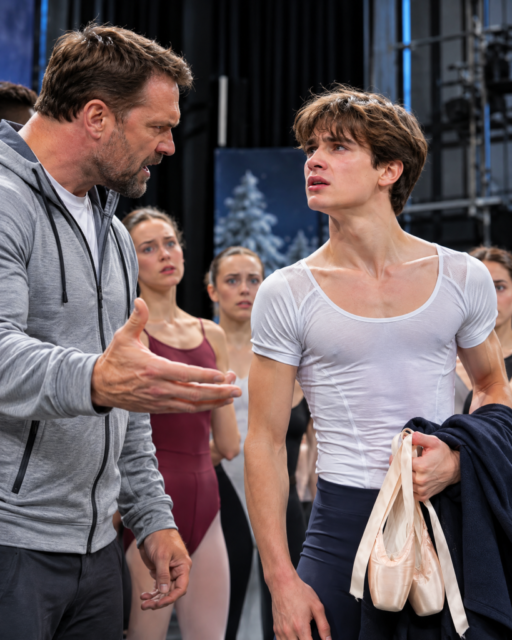
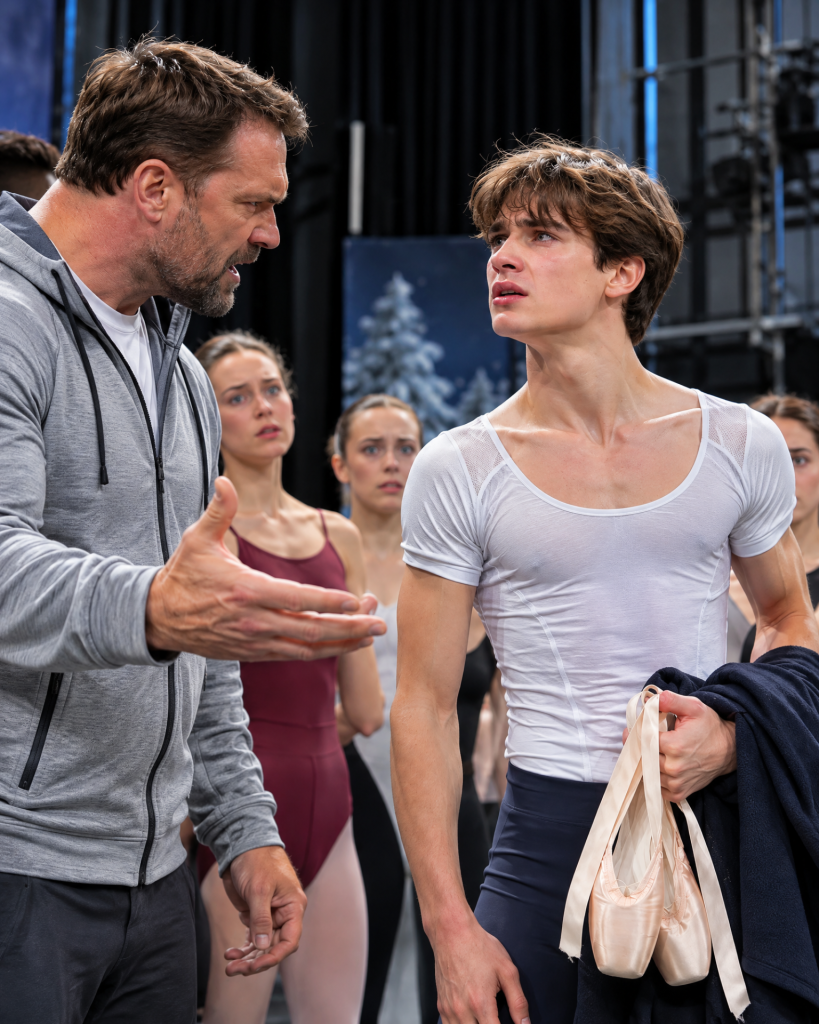

I didn’t show Elliot the withdrawal email while we were standing outside his school. He was already struggling to understand why his father had hidden the scholarship letter, and I didn’t want to frighten him further before confirming what had happened.
Instead, I asked him a question.
“Elliot, is this really what you want? Do you want to pursue ballet seriously?”
He looked at me in disbelief.
“Mom, I auditioned three times before I even had the courage to tell Ms. Kent I wanted advanced training.”
I squeezed his shoulder.
“Then we’re going to make sure you get a fair chance.”
We drove home, where Mara was finishing her homework at the kitchen island.
Graham arrived shortly after six. The moment he noticed the scholarship envelope beside my coffee mug, his expression changed.
“You’ve been going through my desk.”
“You opened a letter addressed to our son,” I replied. “And you told the school I agreed to withdraw him from ballet.”
Graham dropped his keys onto the counter.
“I was going to explain everything once I’d handled the situation.”
“By humiliating him in front of thirty students?”
“He’s been lying to me for almost two years, Heather. Apparently, you have too.”
I couldn’t deny that I’d helped Elliot hide his lessons. But that didn’t excuse Graham’s behavior.
“I should have been honest with you,” I admitted. “But nothing Elliot did justified tearing his costume or threatening him.”
Graham sat down.
“I want him in a real athletic program. Rugby teaches discipline, leadership, and resilience. It gives boys opportunities.”
“So does ballet.”
“Don’t compare the two.”
I placed the Eastbridge Rugby Academy receipt on the table.
“Then explain why you spent $2,600 from our joint account without discussing it with me.”
He glanced at the paper.
“It’s an investment in his future.”
“That money was supposed to repair the roof above Mara’s bedroom.”
“We’ll replace it.”
“With what? We’ve been saving for months.”
Graham leaned back in his chair.
“I’m his father. I have a right to decide what’s best for him.”
“And I’m his mother. You don’t get to make financial decisions for both of us or enroll Elliot in programs he never agreed to attend.”
A movement near the doorway caught my attention.
Elliot was standing there with his backpack.
“I don’t want to go to Eastbridge,” he said.
Graham turned toward him.
“You’re sixteen. You don’t understand what opportunities you’re throwing away.”
“I understand that I don’t want to play rugby anymore.”
“You were good at it!”
“That doesn’t mean I love it.”
Graham’s face tightened.
“Then here’s your choice. You can follow my rules while you’re living under my roof, or you can forget about having my support.”
I stood immediately.
“You are not threatening our son’s home because he wants a different future from yours.”
Graham stared at me.
“You’ve turned him against me.”
“No. You’ve made him afraid to tell you the truth.”
From the kitchen island, Mara spoke quietly.
“We all saw what you did to Elliot.”
Graham looked toward her, and she immediately lowered her eyes.
I moved beside my daughter and rested a hand on her shoulder.
For several seconds, nobody spoke.
Then Graham grabbed his keys and walked into the garage, shutting the door hard behind him.
Elliot remained in the doorway.
“I thought you were going to make me apologize,” he admitted.
I turned toward him.
“Why would you think that?”
“Because whenever Dad gets angry, you tell us to wait until he calms down. Then we usually end up apologizing for upsetting him.”
His words hurt because they were true.
I’d spent years avoiding arguments, telling myself that maintaining peace was the best thing for our family.
But Elliot had learned that his father’s anger mattered more than his own feelings.
“You’re right,” I said. “And I’m sorry I made you feel that way.”
He sat beside Mara, and I stayed with them until they were ready to talk about something else.
At 9:11 that evening, my phone rang.
It was Ms. Kent.
“Heather, I need to tell you something about Elliot’s scholarship application.”
My stomach tightened.
“The foundation received a withdrawal request from Graham tonight,” she explained. “He stated that both parents had agreed to remove Elliot from finalist consideration.”
I closed my eyes.
Graham had sent the email after our argument.
Even after hearing Elliot say he wanted to continue dancing, he’d attempted to cancel the opportunity anyway.
“Has the foundation withdrawn him?” I asked.
“Not yet. But the conflicting information needs to be resolved in writing before Saturday’s performance.”
I opened my laptop and asked her to send me the foundation’s contact details.
That night, I prepared a written statement confirming that I had never authorized Elliot’s withdrawal and fully supported his participation.
I also gathered the scholarship letter, Graham’s previous email to the principal, and the rugby academy registration.
For nearly two years, I’d tried to protect Elliot by avoiding confrontation with his father.
Now I understood that silence was no longer protecting anyone.
On Wednesday morning, I would take those documents to Principal Ortiz and ask the school to review everything.
This time, Graham wouldn’t be allowed to speak for our entire family while the rest of us remained silent.
On Wednesday morning, I walked into Principal Ortiz’s office carrying three folders. One contained Elliot’s scholarship letter, another held the rugby academy payment records, and the third contained copies of Graham’s emails.
Elliot sat beside me, nervously pulling at a loose thread on his backpack.
Ms. Kent, the student-activities coordinator, and a representative from the dance foundation were also present.
Graham arrived last, still wearing his rugby-club jacket.
He glanced at the paperwork.
“Is this a school meeting or a courtroom?”
Principal Ortiz remained composed.
“We’re here to address Monday’s incident and determine whether Elliot can continue participating in the ballet program.”
She began by reviewing the witness statements.
Several teachers had confirmed that Graham interrupted a supervised rehearsal, damaged a school costume, and publicly humiliated our son.
Graham insisted he’d been shocked to discover Elliot had been dancing behind his back.
“I understand you were upset,” Principal Ortiz replied. “But that doesn’t justify what happened in our auditorium.”
She then displayed the email Graham had sent before the confrontation.
“You stated that your wife agreed to withdraw Elliot from the program. Mrs. Whitmore has confirmed that she never authorized that request.”
Graham shifted in his chair.
“I’m his father. I have a right to make decisions about his activities.”
“You do have parental rights,” she answered. “But the school cannot treat a decision as mutual when one parent has explicitly disputed it.”
The activities coordinator confirmed that my original signed permission form remained on file.
Graham folded his arms.
“If this is how the school operates, perhaps my rugby club should reconsider supporting your fundraiser.”
Principal Ortiz didn’t hesitate.
“Your club is free to make its own decisions about donations. Financial contributions do not determine which students are permitted to participate in school activities.”
For once, Graham had no immediate response.
The dance foundation representative then explained that Elliot’s scholarship application had been temporarily placed on hold because of the conflicting withdrawal requests.
She turned toward my son.
“Elliot, do you personally want to remain a finalist?”
He straightened in his chair.
“Yes, ma’am.”
“And do you still want to perform on Saturday?”
He glanced at the damaged costume jacket resting on my lap.
“I’m nervous, but I don’t want to quit.”
Ms. Kent reassured him that the performance could be adjusted if he felt uncomfortable. Nobody would force him onto the stage.
The foundation representative agreed to restore his finalist status once the corrected parental information was documented.
I submitted my written statement before leaving the office.
Principal Ortiz also informed Graham that he would not be permitted to attend closed rehearsals or enter backstage areas while the school reviewed his conduct.
He could communicate concerns in writing, but he couldn’t disrupt another rehearsal.
As we stood to leave, Graham shook his head.
“So everybody gets to decide what happens to my son except me?”
I looked directly at him.
“Elliot deserves a voice in decisions about his own future.”
Outside, Graham followed us toward the parking lot.
I stopped before we reached the children.
“I think you should stay somewhere else for a while,” I told him. “Elliot and Mara need time without another argument waiting at home.”
He stared at me for several seconds.
Then he agreed to stay at a hotel.
I didn’t mistake that agreement for an apology.
That afternoon, I reviewed our household finances and saved copies of the payments Graham had made without discussing them with me. I also documented the money still needed for Mara’s roof repairs.
Then I sent him a message asking him not to pressure either child about Saturday’s performance.
That evening, Elliot brought his torn costume jacket downstairs.
“Mom, can I ask you something?”
“Of course.”
“If I dance well on Saturday, everyone’s going to say Dad should be proud of me.”
I waited.
“But what if he only accepts me because people applaud?”
I took his hand.