
At 2:04 on Christmas Eve morning, a woman called our tow company from a ditch west of Grand Forks. It was four degrees outside, her engine had stopped, and there were two little kids in the back seat. When my boss told her how much it would cost to get them out, she counted the money in her purse and came up with thirty-six dollars.
My name is Ernie Palko. I was sixty-one that winter, and I’d been driving a tow truck in Grand Forks, North Dakota, for twenty-eight years. I worked nights, which meant I heard most of the calls people hoped they’d never have to make. There were dead batteries outside hospitals, cars spun into medians, and people who’d been sitting on the shoulder so long they forgot to tell me which direction they’d been driving.
Behind my seat, I kept three wool blankets, a thermos, and an old child’s car seat. My late wife had put the first blanket there after I came home one morning and told her about a woman I’d picked up wearing slippers. The woman had been on her way to work before dawn and had spent forty minutes with her feet tucked beneath her to keep them warm.
“You never know who you’ll pick up,” my wife told me.
She added the other blankets over the years. After she died, I still took them out every spring to wash and fold them. I always put them back before my next shift, even if it was seventy degrees outside.
Vic Tamblyn owned the company. He could remember what a winch repair had cost him nine winters ago, and he knew exactly how long a driver could leave a truck idling before he’d see it in the fuel bill. If you spent enough years around him, you learned there were things he kept track of closely and things he preferred nobody bring up.
His daughter was one of those things. She’d left town six years earlier after a fight with him, and I couldn’t remember hearing him say her name since. There was an empty picture frame on his desk. Whenever he wiped down the desk, he picked up that frame and cleaned around it like there was still a photograph inside.
The storm came down from Canada that evening. By midnight, Highway 2 was closed, and from where I sat in our yard, I could barely see the gate. I was finishing my coffee when the dispatch line rang. Calls went to Vic’s cell first and rolled over to my truck if he missed them. When he picked up, I could hear the conversation over my speaker.
“Please,” a woman said. “I went into the ditch on Highway 2. I’m about ten miles west of town. I have two little kids with me, and I can’t get the car started.”
Vic asked if she needed a tow. She said yes so quickly I wondered how long she’d already been trying to reach somebody.
“Christmas Eve emergency rate is four hundred dollars,” he told her. “Cash or card, up front.”
There was a rustling sound, like she was trying to open something one-handed. When she spoke again, her voice was quieter.
“I have thirty-six dollars. My card’s maxed out. I can give you what I have now and pay the rest after Christmas.”
From somewhere near the phone, I heard a child crying. The woman tried to soothe them, then came back on the line and said she could give us her name and address if that would help.
“No payment, no tow,” Vic said. “Call your husband.”
“I don’t have a husband anymore. Please, sir. They’re so cold.”
“Try 911.”
He hung up. I called him before he had time to put his phone down.
“Vic, it’s four degrees. That road’s closed. Even if she gets through to somebody, those kids could be out there a long time.”
“We’re a business, Ernie. A customer wants a truck, she pays for a truck.”
“I’m going.”
For a second I thought he might relent. Twenty-eight years gives you a good ear for a man’s silences, and this one lasted long enough for me to hear the wind rattling the truck door.
“You leave that yard without a paid ticket,” he said, “and you don’t bother coming back.”
I set the phone down, reached behind my seat to make sure the blankets were there, and started the truck.
On a clear night, ten miles west of town was a short run. That morning it took me forty minutes. Snow was blowing across Highway 2 so hard that sometimes the only thing I could make out was the next reflector, and by the time I reached it, I was already looking for the one beyond. I kept peering down into the ditches, afraid I’d drive straight past her.
Then I caught a dim light below the shoulder. A small red car had gone nose-first down the slope, and snow had already piled up against its front doors. I parked where I had room to work, got out, and made my way down to the driver’s side. I had to brush snow off the glass before I could see anyone inside.
When I knocked, the driver turned toward me. She lowered the window about an inch, just enough for me to hear her.
“Did he send you?”
“I heard your call. I’m Ernie. Can you get your door open?”
She tried the handle. The door moved a little and stopped against the snow. I cleared enough of it with my boots to pull the door wider. Up close, I could see a bluish tint around her lips, and she had both hands buried in the sleeves of her coat.
“My kids first,” she said.
The little boy looked about five. He was sitting pressed against his sister beneath a blanket so thin I could see the pattern on her pants through it. When I leaned into the back seat, he lifted one corner of the blanket and asked if I was taking both of them.
“Both of you,” I said. “Your mom’s coming too.”
I carried his sister up first and buckled her into the old car seat. She stirred when I tucked a wool blanket around her legs, then turned her face toward the warm air coming from the dashboard. When I went back for the boy, he was trying to fold the thin blanket. His hands were shaking too much to get the corners together, so I told him to bring it the way it was.
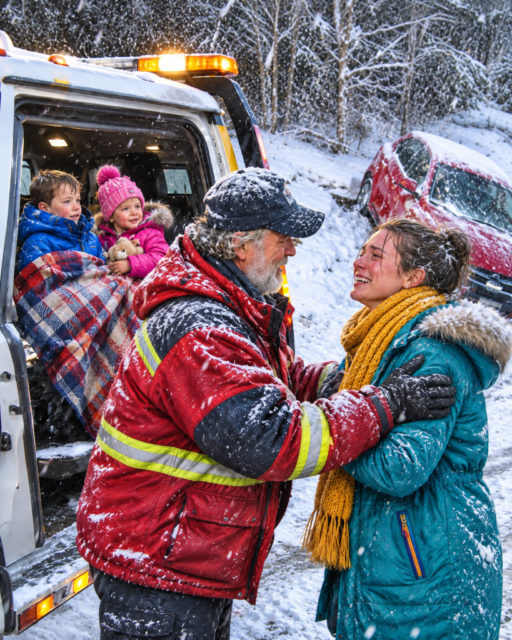
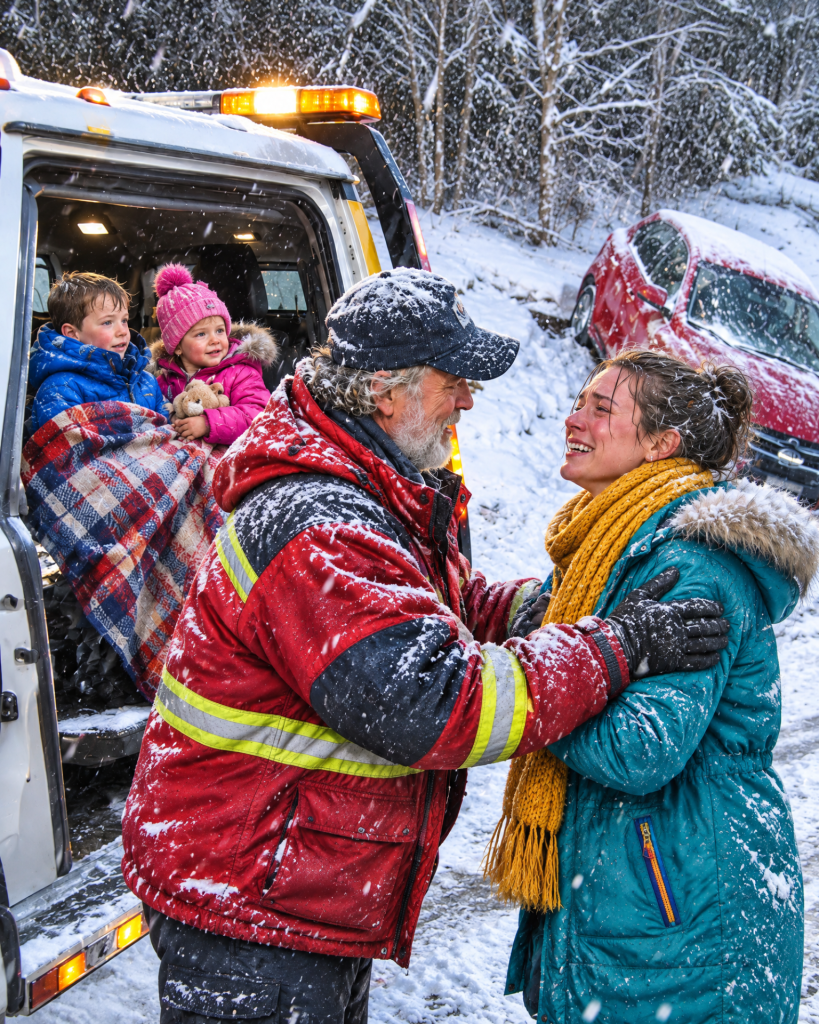
Their mother came up to the truck after us. She climbed into the cab and went straight to checking on the children, bending over each of them as if she needed to see for herself that I’d brought both up. Only then did she sit down. I poured cocoa into the cap of my thermos and handed it to her. She held it in both hands for a while before she took a sip.
“I can give you the thirty-six now,” she said. “I meant what I told the man on the phone. I’ll pay the rest.”
“Keep it in your purse. I’m going to get your car up here.”