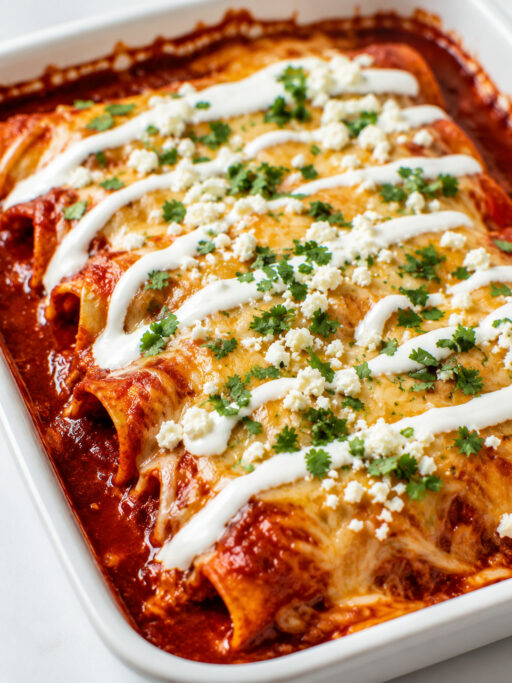
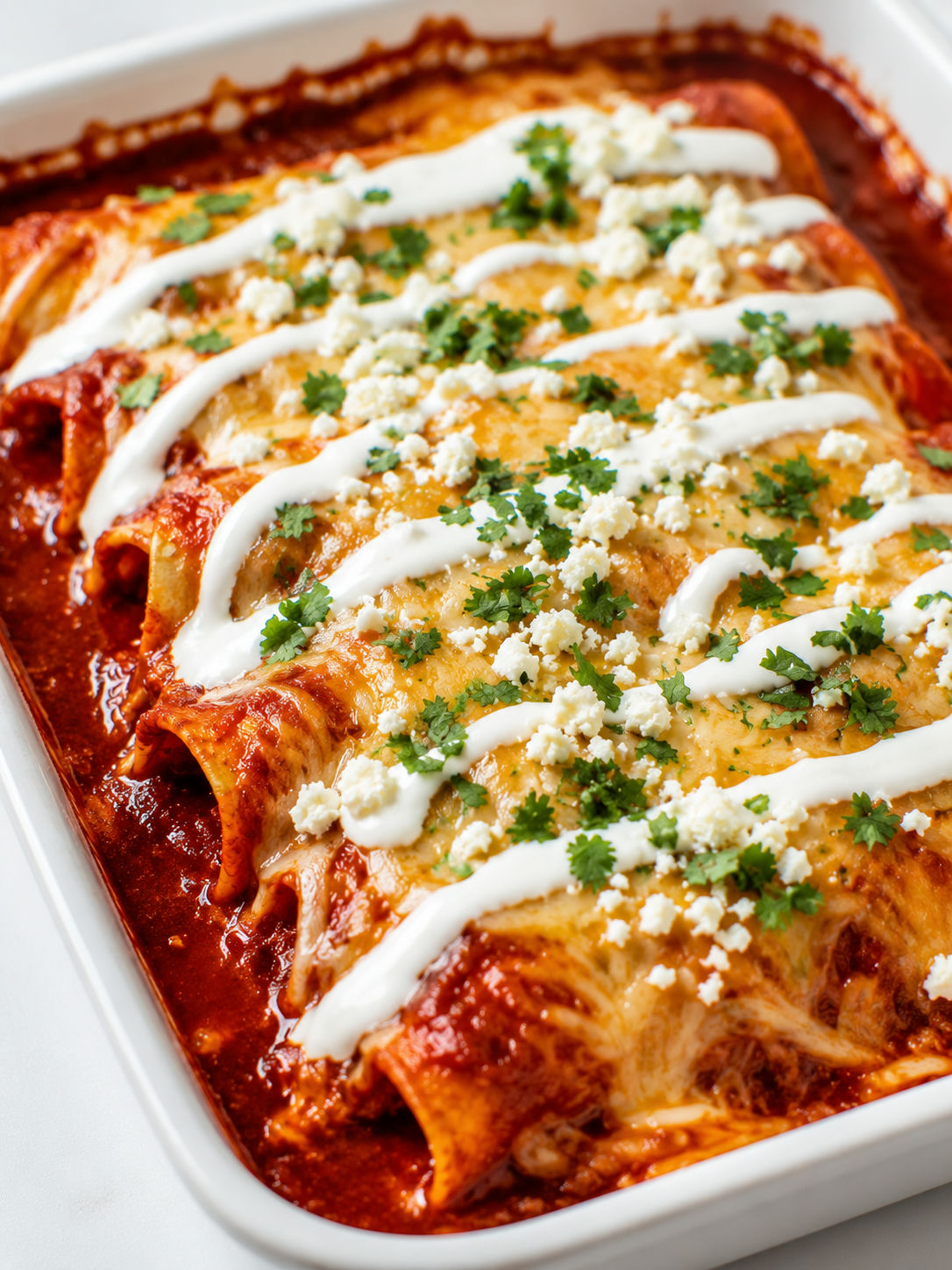

The thing that separates a great enchilada roja from a forgettable one is the sauce. Not the canned stuff. The real thing, built from dried ancho and guajillo chiles, toasted until their skins blister and their oil wakes up, then soaked and blended into something dark, earthy, and worth eating by the spoonful.
This recipe takes about an hour start to finish, but most of that is hands-off time. You can poach the chicken while the sauce simmers. You can make the sauce three days before you need it. Once you have both ready, the actual assembly is maybe fifteen minutes of work.
If you already love our Enchiladas Suizas Rojas, this version goes a bit bolder and smokier. Same family, different character.
What goes into your red enchiladas
The dried chiles are the foundation. Buy them at a Latin grocery store or in the international aisle of most supermarkets. They should be pliable, dark, and smell faintly sweet and smoky. Brittle or faded chiles have lost most of their flavor and the sauce will taste flat. Everything else here is a pantry staple.
- Ancho chiles. The dried form of poblano peppers. They give the sauce its depth, mild heat, and a hint of dried fruit that rounds out the sharper guajillo.
- Guajillo chiles. Bright red, slightly tangy, and more forward in heat than ancho. They give the sauce its color and backbone.
- Chicken breast. Poached and shredded, it stays moist and absorbs the red sauce beautifully inside each rolled tortilla.
- Corn tortillas. The only kind that holds up correctly under the sauce. Fresh ones from a tortilleria are ideal if you can find them.
- White onion and garlic. Blended into the sauce for a sweeter, roasted base flavor.
- Cumin and Mexican oregano. The two spices that make enchilada sauce taste like enchilada sauce rather than tomato soup.
- Oaxacan or Monterey Jack cheese. Both melt smoothly and don’t overpower the chile flavor the way sharper cheeses can.
- Mexican crema and queso fresco. For serving. They cool the richness and add a salty, tangy contrast on top.
Building them from sauce to oven
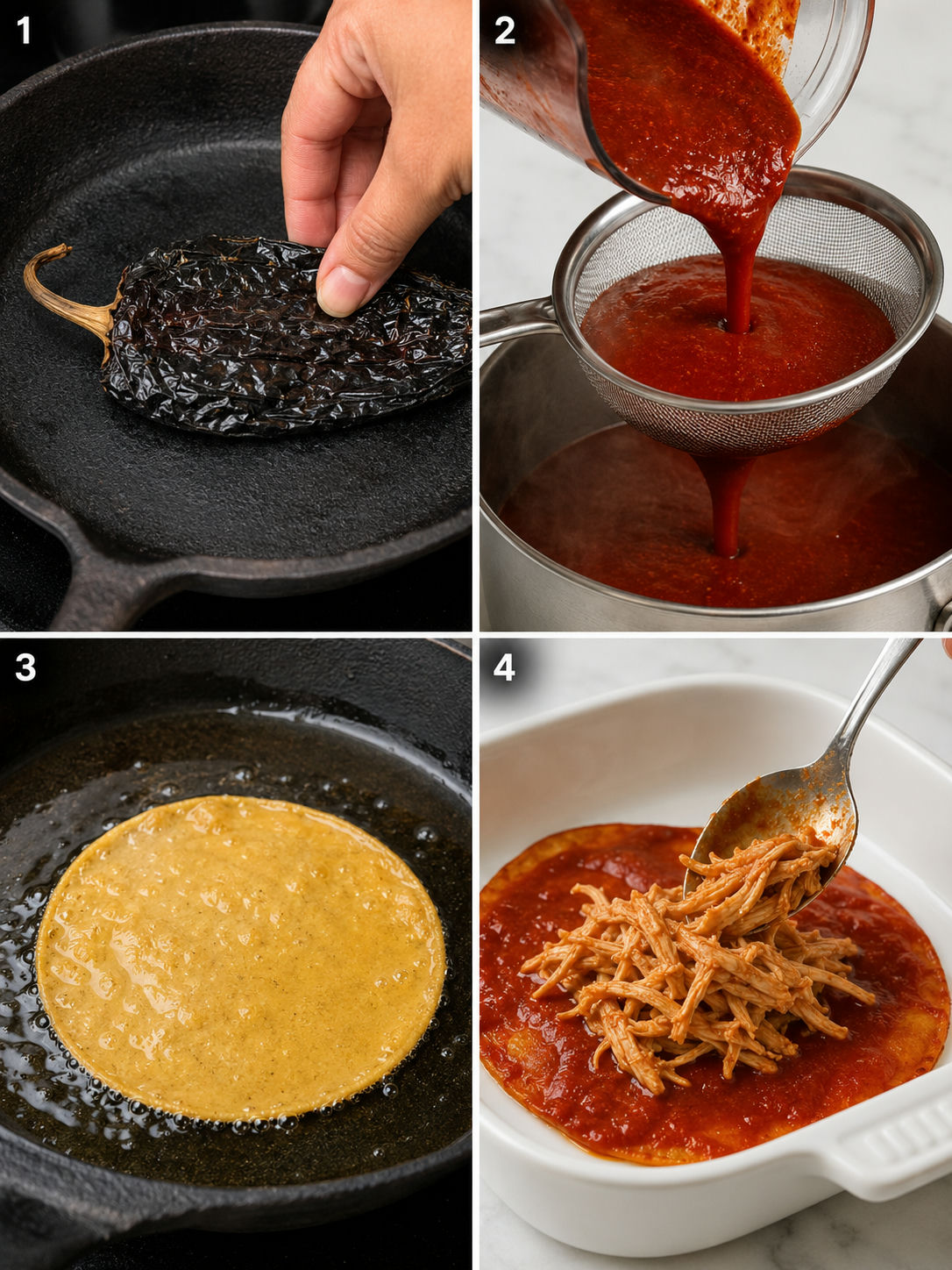
- Toast the dried chiles. Heat a dry skillet over medium. Press each chile flat in the pan for 20 to 30 seconds per side until the skin darkens and smells smoky. Do not let them burn or the sauce will turn bitter. Transfer to a bowl, cover with boiling water, and soak for 20 minutes.
- Blend the sauce. Drain the chiles and transfer to a blender with 1.5 cups of chicken broth, 2 roughly chopped Roma tomatoes, 4 garlic cloves, a quarter white onion, 1 teaspoon cumin, and half a teaspoon of Mexican oregano. Blend on high until completely smooth, about 2 minutes.
- Cook the sauce. Heat 1 tablespoon of oil in a medium saucepan over medium-high heat. Pour the blended sauce through a fine-mesh strainer into the pan and let it sizzle and reduce for 12 to 15 minutes, stirring often. It should coat a spoon and turn a deeper brick red. Season with salt.
- Poach the chicken. Place chicken breast in a pot and cover with cold water. Add half an onion, 2 garlic cloves, and a pinch of salt. Bring to a simmer and cook for 18 to 20 minutes until the thickest part reaches 165°F (74°C), per USDA poultry safety guidelines. Pull it out and shred with two forks while still warm.
- Fry the tortillas. Add a thin layer of oil to a skillet over medium-high heat. Fry each tortilla for about 10 seconds per side until pliable and lightly coated. Set them on paper towels. This step keeps them from tearing and from turning to mush under the sauce.
- Assemble and roll. Preheat the oven to 375°F (190°C). Spread a ladle of sauce across the bottom of a 9×13 baking dish. Dip each tortilla in the warm sauce, lay it flat, add 2 to 3 tablespoons of shredded chicken and a small pinch of cheese, then roll it tight and place seam-side down in the dish.
- Top and bake. Pour the remaining sauce over the enchiladas and scatter the rest of the cheese on top. Bake uncovered for 20 to 22 minutes until the cheese is melted and the edges are bubbling. Rest for 5 minutes before serving.
Why dried chiles make the difference
Fresh chiles and canned sauce are fine for quick weeknight cooking. But dried chiles have had their moisture removed slowly, concentrating everything: the fruitiness, the heat, the deep color, the smokiness. When you toast them in a dry pan, the heat activates oils that would otherwise stay dormant. When you soak them, those oils infuse the liquid and carry into the blended sauce.
The combination of ancho (mild, dark, slightly sweet) and guajillo (brighter, redder, more acidic) is the closest you will get to the enchilada sauce you find in a good Mexican restaurant. Most canned sauces rely on powder instead of whole dried chiles. The flavor gap is real. For more on how different dried chiles behave in traditional Mexican cooking, Mexico in My Kitchen is a reliable and authentic resource.
The tortilla step that changes everything
Most enchilada recipes tell you to dip the tortilla in warm sauce. That part is true. What they skip is what comes before: a quick 10-second pass through a thin layer of hot oil. This does two things. It makes the tortilla flexible enough to roll without cracking. And it creates a light barrier so the tortilla doesn’t immediately absorb all the sauce and turn soft before it even reaches the oven.
You don’t want the tortilla crispy. Just pliable and lightly coated. The whole batch takes about three minutes. It is the most important step in the recipe and the one most home cooks skip the first time they make enchiladas.
Filling swaps that actually work
Shredded chicken is the default here but it’s far from the only option. Ground beef cooked with onion, garlic, and cumin is equally good. For a richer, meatier variation, try the filling from our Beef Enchiladas with Extra Cheese. Cheese and onion only is a classic traditional approach that works beautifully with this red sauce.
For something entirely different, the same sauce and filling ideas translate directly to red chile stacked enchiladas, which skip the rolling step altogether. You just layer tortillas flat in the dish, which is much faster and no less satisfying on a busy night.
Making the sauce three days ahead
The red sauce keeps in the fridge for up to five days and in the freezer for three months. Making it over the weekend means enchiladas rojas can be a weeknight dinner. Pour the cooled sauce into a jar, press plastic wrap against the surface, and seal. When you’re ready, warm it gently in a pan over low heat and thin it with a splash of broth if it has thickened.
The chicken can also be poached and shredded up to two days ahead. Keep it in the fridge in an airtight container with a spoonful of sauce stirred through to keep it moist. Assembly then takes about fifteen minutes flat.
What to serve alongside
Two or three enchiladas per person is typically enough. Mexican rice and warm refried beans round out the plate the traditional way. For a fresh contrast, set out a small bowl of our Homemade Salsa Picante for anyone who wants more heat. A few slices of avocado and pickled jalapeños are worth putting on the table too.
For toppings, set out Mexican crema, crumbled queso fresco, finely diced white onion, and fresh cilantro. Let people add what they want. The crema cools the heat a little and the queso fresco adds that salty, crumbly contrast that makes every bite more interesting.
FAQs
- Can I use store-bought enchilada sauce instead of making it from scratch?
-
You can, but the flavor difference is noticeable. Canned sauce tends to be sharper and thinner. If you are short on time, find a good-quality canned sauce and deepen it with a pinch of cumin, a little garlic powder, and a spoonful of tomato paste. Homemade keeps in the fridge for up to five days, so making it ahead is usually the better move.
- What dried chiles work best for enchiladas rojas?
-
Ancho and guajillo are the classic pairing. Anchos bring a deep, almost chocolatey earthiness. Guajillos add a bright, slightly tangy heat. Together they make a balanced, complex sauce. If you want more heat, add one dried chile de arbol. If you want it milder, lean on more ancho and fewer guajillo.
- Can I substitute flour tortillas for corn?
-
Flour tortillas will work in a pinch but they absorb sauce differently and can turn gluey after baking. Corn tortillas are traditional for a reason: they hold their shape, they have a flavor that plays well with the red sauce, and they don’t fall apart. If tortillas tear when you roll them, the issue is almost always that they aren’t warm enough. A quick 10-second fry in oil fixes that completely.
- How do I store and reheat leftover enchiladas?
-
Store leftovers covered in the fridge for up to three days. Reheat in a 350°F oven covered with foil for about 15 minutes until warmed through. The microwave works too but can make the tortillas a bit soft. If the sauce has thickened overnight, spoon a small splash of chicken broth over the top before reheating.
- Can I make enchiladas rojas ahead of time?
-
Yes, and they are actually better if assembled a few hours ahead. Build the enchiladas, cover the pan with foil, and refrigerate. Pull them out 30 minutes before baking and add an extra 5 to 7 minutes to the oven time since they go in cold. The sauce soaks into the tortillas a bit while they rest, and most people find the texture improves.
- What fillings can I use besides chicken?
-
Shredded beef works beautifully here. Try the filling from our Homemade Picadillo recipe for a seasoned ground beef version that pairs perfectly with the red sauce. Cheese and onion only is a traditional Mexican approach. Black beans mashed lightly with cumin and garlic also hold up well for a meatless option.
- Why do my enchiladas fall apart when I roll them?
-
Almost always a cold, dry tortilla. A 10-second fry in a thin layer of hot oil makes the tortilla pliable and coats it lightly so the sauce doesn’t soak through and make it soggy before it even reaches the oven. If you’d rather not fry them, wrap a stack in a damp paper towel and microwave for 30 seconds. They won’t be quite as sturdy but they will roll without cracking.
References
Sources cited in this recipe.