
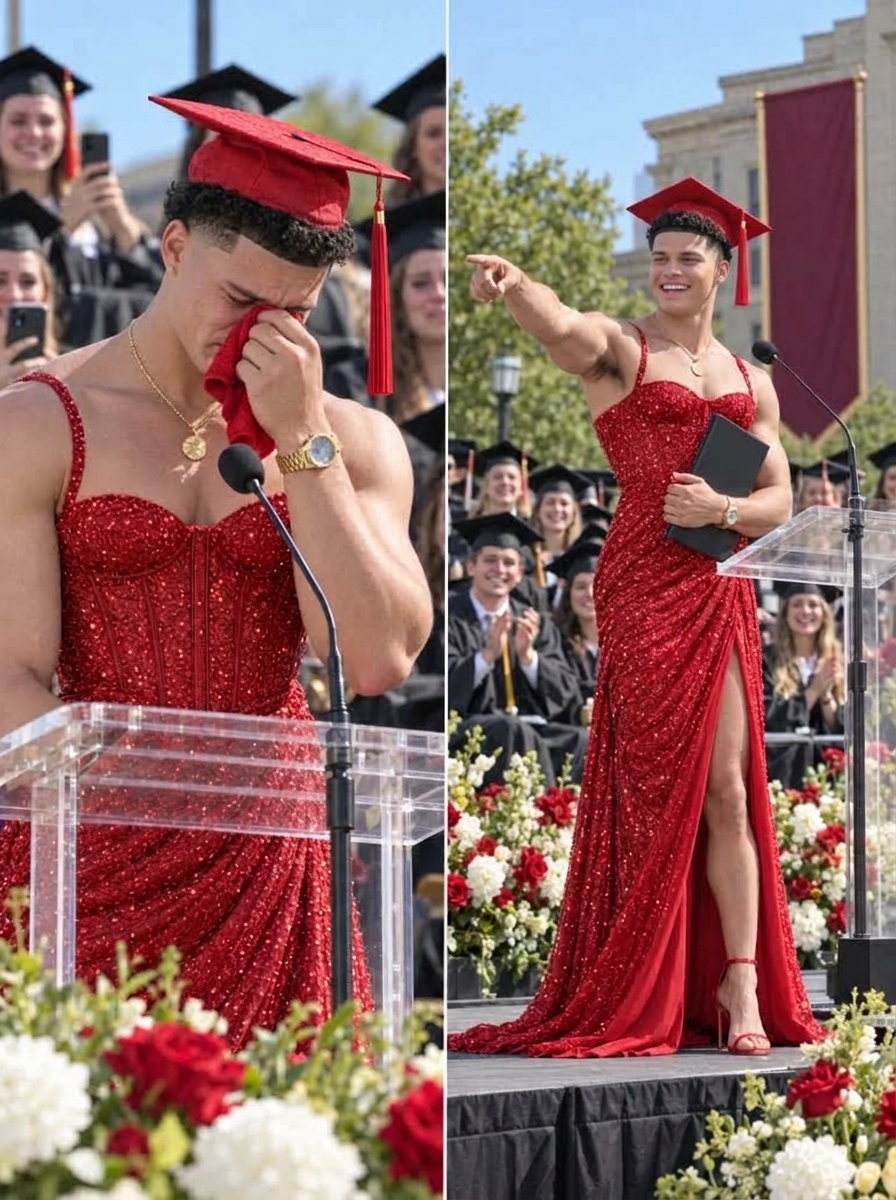

He had told Julian he would not attend if our son insisted on wearing the dress, and technically he had kept that promise because he had never taken a seat beside me. Yet somehow, despite all his anger, he had still come.
Through the glass doors, Caleb watched Julian standing beneath the lights while the entire auditorium applauded. His eyes moved from the bright red dress to the small silver locket in Julian’s hand, and I watched the resistance in his face slowly begin to collapse.
For seventeen years, Caleb had survived Lily’s death by refusing to look directly at the pain. He had hidden her belongings, avoided speaking her name, and convinced himself that moving forward meant burying everything that reminded him of her.
Now there was nowhere left for him to hide from it. As the applause continued inside the gymnasium, Caleb covered his face with both hands and finally began to cry.
When the ceremony ended, Julian and I walked out of the gymnasium together, still holding hands. He did not change out of the red dress, and by the time we reached home, the exhaustion of the evening had settled over both of us.
At one in the morning, we sat quietly at the kitchen table with mugs of warm tea between us. Lily’s silver locket rested beside the red fabric, and neither of us felt any need to fill the silence with conversation.
Then someone knocked softly at the front door.
When I opened it, Caleb was standing on the porch with his suit jacket hanging over one arm. His eyes were red, his face looked exhausted, and the confidence he had carried when he condemned Julian two weeks earlier was gone.
He did not say anything to me. Instead, he walked past the foyer and entered the kitchen, where Julian slowly stood from his chair.
For several seconds, father and son simply looked at each other across the room. Caleb’s eyes dropped toward the bright red dress before moving to the silver locket on the table, and when he finally spoke, his voice barely held together.
“I was a coward, Julian. I was so afraid of the pain of losing her that I let you carry her all by yourself.”
Tears ran down Caleb’s face as the words finally escaped him. For seventeen years, he had convinced himself that avoiding Lily’s name was the same as surviving her death, but Julian’s graduation had forced him to see what that silence had cost our family.
Julian did not answer with anger. He walked around the table, stopped in front of his father, and pulled him into an embrace.
Caleb held him tightly and began sobbing against the shoulder of the same red dress he had condemned only two weeks earlier. I stood beside them and realized that years of grief, resentment, and emotional distance were finally breaking apart in our kitchen.
The next morning, local newspapers did not describe Julian as a student who had disrupted graduation. Instead, they printed a photograph of him walking across the stage with his head held high beneath the headline The Promise Kept.
The story spread quickly because people finally understood what the dress represented. What had looked strange from a distance became something entirely different once they learned about Lily, the childhood promise, and the seventeen years Julian had waited to fulfill it.
Caleb kept one copy of the newspaper on his desk. He never said much about it, but I noticed that he stopped hiding Lily’s photographs after that night and began allowing her name back into ordinary conversations.
For the first time in years, remembering her no longer felt forbidden in our home. We could speak about the funny things she had done, the red dress she loved, and the brief life she had shared with us without acting as though grief required silence.
Julian had crossed the graduation stage because he wanted Lily to have the moment she never lived long enough to experience. In keeping that promise, he had also given his father something Caleb had spent seventeen years refusing to give himself.
Permission to remember her without running from the pain.
A month after graduation, Julian began packing for college. His room slowly filled with boxes, folded clothes, books, and everything else he believed he might need for the next chapter of his life.
When he reached the red dress, I expected him to place it back inside Lily’s memory box or carry it upstairs to the attic. Instead, he carefully hung it in his closet where he could see it every time he opened the door.
He did not treat the dress like a costume from a dramatic night or something embarrassing that should disappear once the attention faded. To Julian, it was still what it had always been: a promise made by a five-year-old boy to the twin sister he had never stopped loving.
The photograph from graduation remained on the front page clipping Caleb had saved. It showed Julian walking across the stage with his head held high in the red dress, while the headline beneath the image read The Promise Kept.
Caleb had changed in ways I had stopped expecting years earlier. He began speaking about Lily again, and photographs that had remained hidden inside drawers slowly returned to shelves around our home.
For the first time in seventeen years, her name no longer brought every conversation to an uncomfortable stop. We could remember the child who wore her favorite red dress to the grocery store, the park, and even to bed instead of pretending those memories had to remain locked away because losing her still hurt.
Julian never asked his father to apologize again after that night in the kitchen. Caleb’s apology mattered, but what mattered more was that he finally stopped forcing our son to carry Lily’s memory alone.
The graduation ceremony had changed something in all of us. I had spent years believing protecting Julian meant shielding him from painful attention, while Caleb believed protecting himself meant burying everything connected to Lily.
Julian had understood something neither of us had been brave enough to accept. Sometimes love requires allowing yourself to remember, even when remembering hurts.
Before leaving for college, Julian stood in his bedroom doorway and looked once more at the red dress hanging neatly inside the closet. The fabric that had caused hundreds of strangers to laugh now seemed completely different because everyone who mattered finally understood what it represented.
I thought about the boy who had sat at our kitchen table two weeks before graduation while I begged him to reconsider. I had been terrified that the world would humiliate him, but Julian had already decided that keeping his promise mattered more than being protected from other people’s opinions.
He had been right.
The crowd had judged him before knowing his story, his closest friend had walked away, the school had tried to discourage him, and his own father had refused to stand beside him. Yet Julian still walked across that stage because seventeen years earlier, a frightened little girl had asked not to be forgotten.
The red dress remained in his closet when he left for college. It was no longer simply Lily’s dress or Julian’s graduation gown, but a reminder that courage sometimes means allowing people to misunderstand you while you remain faithful to something they cannot yet see.
That night had taught all of us the same lesson. Real strength was never about satisfying the expectations of a crowd.
It was about loving someone enough to carry their memory into the light, even when everyone around you was still laughing.