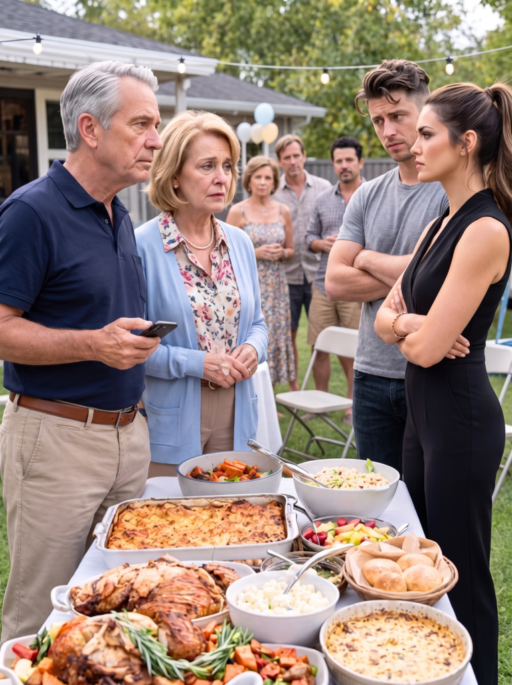
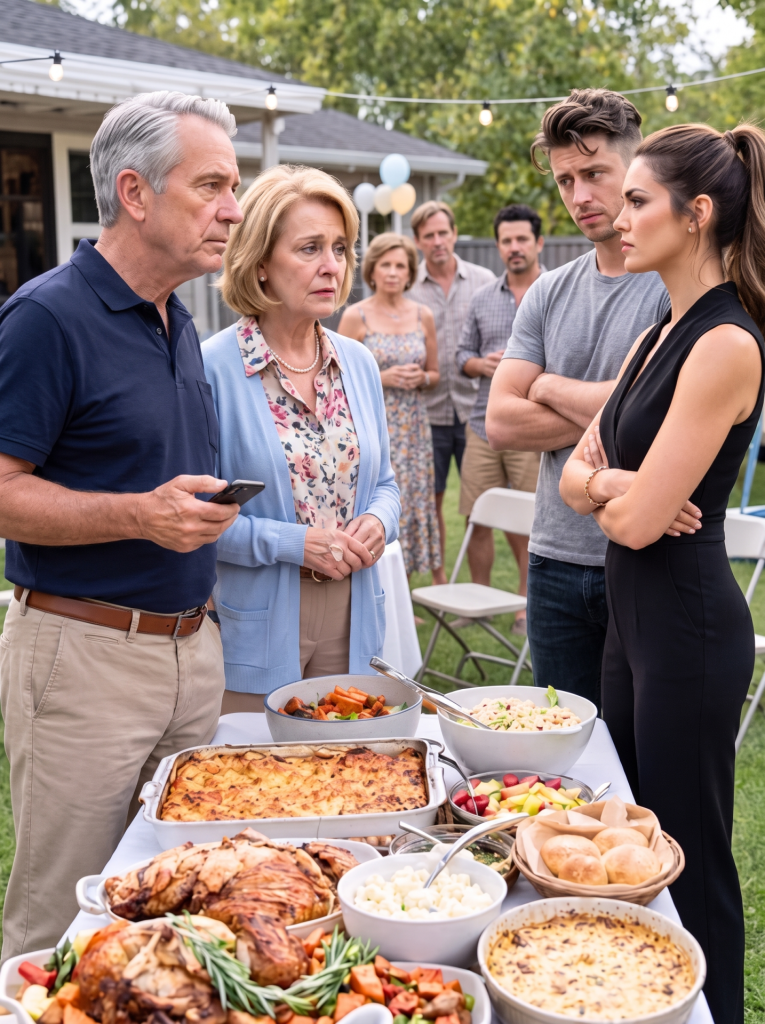

The first thing I remember after Tiffany made her announcement was how completely the backyard fell silent. My wife, Gloria, stood in the kitchen doorway wearing the apron she had tied on shortly after midnight, while two burned fingers remained wrapped in fresh white bandages.
“We’re moving the party to Rosewood. This is too homemade for the guests I invited.”
Behind Gloria, six long tables held thirty-eight homemade dishes that were still warm beneath their polished lids, yet not one serving had been touched. Our granddaughter Kayla stood near the gate surrounded by friends, while our son Kevin stared at his phone instead of looking at his mother.
Tiffany calmly explained that she had reserved a private dining room at Rosewood because Kayla only turned eighteen once and deserved something more elegant. Then she gestured toward the food Gloria had spent the entire night preparing.
“You can keep everything. Don’t let it go to waste.”
Within minutes, guests began collecting their belongings and heading toward the gate. Watching them leave, I could only think about how the entire disaster had begun less than twenty-four hours earlier.
On Friday evening, Tiffany had arrived at our house carrying a folded sheet of paper. Gloria had just finished the paperwork for Gloria’s Corner, the neighborhood restaurant she had owned for eleven years, while I had returned from another long day driving passengers around Chicago with a heating pad pressed against my aching lower back.
“Mom, I only need you to handle the food.”
Gloria unfolded the paper and quickly realized it was not a simple menu. Tiffany had written down thirty-eight different dishes, complete with dietary restrictions, separate utensils, extra sauces, and individual serving instructions.
“For how many people?”
“About seventy-five.”
Gloria studied the page again before looking at Tiffany.
“And this is tomorrow?”
“The party starts at three.”
Kevin stood behind his wife scrolling through his phone until I asked whether he had even read the list. He admitted he had only looked at part of it and seemed almost surprised that I considered thirty-eight dishes on less than a day’s notice unreasonable.
“Tiffany said Mom could handle it.”
Gloria knew better than anyone how difficult the request was because even a professional kitchen would struggle to prepare nearly forty customized dishes overnight. Tiffany, however, smiled as though she had asked for nothing more demanding than a birthday cake.
“It’s Kayla’s eighteenth birthday. You run a restaurant. This shouldn’t be that difficult.”
Gloria quietly folded the paper and gave the answer she had been giving people for most of her life.
“Okay.”
That word had never meant something was easy for Gloria. It meant she had already accepted that another person’s problem would become her responsibility.
After Kevin and Tiffany left, I told her we could refuse, especially after they had waited until the last minute to make such an unreasonable request. Gloria admitted that I was right but reminded me that Kayla had not created the menu or decided when to deliver it.
“She’s still our granddaughter.”
That was enough to end the argument. I picked up my keys, and we spent the rest of the evening driving to three different grocery stores until Gloria had every specialty ingredient on Tiffany’s list.
The groceries cost $587.34, almost exactly what Gloria had spent months saving to repair the aging oven at her restaurant. She never complained about using the money, but we both understood that the repair would now have to wait.
We returned home shortly before midnight, and Gloria immediately tied on her apron and began working. I stayed beside her peeling vegetables, washing dishes, measuring ingredients, and cleaning counters until the pain in my lower back became too strong for me to remain standing.
At 1:17 a.m., Tiffany sent another message asking Gloria to prepare five additional dishes for guests with dietary restrictions. She ended the request as casually as though Gloria had not already been cooking for hours.
“Nothing fancy. Thanks, Mom!”
I reached for my phone because I was ready to call Tiffany myself, but Gloria stopped me before I could.
“Don’t.”
A little after four in the morning, I heard Gloria gasp when a hot tray burned two of her fingers. I wrapped her hand in ice while she kept staring nervously toward the stove, more worried about the unfinished food than the pain in her own hand.
“The soufflé needs attention.”
“It can wait.”
“It can’t.”
By six o’clock, Gloria had completed everything Tiffany requested, including the last-minute additions. Even then, she made two extra dishes of her own: tomato soup because it had always been Kevin’s favorite when he was sick, and peach cobbler because it was the first dessert he had learned to make beside her as a child.
When Gloria finally lifted her coffee cup, her bandaged fingers were trembling with exhaustion. The counters were covered with food, every burner had been used, and an entire night of sleep had disappeared into a birthday meal for the family she loved.
“It’s beautiful.”
Gloria rested her head against my shoulder for a moment before returning to work. Neither of us knew that only a few hours later, seventy-five people would stand beside those tables and walk away without tasting a single thing.
By the time Saturday morning arrived, Gloria and I had barely slept, but there was still an entire backyard to prepare before the guests came. Our yard was simple, with a concrete patio, a narrow strip of grass, and a chain-link fence, yet Gloria transformed it with white tablecloths, jars of rosemary, colorful balloons, and long tables covered with the food she had spent all night making.
My back was still aching from the day before, and every trip across the yard made it worse. While I struggled to tie the final balloons, our neighbor Miss Doy appeared at the gate carrying coffee and immediately noticed how stiffly I was moving.
“Hank Coleman, you’re walking like you’re eighty.”
I told her about Tiffany’s thirty-eight-dish menu, the $587.34 grocery bill, Gloria’s burned fingers, and the sleepless night we had spent cooking. Miss Doy listened without interrupting, then shook her head.
“That daughter-in-law of yours has some nerve.”
“She’s family.”
Miss Doy raised one eyebrow but said nothing more.
By midmorning, everything was ready. The smell of roast chicken, fresh bread, beef stew, herbs, butter, and peach cobbler drifted through the yard, and although the celebration was not expensive, Gloria had poured herself into every detail.
At 10:15, Kevin called to ask whether everything was on schedule. He never asked how his mother was feeling, whether we needed help, or how we had managed to complete nearly forty dishes in one night.
“Everything on track?”
“Yes.”
“Great. We’ll be there at three.”
The first guests arrived shortly before three, and within minutes almost seventy-five people filled the backyard. Tiffany immediately began taking photographs, Kevin kept looking at his phone, and Kayla arrived with friends who joked about the “grandma-style” decorations while recording videos for social media.
For a brief moment, I convinced myself that none of it mattered because Gloria looked happy seeing everyone gathered together. Then Tiffany tapped her wineglass and made the announcement that turned the entire afternoon upside down.
“We’re moving the party to Rosewood. This is too homemade for the guests I invited.”
Silence spread across the yard as Tiffany explained that she had reserved a private dining room because Kayla deserved something elegant for her eighteenth birthday. Then she looked toward the tables that Gloria had spent the entire night preparing.
“You can keep everything. Don’t let it go to waste.”
People started leaving almost immediately. Some guests looked embarrassed, others avoided Gloria’s eyes, but Kevin followed his wife without protest, and Kayla disappeared through the gate with her friends without once turning back toward her grandmother.
When everyone was gone, the balloons still floated above the yard and every serving spoon remained untouched beside food that was slowly cooling. I found Gloria inside at the kitchen table with her apron folded beside her, quietly crying into her hands.
“I burned my hand at four this morning, and I kept cooking.”
“I know.”
“I thought if everything was perfect, she couldn’t criticize it.”
I sat beside her and rubbed her back while she looked through the window toward the untouched tables. What hurt her most was not Tiffany’s insult but the fact that Kayla had walked away with everyone else.
“She used to fall asleep on my chest. She called me Grandma G.”
“I remember.”
“She once told me I was the only grown-up she trusted.”
While searching a drawer for tissues, I found an old fourth-grade essay Kevin had written years earlier. The final sentence described Gloria better than anything I could have said.
“My mom feeds everybody and never asks for anything back. That is what a hero does.”
I folded the paper and slipped it into my shirt pocket. Then I walked outside, photographed every untouched dish, the empty chairs, the decorations, and the tables Gloria had prepared.
Gloria watched from the doorway.
“What are you doing?”
“Taking pictures.”
“Why?”
“Because somebody deserves to see what you made.”
My old friend Earl called while I was deciding what to do with the photographs. After hearing what had happened, he gave me the simplest suggestion possible.
“Post it. Don’t name anybody. Just tell people your wife cooked enough food to feed a neighborhood, then open your gate.”
So I wrote that Gloria had spent nearly six hundred dollars and stayed awake all night preparing thirty-eight dishes for a birthday gathering that had suddenly moved elsewhere. I explained that she had burned her hand before sunrise and continued cooking anyway, leaving an entire backyard full of untouched food.
Then I added one final invitation.
“If you’re nearby and hungry, our gate is open. Bring your family, bring a neighbor. Children eat free. Nobody should work this hard only to watch good food grow cold.”
I attached the photographs and pressed Post.
Within minutes, my phone began filling with notifications faster than I could read them. I turned the screen face down and looked at Gloria.
“We should keep everything warm.”