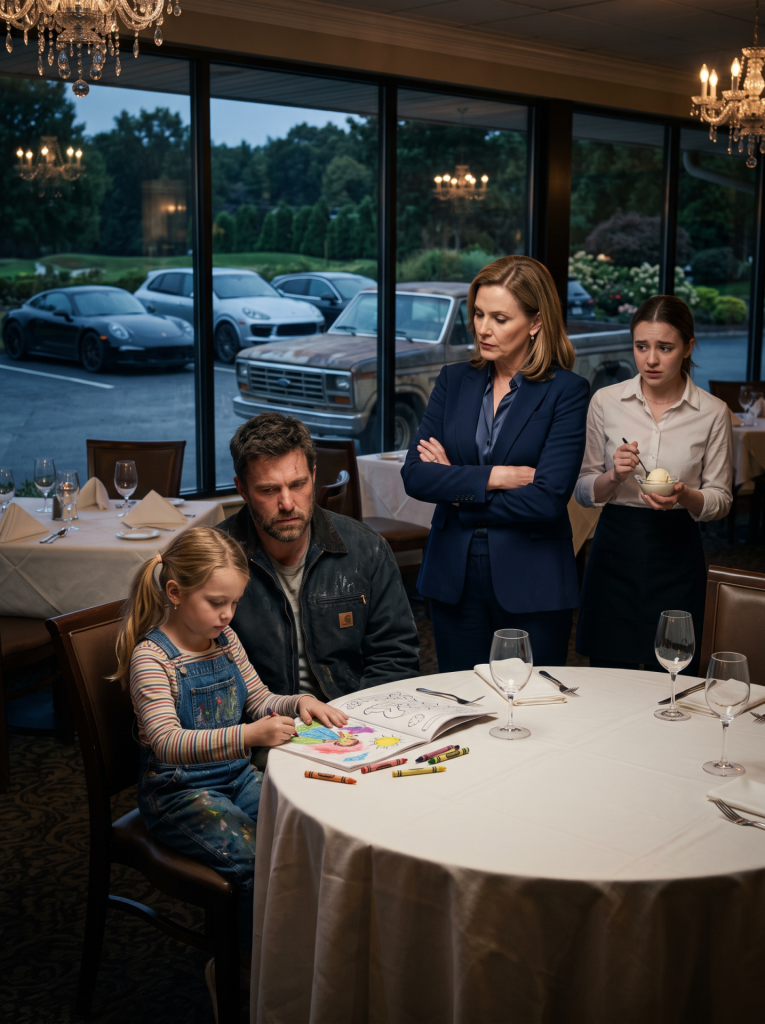

Her shoulders dropped with relief.
When I reached Lily, she held up her picture.
Three people sat at a table beside a blue swimming pool.
I recognized myself, Lily, and Sarah.
“Nora said Mommy liked this table too,” she told me.
I sat down before answering.
“She did.”
PART 4: THE WORK AFTER THE APOLOGY
I apologized to Lily on the drive home.
She looked puzzled.
“You didn’t say the mean thing.”
“No. But you came with me, and it was my job to make sure you felt safe.”
She considered that.
“Elena was nice.”
“She was.”
“Even before that lady knew you were the boss.”
I looked at her in the rearview mirror.
“That’s the part that matters.”
The following morning, I met with the staff.
I told them what would change immediately and what still needed investigation. Then I asked questions and listened.
Once people believed they could speak without losing shifts, the details came quickly.
A host had been instructed to mark unwanted reservations as cancellations. A groundskeeper had been blamed for course closures that never occurred. Servers had stopped reporting problems because Patricia punished whoever brought them to her.
I had delegated management. I had also allowed too much information to reach me through the same person employees feared.
That had to change.
Over the next three weeks, corporate reviewed the complaints and corrected the records. Employees received money they had been wrongly denied, and affected members received direct explanations and appropriate reimbursements.
We created a reporting channel outside the club’s management team.
We also rewrote the dining policy in plain language. Clean work clothes were welcome in the casual pool restaurant. Any genuine dress requirements elsewhere had to be published and applied consistently.
Choosing the next manager took longer.
Elena had worked at the club for five years, first coordinating banquets with Sarah and later training servers and supervising dining shifts. Before joining us, she had managed a small hotel restaurant.
Under Patricia, she had lost most of those responsibilities after repeatedly challenging questionable instructions.
When Mark suggested an outside candidate, I asked him to interview Elena too.
“Not because she helped Lily,” I said. “Because we should know what she can do.”
She went through the same interviews and budgeting exercise as the other candidates. We appointed her acting manager with support from an experienced regional director and reviewed her progress over six months.
She earned the permanent position.
Members began returning. Employees recommended friends for open jobs again. Complaints that once disappeared into an office were answered.
The financial review continued separately. It was slower and less dramatic than the confrontation, but the records mattered more than anything said in anger that evening.
I kept closer contact with the club without trying to run every shift.
And, little by little, Lily stopped asking whether her clothes were good enough before we went somewhere new.
PART 5: TABLE SEVENTEEN
Six months later, we returned for dinner.
It was raining again.
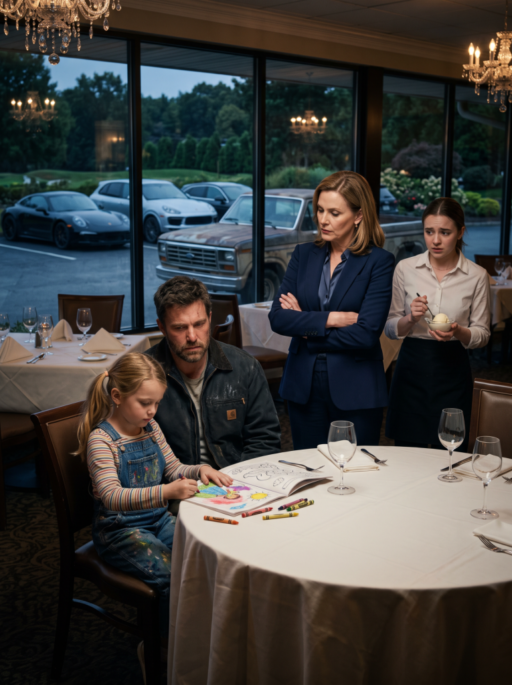
I wore the same jacket, and Lily carried the same box of crayons, though several were now broken and the yellow was nearly gone.
Elena met us near the entrance.
“Table seventeen?”
Lily nodded.
We had just ordered when another family arrived: two parents and two little boys, all wearing clothes marked with paint.
The father hesitated at the host stand.
“We have a reservation. Under Mercer.”
The host checked the screen.
“Of course. Would you prefer a booth or a table by the pool?”
No glance at their shoes. No pause to decide what kind of people they might be.
One of the boys asked whether they served ice cream.
Lily turned toward me, smiling.
“They should get vanilla.”
“After dinner,” I said.
She rolled her eyes.
Across the room, Elena noticed a server struggling with a tray. She took two plates, helped deliver the order, and returned to greeting a member.
Nobody stiffened when she walked past.
I thought about Sarah then—how she remembered birthdays, kept spare crayons at the desk, and noticed the people who looked uncertain in a room.
For a long time, returning here had felt like walking into the space she left behind.
That evening, it felt like finding something she had taught us to keep.
Lily slid her drawing across the table.
This one showed the pool, our dinner plates, and a bowl of ice cream much larger than either of us.
“You forgot something,” I said.
She frowned.
“What?”
“Your chicken.”
She groaned exactly as she had when Sarah said it.
I laughed, and for once the memory did not arrive with a weight I had to hide.
Outside, rain shimmered beneath the pool lights. Inside, the Mercer boys argued quietly over which dessert to share, and their parents relaxed into their seats.
Nobody needed me to stand up or make a call.
Lily reached for another crayon.
And this time, table seventeen was just a table.
That was exactly what it should have been.