
But Mason had made one thing unmistakably clear.
Walking through it once would be easy.
Proving he deserved to stay would take much longer.
Two days after Lucas visited our apartment, formal documents arrived from his attorney. Instead of demanding immediate custody or using his wealth to force himself into Mason’s life, Lucas requested structured family mediation and agreed to follow the recommendations of a therapist.
That choice didn’t erase the past, but it gave me enough confidence to allow the process to continue. Mason remained curious about his father without pretending that one honest conversation had repaired nine years of absence, and I made it clear that their relationship would develop according to our son’s comfort rather than Lucas’s guilt.
At first, Lucas still approached fatherhood the way he approached most problems: with money. A few weeks into the process, he arrived carrying an expensive new laptop for Mason, convinced that such a gift would help with his science and robotics projects.
“You can’t buy him a brand-new childhood with expensive electronics. He needs your consistent time, not your money.”
To his credit, Lucas didn’t argue. He returned the laptop and began replacing grand gestures with ordinary routines, picking Mason up after robotics club, taking him to simple dinners, and spending weekends helping him assemble science models.
Slowly, he learned the small things that couldn’t be discovered through a financial report or purchased with a credit card. He discovered that Mason hated avocados, preferred iced tea to soda, and could spend hours reading about deep-space astronomy without becoming bored.
I watched their relationship grow carefully because I knew Mason was testing Lucas even when he didn’t say so. Every promise kept mattered, but so did every disappointment, because my son needed to know whether this man would remain present after the excitement of discovering him disappeared.
Six months into the process, Mason had an important presentation at school. Lucas promised to attend, but a highway delay caused him to arrive twelve minutes late.
By the time he entered, the presentation had already begun. Mason pretended it didn’t matter, but I knew my son well enough to recognize the disappointment behind his silence for the rest of the evening.
Later that night, Lucas sent me a message.
“I failed our son again today.”
Reading those words, I realized he was in danger of making a different kind of mistake. Lucas had spent years defining himself by one catastrophic decision, and now he was treating every smaller failure as proof that he was destined to repeat it.
“Don’t turn a twelve-minute delay into another nine-year absence. Call him tomorrow morning and apologize.”
Lucas called exactly as I suggested. He didn’t blame traffic, his schedule, or anyone else; he simply apologized for arriving late and allowed Mason to decide when he was ready to talk.
That moment changed something in the way I viewed him. Lucas was finally learning that being a parent wasn’t about never disappointing your child, because that was impossible, but about accepting responsibility and continuing to show up after you made a mistake.
Over the following months, their relationship became increasingly natural. Mason began mentioning his father without carefully watching my reaction afterward, while Lucas stopped behaving as though every visit needed to compensate for nearly a decade he could never recover.
I also noticed something changing inside myself. For years, I had carried anger toward Lucas because anger had helped me survive the humiliation of our divorce, but watching him accept Mason’s boundaries made that anger less necessary.
That didn’t mean I wanted him back.
Our marriage belonged to another lifetime, and nothing Lucas did as Mason’s father could rewrite the husband he had once been to me. Forgiving enough to move forward was entirely different from pretending the damage had never happened.
A full year after Lucas first saw Mason on that award stage, the academy completed its new science laboratory. Mason was chosen to deliver the opening presentation, and when I entered the auditorium, I found Lucas already waiting in the front row.
He sat three seats away from me.
Not beside me as my husband.
Not behind me as a stranger.
Simply close enough to watch our son step onto the stage.
As Mason approached the microphone, Lucas rose immediately and began applauding. Mason looked down toward us, smiled brightly, and gave a small wave.
I lifted my camera and captured the moment.
The photograph looked nothing like the one our lives could have produced a year earlier.
And before that afternoon ended, Mason would give Lucas something no amount of money could ever have purchased.
A year after Lucas discovered Mason existed, I sat in the front row of the academy auditorium while our son prepared to open the new science laboratory. Lucas occupied a seat three places away from me, a distance that perfectly represented what our lives had become: we were connected through Mason, but we were no longer a couple and never would be again.
When Mason’s name was announced, Lucas immediately stood and applauded. Mason stepped confidently onto the stage, adjusted the microphone, and looked toward us with a bright smile before giving a small wave.
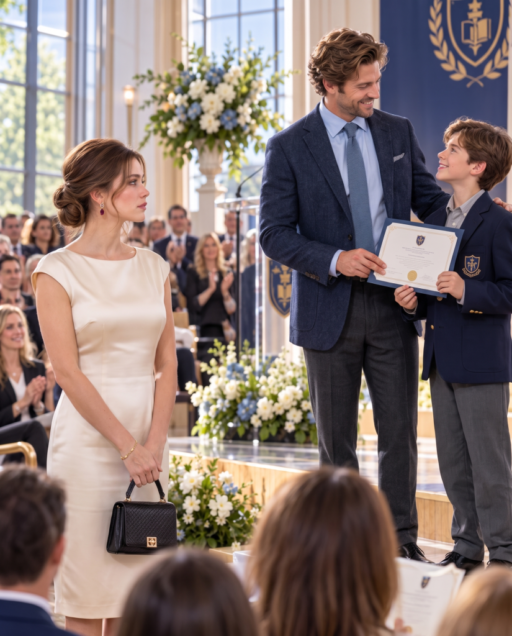
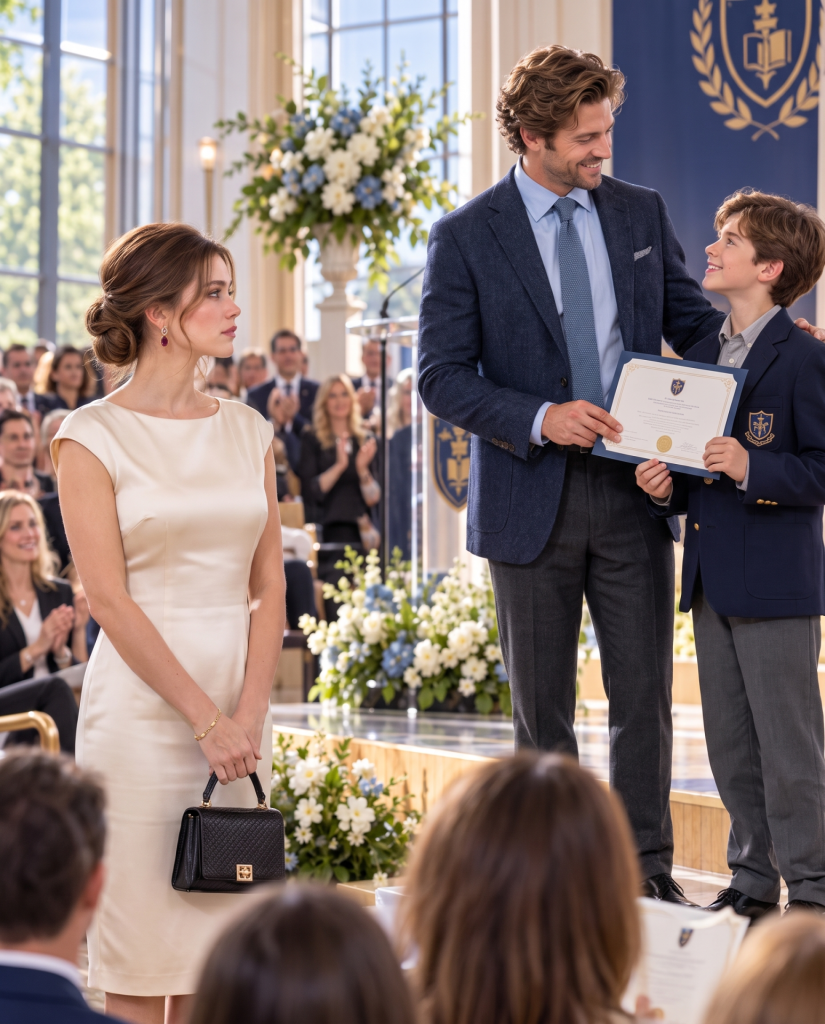
I raised my camera and took a photograph. It was completely different from the image I could have captured one year earlier, because this time there was no shocked father staring at a son he never knew existed and no mother wondering whether the past was about to invade the life she had carefully built.
Instead, I saw a child who knew exactly where he belonged. Beside him were two parents who had finally understood that loving him didn’t require them to repair a marriage that should remain in the past.
Mason delivered his presentation confidently and answered every question during the demonstration. When it ended, he hurried toward us, hugged me first, and then turned excitedly toward Lucas.
“Did you see that I got every single answer right during the demonstration?”
“I saw every single second of it.”
There was something different in Lucas’s expression now. He no longer looked like a man desperately calculating how to recover nine missing years, but like a father learning to appreciate the moments his son was willing to give him.
“I want to enter the national engineering contest next year. Will you help me program the automation software on weekends?”
“I’ll help whenever you need me.”
Mason smiled and started toward his classmates, already distracted by their excited conversation. After several steps, however, he suddenly turned around.
“Thanks, Dad! Don’t forget we’re buying project materials this Saturday.”
Lucas stopped moving.
For a second, I thought he might not have heard correctly. Then tears filled his eyes as he looked at the boy who had once allowed him to attend a robotics exhibition without promising forgiveness.
“I’ll never forget it, son.”
Mason ran back to his friends, completely unaware of how much that single word had meant. I watched Lucas wipe his eyes and realized that this was the moment he had been working toward for an entire year, yet it had arrived only after he stopped demanding it.
I didn’t feel jealous, angry, or threatened by their relationship. Mason calling Lucas “Dad” didn’t erase the years when I had raised him alone, just as Lucas becoming a better father didn’t transform him into the husband I once needed.
There would be no romantic reunion between us. Lucas and I had destroyed that possibility long ago, and rebuilding it simply because we shared a child would have turned Mason into the reason two adults ignored the truth about their own relationship.
What mattered was that Lucas had finally learned the difference between having a biological connection and earning a place in someone’s life. Money could fund laboratories, purchase equipment, and open doors, but it couldn’t create the trust Mason had slowly given him.
Nine years had been lost, and nothing could return them. Lucas would never see Mason’s first steps, hear his first words, comfort him on his first day of school, or experience thousands of ordinary moments that disappeared while he remained unaware that his son existed.
But being late didn’t mean everything afterward had to be destroyed.
I had once wondered whether keeping the pregnancy secret had made me the villain in Mason’s story, while Lucas had spent months wondering whether his failure as a husband permanently disqualified him from becoming a father. Eventually, we both understood that neither question mattered as much as Mason’s right to decide what relationship he wanted with each of us.
Fatherhood didn’t begin the moment Lucas discovered that Mason shared his blood. It began when he accepted boundaries, returned the expensive gifts, attended robotics meetings, apologized when he was late, and continued showing up without knowing whether Mason would ever call him Dad.
As I watched my son laughing with his classmates, I realized I no longer needed revenge against the man who had once hurried me through our divorce. The consequences of Lucas’s choices had already followed him for nearly a decade, while Mason had grown into a child capable of choosing his own future.
That was enough for me.
Justice hadn’t restored my marriage or erased the past.
It had simply returned the choice to the person who deserved it most: our son.