
I Married a 78-Year-Old to Save My Mother. Two Years Later, His Lawyer Revealed the Lie Behind Our Marriage.
PART 1: WHAT WAS LEFT IN THE TIN
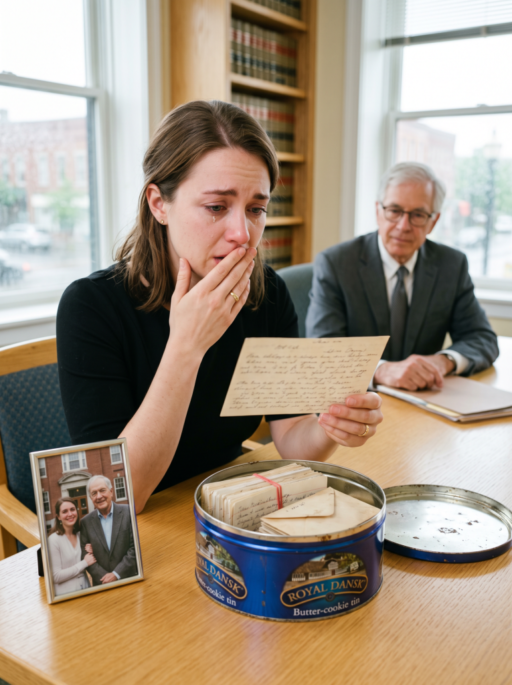
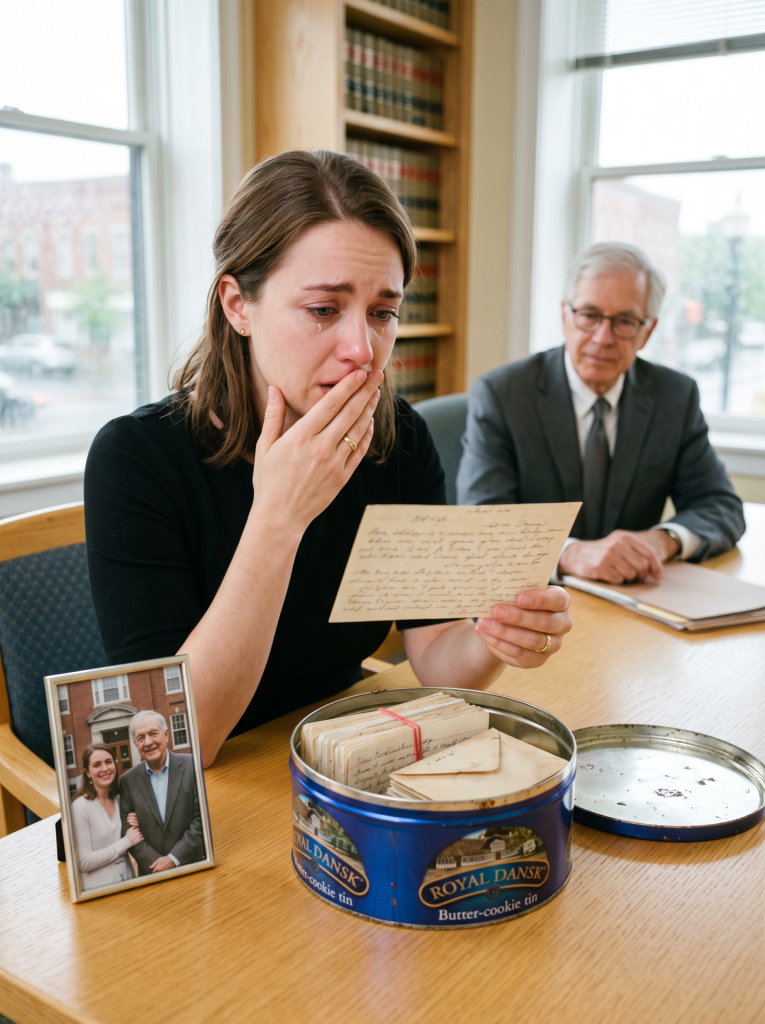
A week after I buried my husband, his attorney placed a faded blue butter-cookie tin between us.
Arthur Whitaker had been eighty years old.
I was twenty-seven.
Outside the office window, November rain blurred the storefronts of downtown Burlington, Vermont. Someone across the street was hanging Christmas lights.
I kept looking at the tin.
For more than two years, it had sat on the highest shelf in Arthur’s bookstore. Whenever I asked what was inside, he said, “Things I’m not finished with.”
Now he was gone.
Mr. Ellis rested his hands on a folder.
“Arthur asked me to give you this after the funeral. Whenever you felt ready.”
“Is there something else I need to sign?”
“No.”
I had signed so many things lately. Hospice paperwork. Funeral arrangements. Documents concerning the bookstore.
Once, I had signed an agreement to become Arthur’s wife.
Two years of companionship and practical help. In return, he would pay for my mother’s heart surgery, help me finish nursing school, and leave me the house on the lake.
The last promise had been a lie.
I knew that before he died.
Knowing had changed everything between us. It had also given me the first real choice I had made since entering that house.
I touched a rust spot along the lid.
“I don’t want another apology,” I said.
Mr. Ellis nodded.
“Then you don’t have to open it today.”
That was something Arthur had finally learned near the end: a choice was only a choice if I was allowed to say no.
I pulled the tin toward me.
Inside were dozens of old library checkout cards, bundled with rubber bands. Beneath them lay a small envelope with my name written in his unsteady handwriting.
On top was a single card.
The day Maya came back.
Underneath, he had written:
She left her suitcase in the car. For once, I knew she could leave whenever she wanted.
I pressed my hand against my mouth.
That was where our marriage had truly begun.
PART 2: A PRACTICAL ARRANGEMENT
When I met Arthur, I was twenty-five and working afternoons at Whitaker’s Books between nursing classes.
He was seventy-eight, a widower with a dry sense of humor and a habit of remembering what people read when they were sad.
He could not remember where he left his glasses.
Usually, they were on his head.
My mother needed a heart-valve operation. There had been delays over coverage, an appeal, and a growing list of expenses that did not stop at the hospital bill.
She had spent most of her life working at a diner in central Vermont. When she became too ill to work, her savings disappeared quickly.
I picked up extra shifts wherever I could.
Arthur noticed.
One evening, he found me at the bookstore’s back desk, trying to choose which overdue notice mattered most.
He did not look over my shoulder.
He set down a mug of tea.
“Is your mother getting worse?”
I nodded.
He pulled out the other chair.
“Tell me what’s happening.”
A week later, he made his proposal.
He had cancer. Treatment might give him more time, but nobody could promise how much. He lived alone in a house overlooking Lake Champlain, and the silence there had begun to frighten him.
“I could hire a caregiver,” he said. “I know that.”
“That would make more sense.”
“Probably.”
He looked toward the front windows.
“I miss having someone who belongs in the house. Someone who notices if I’m being impossible.”
“Your customers notice that.”
He smiled.
Then he asked whether I would consider marrying him.
There would be separate bedrooms. No expectation of romance or physical intimacy. I would help with meals, appointments, and the bookstore, around my studies.
He would use his savings to cover the agreed medical expenses and the remainder of my tuition.
After two years, I could stop providing that help. If I wanted to end the marriage, he would cooperate. What he had already paid would not become a debt I owed him.
And when he died, he said, the lake house would be mine.
That promise made me look up.
Everyone in town knew the house: cedar siding, enormous windows, a narrow dock stretching into the water.
“Why me?”
Arthur folded his hands.
“Because you’re kind to people when you don’t think anyone important is watching.”
I wish I could say I accepted because of that answer.
I accepted because my mother called that night trying not to cry over another bill.
We took several days to put the arrangement in writing. A local attorney I consulted reviewed the proposed terms and recommended further work on the estate provisions, including verification of the house’s ownership.
Arthur said his longtime lawyer would handle it.
I should have followed up.
I was frightened about my mother, exhausted, and eager to believe the problem in front of me finally had a solution.
We married quietly at city hall.
Arthur wore a suit that smelled faintly of cedar.
My mother held my hands afterward.
“You don’t have to save me this way,” she whispered.
“I know.”
But I did not really believe that yet.
PART 3: THE LIFE BETWEEN APPOINTMENTS
Arthur paid the medical expenses we had agreed on directly. My mother had her operation and began the slow work of recovering.
He paid my tuition, too.
Those promises were real.
At first, I treated the rest as employment.
I wrote appointments on a calendar. I kept receipts. I learned which soup he would eat after treatment and which pills made him nauseated.
I also looked up the lake house online.
One afternoon, I took photographs of the dock.
Arthur watched from the porch.
“Good light today,” he said.
I lowered my phone, ashamed.
He looked away first.
Our routine settled around the things each of us needed.
I made tea before class. He complained that I let it steep too long, then drank every drop.
On afternoons I worked at the bookstore, he sat near the register and recommended novels to people who had come in for birthday cards.
When he was well enough, he cooked.
When he wasn’t, he issued instructions from a kitchen chair.
“That’s enough salt.”
“I haven’t added any.”
“Good. We agree.”
There were paid aides on the days my classes and clinical placements kept me away. Arthur had promised not to turn my education into something I finished only if he happened to feel well.
The first time I offered to miss a clinical shift, he pointed at my shoes.
“Put those on.”
“You were sick all night.”