
My name is Renata Ferris, I’m thirty-four, and until one particular week, I would have said without hesitation that I understood the man I had married. Luca and I had been together for six years and married for four, after meeting at a continuing education seminar where he represented a medical supply company and I was renewing my occupational therapy license.
By the time we married, Luca had moved into industrial sales, eventually specializing in commercial cleaning and sanitation products. His job kept our garage filled with samples, discontinued inventory, and unfamiliar bottles, all meticulously arranged around a workbench and a metal cabinet he simply called his cleaning cabinet.
Our marriage had never seemed dangerous to me, although Luca liked controlling certain parts of our life. He handled the finances, had strong opinions about how I organized things, and sometimes became irritated when I made plans without consulting him, but after six years I had learned to interpret those habits as simply part of his personality.
Everything changed on an ordinary Tuesday evening when I slipped while carrying laundry down the basement stairs. My heel scraped against the concrete, leaving a shallow but bloody cut about two inches long along the back of my right ankle.
Luca returned from a sales trip that evening and immediately insisted on replacing the bandage I had applied myself. He brought in what he called his “real” first-aid kit from the garage and examined the injury with such confidence that I felt relieved to let him handle it.
“You don’t need to go anywhere for this. I see worse than this in the field all the time. Just keep it clean and dry, and let me change it before bed.”
I trusted him. Given his professional experience with medical and industrial products, questioning his judgment never crossed my mind.
By the second morning, my ankle had developed a deep ache and slight swelling. Luca examined it that evening and assured me that swelling was a normal part of healing before changing the dressing again.
“That’s normal. Bodies swell when they’re healing. I’ll change the dressing again tonight, keep an eye on it.”
Whenever he treated the wound, Luca encouraged me to close my eyes or look away while he handled the more delicate parts. It seemed reasonable at the time, so I never questioned why he didn’t want me watching.
By the third day, the swelling had spread and reddish heat was moving toward my shin. I suggested seeing a doctor, but Luca remained completely calm.
“Tomorrow. If it’s not better by tomorrow, I’ll take you myself. I promise. Let’s just give the ointment one more night to work.”
That word became a pattern. Tomorrow.
By the fourth day, I had developed a fever, and by the fifth, the skin surrounding the wound had turned frighteningly discolored. When I insisted that we should visit urgent care, Luca again told me I was overreacting and promised that his stronger ointment only needed one more night.
For six years, I had gradually learned to trust Luca’s judgment above my own instincts, whether the subject was money, schedules, or household decisions. Without realizing it, I had begun doing exactly the same thing with my own body.
By the sixth day, I could barely stand on my injured foot and my fever was high enough to leave me drifting in and out of an exhausted haze. That evening, while Luca changed the dressing, I briefly glimpsed the wound before he told me to close my eyes.
It looked nothing like a healing scrape.
I said nothing, but something inside me finally stopped believing him.
The following morning, Luca left for a two-hour sales meeting. As soon as his car disappeared, I peeled back the dressing myself for the first time in seven days.
What I saw was enough.
I picked up my phone, called a cab, and left without asking my husband for permission.
I barely remembered making it down the stairs and reaching the curb. I had to steady myself against the porch railing, then the mailbox, and finally the cab itself, while the driver stared at me with obvious concern.
During the entire ride to the hospital, I was terrified Luca might return early, discover I was gone, and somehow stop me before I reached the emergency room. Looking back, that fear seems difficult to explain, but in that moment, escaping the house without his permission felt like the most dangerous part of what I was doing.
The triage nurse took one look at my ankle and temperature and immediately moved me ahead of the waiting room. Even then, some conditioned part of me expected the doctors to tell me Luca had been right and I had simply overreacted.
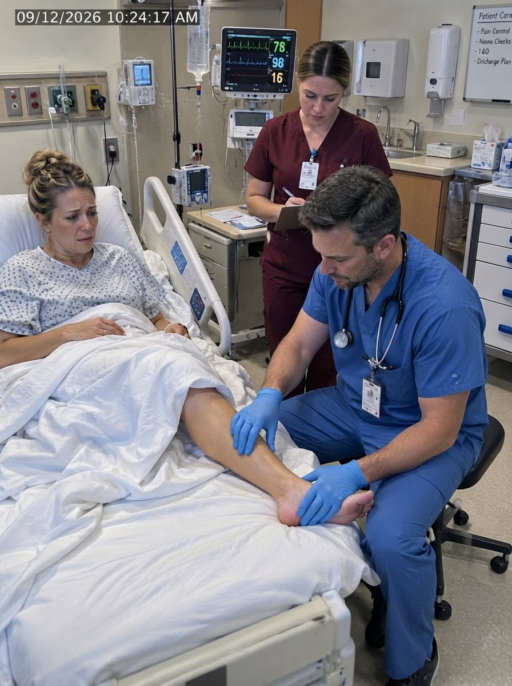
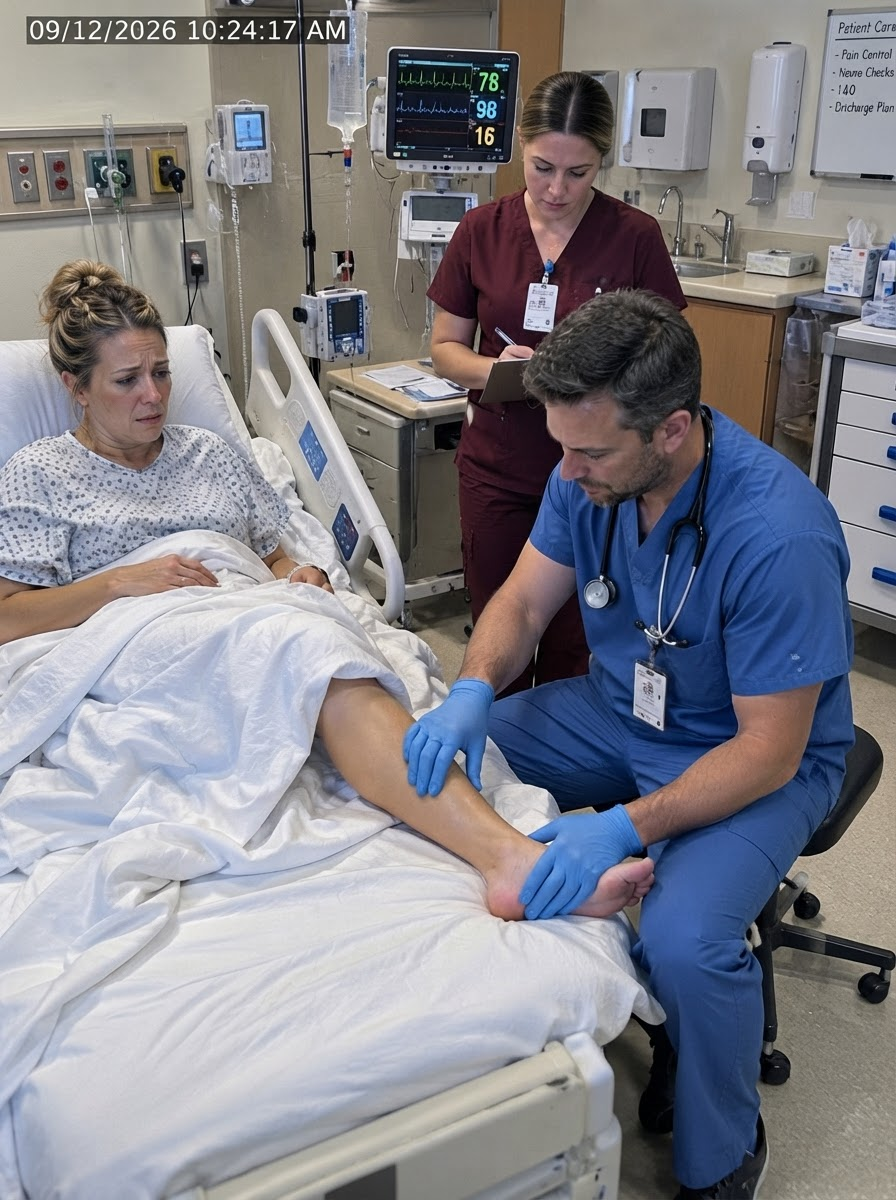
Instead, Dr. Marcus examined the wound and suddenly froze. His expression changed as he lifted the dressing, and the calm efficiency in the room became noticeably more urgent.
“I need to get a sample of this dressing to the lab. And I want to talk to you, separately, about exactly what’s been happening with your care over the past week.”
Within minutes, nurses started an IV while another doctor marked the spreading discoloration around my ankle so they could monitor it. Soon afterward, Detective Hall entered my room and gently asked whether I felt safe answering questions about what had been happening at home.
I told her about the fall, Luca’s nightly dressing changes, and every promise that we would see a doctor “tomorrow.” I also explained how he repeatedly told me not to touch the bandage and asked me to close my eyes whenever he treated the wound.
Almost as an afterthought, I mentioned the security camera in our garage.
“Does it still work?”
“Luca told me it broke months ago. He said he never got around to fixing it.”
Detective Hall’s expression shifted before she stepped outside to make a phone call. Before I could understand why that detail mattered, Dr. Marcus returned with the laboratory results from the residue on my dressing.
“The material on the gauze is consistent with a highly caustic alkaline cleaner. It can cause severe chemical burns and tissue damage. Combined with an existing wound, repeated exposure could make the injury significantly worse.”
My throat tightened.
“Did he cause the fever?”
Dr. Marcus explained that the fever and condition of my leg suggested a serious infection or inflammatory response that required aggressive treatment. What the laboratory had established separately was that my open wound had repeatedly been exposed to a dangerous chemical.
The substance Luca had described as treatment had actually been damaging my ankle.
Detective Hall soon returned with another disturbing update. Luca was downstairs demanding to see me, insisting that I was confused because of the fever and claiming he had only been taking care of me.
“Can he come here?”