
I watched most of it from a distance because I had no desire to make Nathan the center of our lives again. I had spent thirteen years building a home in which my sons could grow without waiting for a father who had repeatedly chosen not to appear.
Then I received a call about something I had stopped expecting long ago.
My old child-support case had been reopened.
Nathan had spent thirteen years avoiding an obligation that never disappeared simply because he refused to acknowledge it. The unpaid support was converted into a legal judgment against assets he had spent years protecting, forcing him to confront a financial responsibility he had treated as though it belonged to someone else.
I thought the news would make me feel victorious, but mostly it reminded me of what those numbers represented. They were groceries bought after double shifts, school supplies stretched across another month, medical bills, shoes, textbooks, rent, and all the ordinary expenses that never paused simply because Nathan had decided fatherhood was inconvenient.
Preston also quietly transferred to another school and stopped competing for a while. I never blamed him for what Nathan and Celeste had done, and I genuinely hoped he eventually discovered a life in which his worth wasn’t measured by trophies, rankings, or his father’s ambitions.
My own sons had already learned something very different.
Eli and Ethan received full scholarships to the state science academy. The acceptance letters arrived only weeks apart, and both boys tried to behave as if leaving home was simply another challenge to solve rather than the beginning of an entirely new life.
On move-in day, we packed the car with clothes, books, electronics, and far too many snacks. When we reached campus, they insisted on carrying their own boxes into the dorm while I stood near the car pretending my eyes weren’t filling with tears.
For years, I had imagined this moment differently. Somewhere inside me had remained the image of two little boys sitting on a courthouse bench, wondering why their father could walk away from them so easily.
Those boys were gone now.
In their place were two young men walking toward a future they had earned without Nathan’s money, approval, connections, or surname. Watching them cross that campus, I realized the greatest consequence Nathan faced wasn’t the investigation, his resignation, or even thirteen years of unpaid support finally becoming a judgment against him.
Those things could be measured.
What Nathan had truly lost couldn’t.
Ethan returned from the dorm first and wrapped his arms around me.
“We did this because of you.”
Eli came beside him and kissed my forehead.
“He missed everything.”
I looked at my sons, then across the bright campus stretching behind them. For thirteen years, I had believed the same thing, but standing there, I finally understood that Nathan’s loss was far more specific than that.
“No.”
They both turned toward me.
“He didn’t miss everything.”
I smiled as they waited for me to finish.
“He missed the only thing that mattered.”
The months after the championship were quieter than I expected. Nathan’s name still appeared occasionally in articles about the Crowe Preparatory accreditation review and the donor scandal, but I stopped reading them because I had already spent too much of my life measuring time by what he had done or failed to do.
For thirteen years, I had believed that raising Eli and Ethan alone meant constantly compensating for something missing. I worked double shifts, took night classes, searched for scholarships, stretched every dollar, and tried to answer questions about their father without allowing my anger to become theirs.
There had been birthdays when I secretly watched the phone, wondering whether Nathan might finally call. Christmases came and went without cards, and school ceremonies ended with my sons scanning the crowd even after they were old enough to pretend they no longer cared.
Eventually, they stopped asking when he would come back.
I had once considered that heartbreaking. Now I understood it was the moment they began building their identities around the people who actually stayed.
Eli and Ethan never needed Nathan to teach them ambition because they found their own reasons to work hard. They built engineering projects from secondhand parts, solved mathematics problems wherever they could find space to write, and challenged each other without turning every achievement into a competition for affection.
Their success at the championship hadn’t been revenge. The Governor’s Cup simply made visible what had already been true for years: Nathan’s absence had never defined their potential.
The same was true for me.
When Nathan left, I had been a frightened mother with two small children and bills I didn’t know how to pay. Thirteen years later, I had earned my doctorate, built a respected career, joined the State Academic Integrity Board, and raised two young men who understood that integrity mattered more than applause.
Nathan had mocked my clothes and assumed I belonged with the catering staff because he still remembered the woman he abandoned. He had never imagined that while he was constructing a new life, I had been constructing one too.
The difference was that mine didn’t require pretending the past had never happened.
On the morning Eli and Ethan officially began classes at the science academy, they sent me a picture from outside their residence hall. Ethan was holding a stack of books against his chest while Eli pointed dramatically toward one of the campus buildings, and beneath the photograph was a message.
We’re going to be fine, Mom.
I stared at those words for a long time.
Thirteen years earlier, I had been the one saying that to them, even when I had no idea whether it was true. I had repeated it through overdue bills, fevers, school problems, lonely birthdays, and every moment when being both parents felt heavier than I wanted them to know.
Now they were saying it to me.
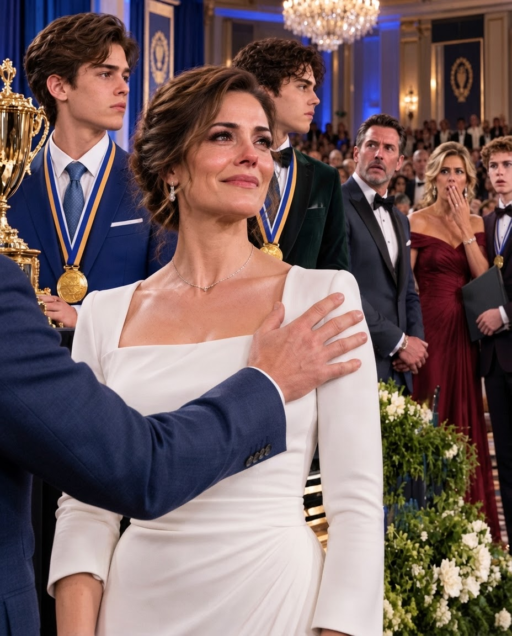
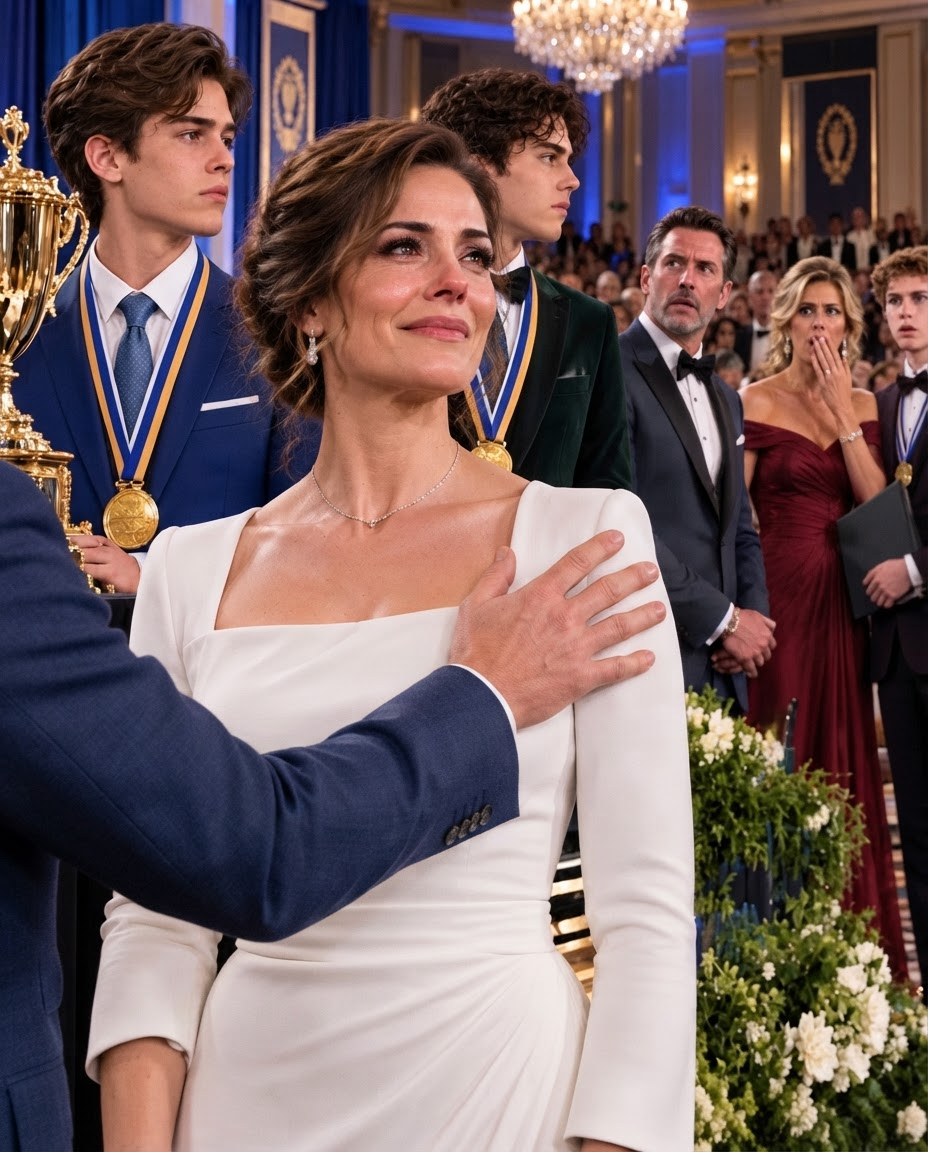
That evening, I placed the championship photograph on my bookshelf. In it, Eli and Ethan stood on either side of me with the Governor’s Cup between us, while somewhere outside the frame Nathan was being escorted away from the ceremony.
I didn’t need him in the photograph.
I didn’t need an apology either.
Nathan had lost thirteen years believing that abandoning his children had freed him from responsibility. What he never understood was that while he was escaping fatherhood, he was also surrendering every birthday, every school morning, every ridiculous kitchen-table conversation, every quiet victory, and every chance to know the extraordinary young men his sons became.
That was why, when Eli said Nathan had missed everything, I corrected him.
Nathan hadn’t missed everything.
He had missed the only thing that mattered: the privilege of being there while his children became themselves.