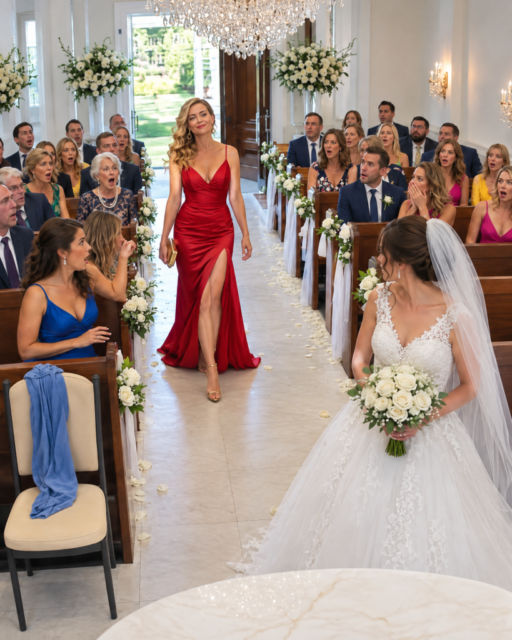
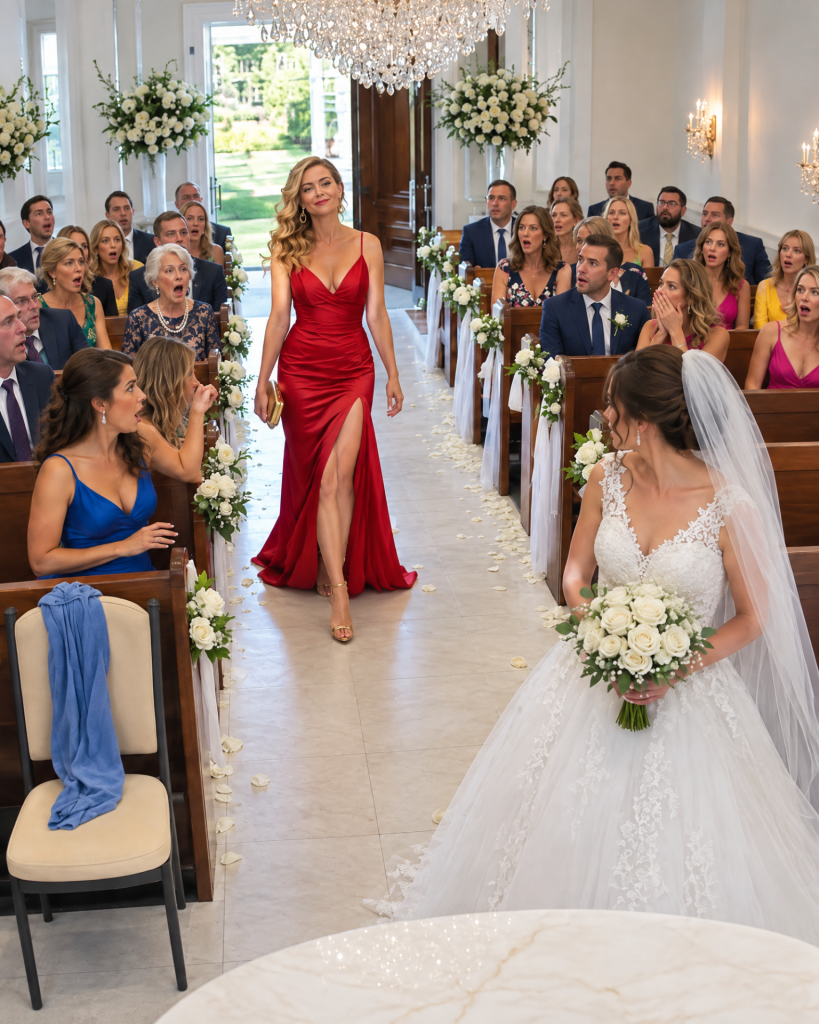

My sister walked into my wedding wearing white—not ivory, champagne, or one of those pale dresses someone could defend by blaming the lighting, but unmistakable bridal white. The moment Paige appeared at the back of the chapel, conversations stopped, my aunt stared openly, and my cousin covered her mouth as if she had just witnessed a disaster unfold.
Brooke, my maid of honor, immediately turned toward me with panic in her eyes. She looked ready to physically remove Paige from the church if I gave her permission.
“Clara, do you want me to handle this?”
I kept my eyes on my sister. Her hair fell in perfect curls over one shoulder, her lips were painted the same soft rose shade I had worn since college, and the silk dress fit her so perfectly that anyone would have assumed it had been made specifically for her.
It had.
“No,” I said quietly. “Let her come in.”
Brooke stared at me as though I had lost my mind, but I knew exactly what I was doing. For twenty-nine years, Paige had treated life like a stage and my milestones like opportunities to redirect the spotlight toward herself.
At my high-school graduation, she announced her engagement. When I bought my first house, she posted online about how I had supposedly abandoned our family, and when Ethan proposed to me, she laughed before offering a warning I never forgot.
“Enjoy it while he still thinks you’re the special one.”
Years ago, I would have fought back, but eventually I became exhausted by the competition. Mom used to tell me that some people steal other people’s light because they never learned how to create their own, and for years, those words helped me tolerate Paige.
But Mom wasn’t there anymore.
An empty chair waited in the front row with her blue scarf folded carefully across it. She had died eight months before my wedding, leaving behind a silence that neither Paige nor I knew how to handle.
I buried myself in work and wedding preparations because staying busy kept grief from swallowing me. Paige reacted differently; she stopped answering my calls, skipped my dress fitting and bridal shower, then told relatives that I was too busy creating my perfect life to notice that she had lost her mother too.
Maybe there was some truth in that accusation. I had been so focused on surviving my own grief that I hadn’t always recognized hers, but grief didn’t erase the years of resentment that had existed between us long before Mom became sick.
So when my wedding planner quietly told me Paige had been calling boutiques asking for something “bridal but technically not a wedding dress,” I knew exactly what she was planning. Instead of confronting her, I made a decision that even Ethan didn’t fully understand at first.
I bought the dress myself.
I had it altered to Paige’s measurements and delivered anonymously to her hotel room before the wedding. There was no card explaining who had sent it, only a single note tucked inside the box.
Wear this if you need everyone to look at you.
Paige accepted the invitation.
Now she was walking down my aisle in the exact dress I had chosen for her, pretending not to notice the whispers following her through the chapel. She carried herself with the confidence of someone who believed she had already won.
Ethan leaned closer as Paige approached.
“Are you okay?”
I looked at the man I was minutes away from marrying. There was no anger in his expression and no desire to create a scene; he was only worried about me, which was one of the reasons I loved him.
“I’m okay.”
Paige finally reached the front and stopped beside me. Her smile widened as she glanced at my dress, clearly waiting for anger, humiliation, or some other reaction that would confirm she had successfully disrupted my wedding.
“Surprise,” she whispered.
I smiled back.
“Yes. It is.”
For the first time, uncertainty flickered across her face.
Before Paige could say anything else, Pastor Reynolds stepped forward carrying a small sealed envelope I had given him earlier that morning. He cleared his throat, and the remaining whispers disappeared from the chapel.
“Before we begin, Clara has asked for one family matter to be addressed.”
Paige’s smile faded.
I glanced toward Mom’s empty chair and the blue scarf resting across it. For months, I had wondered whether following her instructions was cruel, compassionate, or somehow both, but now there was no turning back.
Pastor Reynolds looked directly at Paige.
“Your mother left something for you.”
The color disappeared from my sister’s face.
After Mom died, I had found a cedar box beneath her bed containing two letters, one addressed to me and another meant for Paige. Mine was simple: Mom told me to marry with a clean heart and warned me not to carry bitterness with me to the altar.
Paige’s letter was different.
Mom had hidden it inside the lining of a white silk dress she had ordered before her illness became too severe. Along with it, she had left instructions that made almost no sense to me at the time.
If your sister ever wears white to your wedding, don’t stop her. Let her. Then give her this.
I had hated those instructions when I first read them because they felt like another request for me to tolerate Paige’s behavior. Eventually, however, I realized Mom hadn’t asked me to stop what Paige might do; she had asked me to let Paige reveal it herself.
Pastor Reynolds extended the envelope.
Paige’s hands trembled as she accepted it.
She had walked into my wedding believing the white dress would embarrass me in front of everyone I loved. What she hadn’t known was that I had chosen that dress, sent it to her, and spent months waiting to see whether she would actually wear it.
Now she had.
And as Paige stared at our mother’s handwriting across the envelope, she finally understood that the white dress hadn’t ruined my plan.
It had completed it.
Paige stared at the envelope as though she were afraid to open it. Around us, more than a hundred wedding guests had fallen silent, but for the first time since she entered the chapel, my sister didn’t seem interested in their attention.
Her fingers trembled as she broke the seal.
“This is ridiculous,” she whispered.
But she opened the letter anyway.
Her eyes moved across the first line, and almost immediately, the confidence disappeared from her face. She pressed one hand over her mouth while the paper shook between the fingers of the other.
My sweet Paige, if you are reading this, it means you are hurting louder than you are loving.
My throat tightened as I watched her.
I had already read my own letter, but I had never opened Paige’s. Mom had made that condition very clear: whatever she had written belonged to my sister, and Paige alone had to decide whether anyone else would hear it.
For several seconds, she said nothing.
Ethan gently squeezed my hand.
“You don’t have to continue this,” he whispered.
I looked toward Mom’s empty chair, where the blue scarf remained folded across the seat. Then I looked back at Paige, standing in the white dress she had chosen to wear as a challenge.
“Yes,” I whispered. “I do.”
Paige swallowed and looked at the letter again. When she finally began reading aloud, her voice was so quiet that the people in the back rows leaned forward to hear her.
“Mom says she knew the face I made whenever I felt forgotten. She knew I used jokes when I was hurting, and that I learned to say something cruel before anyone could ask what was wrong.”
Paige stopped and looked at me.
There was something in her expression I hadn’t seen in years.
Fear.
Not fear that the guests would judge her for wearing white, but fear that our mother had understood exactly why she had done it.
My father shifted in the front row. For most of our childhood, he had described Paige as “fire” and me as “water,” as though those labels explained everything about us.
Paige was loud, emotional, impulsive, and impossible to ignore. I learned early that being the quieter daughter made life easier for everyone, so whenever Paige exploded, I was expected to remain calm.
When she made mistakes, I was asked to understand. When she demanded attention, relatives reminded me that I already received plenty.
At the time, I thought those compromises kept our family peaceful.
Standing at the altar, I began wondering whether they had helped create the problem instead.
Paige continued reading.
“Mom says we were never supposed to become enemies. She said somewhere along the way, we started competing for love that already belonged to both of us.”
My chest tightened.
For years, I had built a simple explanation for my sister: Paige was jealous, selfish, and incapable of allowing anyone else to be happy without making the moment about herself.
That explanation wasn’t entirely wrong.
But maybe it wasn’t complete.
Paige wiped her cheek and continued.
“She says if I’m wearing white at your wedding, everyone will assume I wanted to steal your day.”
A nervous breath moved through the chapel.
Paige’s voice became quieter.
“She says maybe part of me did.”
Nobody moved.
Then she read the next sentence.
“But she thinks another part of me wanted someone to stop me. Someone to notice how lost I’d become.”
Paige broke.
The letter slipped from her fingers and fell onto the chapel floor as she covered her face. There was nothing graceful or theatrical about the way she cried; it sounded like years of anger had finally collapsed under their own weight.
For a moment, I remained beside Ethan.
I had imagined confronting Paige countless times. In some versions, I finally told her everything she had done to me; in others, she stormed out while everyone watched her humiliation.
I had never imagined feeling sorry for her.
Slowly, I stepped down from the altar.
That was when Paige finally looked at what I was wearing.
My wedding dress wasn’t white.
It was pale blue.
Mom’s favorite color.
It matched the scarf resting on her empty chair and reminded me of the dresses she wore in the photographs where she looked happiest. Paige had expected to stand beside me in white and force everyone to compare us, but there was no comparison to make.
“Don’t,” Paige whispered as I approached.
I stopped in front of her and picked up the letter.
“I didn’t know,” she said.
“Didn’t know what?”
“That Mom saw me like that.”
I handed the letter back.
“She saw both of us.”
Paige shook her head.
“No. She saw you. She always saw you.”
There it was.
The sentence beneath almost every argument we had ever had.
Paige looked directly at me, no longer caring about the guests surrounding us.
“You were the daughter she was proud of. Clara got good grades. Clara remembered everyone’s birthday. Clara helped when Mom was sick. Clara never caused trouble.”
Her voice cracked, but she continued.
“And I was always the difficult one. Too loud. Too emotional. Too much.”
I could have answered with a list of everything she had done to me. I could have reminded her of the milestones she had disrupted, the cruel jokes she had disguised as humor, or the days she disappeared while Mom was dying.
Instead, I told her the truth she had never considered.
“I needed things too, Paige.”
She blinked.
“I just learned to stop asking.”