

When my friend Leah finally drove me away from the hospital, the sky above New York was turning pale gray. We passed the road leading toward my parents’ neighborhood, and I watched it disappear behind us without asking her to turn.
Then my phone rang.
It was my seventeen-year-old cousin, Nora.
Her voice trembled when she spoke.
“Ella, I have something from the party.”
“What?”
“A video.”
She had been recording Mark’s promotion toast and hadn’t stopped when Dad came toward me. Her phone had captured what happened afterward—including Dad’s actions, Mark’s reaction, and the guests who stood watching.
Then Nora told me the part that made my stomach tighten.
Her father had already ordered her to delete it.
Nora told me she had been recording Mark’s toast when Dad crossed the yard toward me. She had captured everything—the strike, my scream, Mark’s words afterward, and dozens of guests watching without stepping forward.
Then she admitted that her father, my uncle Dean, wanted the recording erased. He had been standing beside the barbecue when it happened, and apparently his first instinct was still to protect the family from embarrassment rather than preserve evidence of what everyone had witnessed.
“Don’t delete it,” I told Nora. “But don’t send it around either. I’ll give you Investigator Bellamy’s number.”
Nora hesitated before asking whether her father would hate her if she cooperated. I couldn’t promise how Dean would react, so I told her the only thing I knew for certain: whatever happened afterward, she wouldn’t have to face it alone.
She preserved the original video and gave it directly to investigators.
When I watched it two days later, Dad’s actions weren’t the hardest part to see. What broke me was Mom standing several feet away, folding the corner of a napkin over and over while her husband hurt her daughter in front of nearly seventy people.
Three days after the party, Mom came to my apartment.
I didn’t open the door.
She told me she hadn’t known what to do when Dad lost control, and I reminded her that saying “stop” would have been a beginning. When she answered that she had been afraid, I told her I had been afraid too.
Then the real reason for her visit emerged.
Investigators were asking questions about Dad’s company, and he believed they were twisting innocent business records into something criminal. Mom wanted me to reconsider what I had started, but I refused to become the person responsible for making his consequences disappear.
“If you know something, get your own lawyer and tell the truth,” I said. “But don’t come here asking me to undo this.”
The investigation expanded during the following weeks.
Bank transactions matched instructions in Dad’s notebook, phone records aligned with meetings, and recovered messages supported accounts from witnesses who had never met one another. Mark’s police records also showed access to information he had claimed he knew nothing about.
The case wasn’t becoming stronger because I was their daughter or because people felt sorry for me.
It was becoming stronger because the evidence agreed.
One of the witnesses who eventually came forward was Miriam Vega, Julian Ortiz’s girlfriend. When we met at the prosecutor’s office, she told me Mark had warned her that nobody would believe her and suggested that continuing to resist could create problems involving her daughter.
Dad had approached her too.
“He came to my workplace,” Miriam said. “He told me good mothers know when to cooperate.”
The words made me cold because I recognized the logic immediately. Good daughters stayed quiet, good wives protected their husbands, and good mothers accepted whatever frightened them if speaking might make powerful men uncomfortable.
Miriam had changed her statement.
Soon afterward, money from Dad’s company appeared in the records.
She showed me a photograph of her nine-year-old daughter, Sofia, standing beside a crooked birthday cake with one front tooth missing. Julian had spent three of her birthdays behind bars, and suddenly the documents I had discovered were no longer simply numbers on a spreadsheet.
They represented years people couldn’t recover.
The investigation wasn’t flawless. One witness withdrew cooperation, another remembered an important date incorrectly, and defense attorneys challenged how documents had been obtained and whether certain searches were valid.
For several days, I became convinced everything might collapse.
Bellamy refused to comfort me with promises she couldn’t make.
“Evidence has to be tested,” she said. “Believing you isn’t the same as proving every allegation.”
Strangely, that made me trust the process more. My father had built his authority on people accepting his word because of his reputation, and I didn’t want accountability to depend on anyone blindly accepting mine.
Meanwhile, the consequences inside my family continued.
Mom hired her own attorney and eventually gave investigators a recorded statement. Bellamy later told me that my mother had previously signed a false account placing Dad somewhere else during one of his meetings with Miriam.
She hadn’t simply looked away.
She had helped him.
When Mom asked to meet, I agreed only if we met at her attorney’s office. I prepared myself to leave if she blamed me, minimized what Dad had done, or asked me to save the family.
Instead, she sat across from me without her wedding ring and said, “I lied.”
She admitted knowing about the false statement. Then she acknowledged covering for Dad during incidents from my childhood, including times when she had given other people explanations for injuries I hadn’t received accidentally.
“You knew?” I asked.
“I knew.”
I had imagined that hearing those words would feel like victory.
Instead, it felt like grief finally being given the correct name.
Mom cried, but I didn’t reach across the table to comfort her. For the first time, she allowed me to remain hurt without asking me to make her feel better about being the person who had helped cause it.
A week later, Uncle Dean asked to meet me.
He admitted that he had told Nora to delete the video because he thought staying out of the conflict would preserve peace. When I asked whose peace he had been protecting, he looked down before answering.
“Your father’s.”
I didn’t tell him everything was forgiven.
Instead, I told him what he could do now: stop teaching Nora that fear made her disloyal, cooperate honestly with investigators, and correct relatives whenever they claimed I had destroyed the family.
Over the following months, he did exactly that.
Then, ten weeks after Mark’s promotion party, Bellamy asked me to come to court.
Julian Ortiz’s conviction was being reviewed.
The hearing was quiet and procedural, nothing like the dramatic courtroom moment I had imagined. Prosecutors presented evidence of false testimony, witness intimidation, and information that should have been disclosed before Julian was convicted.
Then the judge set aside his conviction.
The prosecution announced it would not retry him.
Hours later, I stood at a distance as Julian walked out of the facility carrying his belongings in a clear plastic bag. Sofia ran toward him, and he dropped everything before wrapping both arms around his daughter.
Eventually, Julian walked over to me.
“I wish I’d found the records sooner,” I said.
His face carried the exhaustion of a man who had lost years no apology could return.
“So do I,” he answered.
I nodded because he deserved the truth more than he needed me to feel better.
Then Julian looked back at his daughter.
“But you found them.”
Months later, as the criminal case against Dad and Mark moved toward trial, I learned that freeing Julian hadn’t been the end of what my family’s secrets would uncover.
It had only been the first consequence they could no longer explain away.
The criminal case against Dad and Mark took months to reach trial. During that time, attorneys challenged documents, questioned witnesses, and argued over what investigators had been entitled to search, while I slowly learned that telling the truth once was very different from continuing to stand behind it when everyone began examining it.
The video from Mark’s promotion party eventually reached the internet through someone outside our immediate circle. For two days, strangers debated my life as though they knew us, with some calling me brave while others insisted I had provoked Dad by embarrassing him in front of his guests.
I wanted to answer every accusation.
Leah stopped me.
“You don’t have to convince every stranger,” she said. “The evidence has somewhere more important to go.”
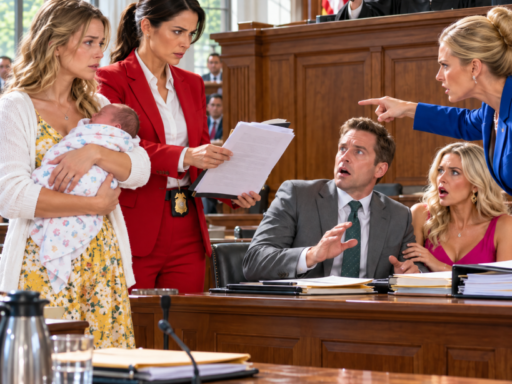
Nine months after the party, the trial finally began. Dad entered the courtroom in a dark suit, while Mark wore gray and avoided looking toward the benches where I sat with Leah and Investigator Bellamy.
When I was called to testify, my legs felt unsteady.
For one brief moment, seeing Dad watch me from across the courtroom made me feel like a child again, trying to explain some mistake before he decided whether my answer was acceptable. Then I looked toward Leah and Bellamy and remembered that this room did not belong to him.
I took the oath.
The prosecutor began with my bookkeeping work and asked me to explain exactly what records I had been authorized to handle. We moved carefully through the unusual payments, Dad’s notebook, the documents I had preserved, and the steps I took before bringing them to investigators.
I didn’t exaggerate.
When I couldn’t remember something precisely, I said so. When I hadn’t personally witnessed an event, I refused to pretend that I had, because the case needed accuracy more than it needed me to sound certain about everything.
The defense attorney focused on my relationship with my family.
He asked whether I resented Dad, whether I had been jealous of Mark’s success, and whether I had deliberately created a confrontation at the promotion party after already contacting investigators.
I recognized the strategy immediately.
It was the same logic my family had used for years: first identify something I had done wrong, then make everything that happened afterward my responsibility.
“You had already set events in motion,” the attorney said, “and then you publicly embarrassed your father. Correct?”
“I reported evidence that was being moved,” I answered. “My father made his own decision about what he did afterward.”
Then Nora’s recording was played.
The courtroom heard Dad approach me, the sudden sound of the confrontation, my reaction, and Mark’s words afterward. Watching it was difficult, but this time the people in the room didn’t turn the music back on and pretend nothing had happened.
Mom testified too.
She admitted signing a false statement that supported Dad’s version of events involving Miriam Vega. When the prosecutor asked whether she had known the statement was untrue, Mom gripped the edge of the witness stand and answered yes.
She didn’t blame Dad for making her do it.
She said she had made the choice herself.
Hearing that hurt, but it also mattered. For years, Mom had measured truth according to how much anger telling it might create, and now she was finally allowing the facts to exist without rearranging them to protect her husband.
Mark chose to testify despite his attorney’s advice.
He claimed he had trusted Dad and knew little about the questionable payments. He also suggested that witnesses could be unreliable, but prosecutors began displaying messages from his own accounts.
There were requests to delay interviews, discussions about witnesses, and communications connected to information Mark claimed he had never possessed. One message sent after Julian’s conviction described the situation as another problem handled.
Mark tried to explain what he had meant.
Each explanation became less convincing than the one before it.
Dad never testified.
His attorneys argued that the financial records had legitimate explanations and that investigators were interpreting ordinary consulting work as something sinister. The problem was that the witnesses, dates, bank transactions, and recovered communications repeatedly pointed in the same direction.
The jury deliberated for almost three days.
When we were finally called back into court, I sat beside Leah and watched Dad adjust his cuffs as though maintaining his appearance might somehow restore the authority he once carried into every room.
Then the verdicts were read.
Dad and Mark were found guilty on the principal charges involving fraud, bribery, obstruction, and conduct connected to the manipulation of witnesses and investigations. Not every allegation resulted in a conviction, but enough had been proved for the story my family had protected for years to finally exist in an official record.
Dad was also convicted in the separate case involving what he had done to me at the party.