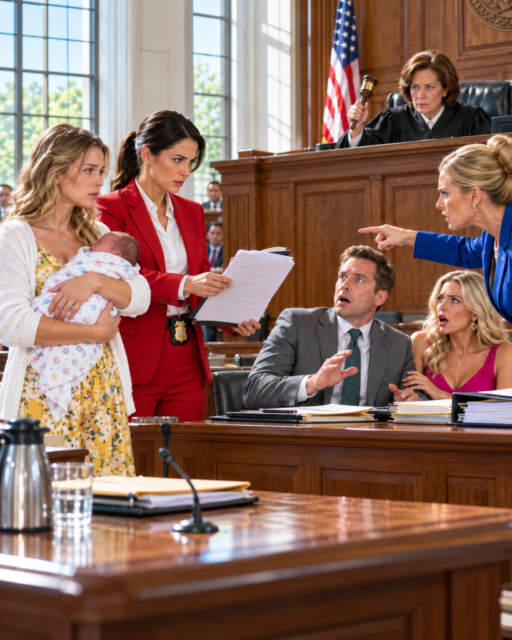
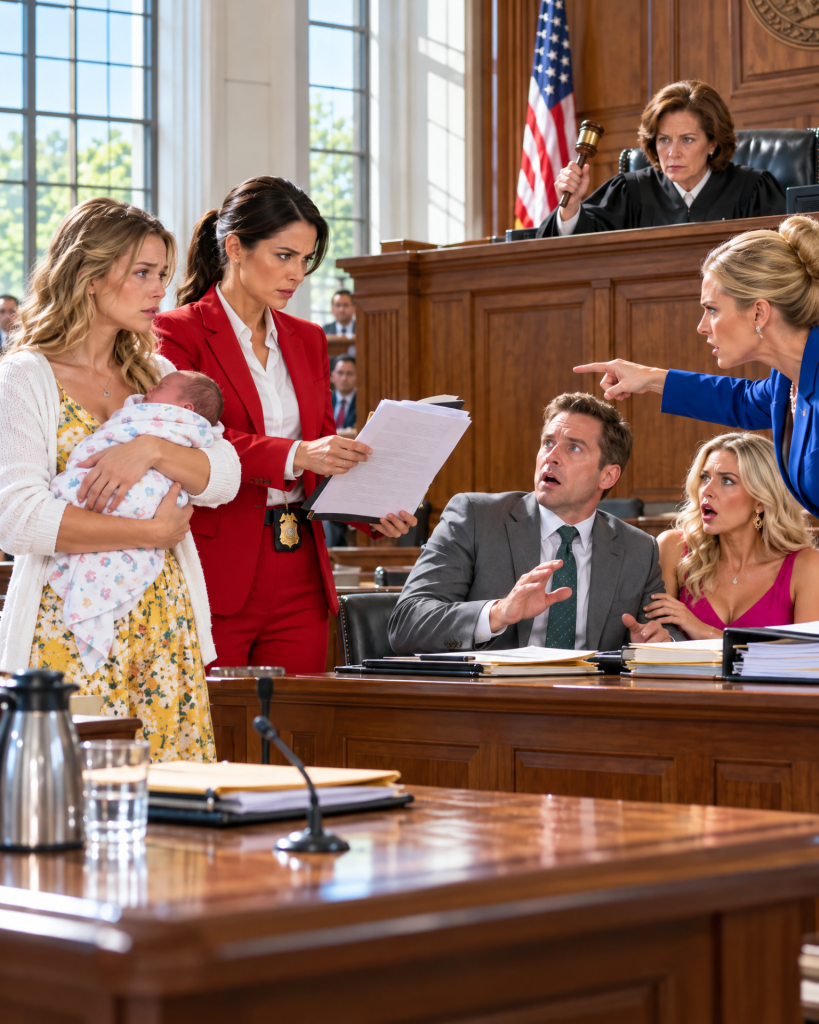

Eight days earlier, I had been lying beneath bright operating-room lights while doctors worked around me. I remembered the monitors, the urgent voices, and the moment fear swept through the room, but I had assumed everything was caused by the complications of childbirth.
Now I had to consider something far worse.
Someone I trusted may have wanted those complications to become fatal.
The life insurance policy suddenly made sense in a way I wished it never had.
Julian had allegedly obtained the five-million-dollar policy shortly before Maya’s birth, using a signature I hadn’t provided. If investigators were correct about the hospital payment, the policy wasn’t simply suspicious financial planning.
It could have been part of something deliberate.
Chloe’s words in the courtroom had only increased those suspicions.
She had shouted that Julian promised they would receive insurance money and leave together. Whether she understood every part of his plan was something investigators would determine, but she clearly knew far more than the woman who had initially claimed she was “just his girlfriend.”
The hearing ended without the dramatic victory Julian had expected.
Judge Vance rejected his attempt to obtain an immediate ruling based on the false DNA evidence. Temporary protections were put in place for Maya and me, and disputed marital assets were preserved while the criminal and financial investigations continued.
I didn’t leave the courthouse feeling triumphant.
I felt exhausted.
My body was still recovering from surgery, my marriage had collapsed in public, and I had just learned that investigators believed my husband might have interfered with the medical care surrounding our daughter’s birth.
Outside the courtroom, I sat for several minutes with Maya against my chest.
She opened her eyes briefly before settling back into her blanket.
I kissed her forehead.
Julian had believed the false DNA report would leave me isolated, humiliated, and financially vulnerable. Instead, the independent test proved he was Maya’s father and gave investigators another reason to examine how far he had been willing to go.
But I knew the arrests weren’t the conclusion.
There would be lawyers, hearings, financial audits, and months of investigation before anyone could say exactly what Julian, Chloe, or the others had done.
For the first time, that uncertainty didn’t frighten me.
I wasn’t trying to defeat Julian anymore.
I was trying to protect my daughter and discover the truth.
As I carried Maya down the courthouse steps, Agent Miller approached me with one final update.
Investigators had begun searching Julian’s business records.
What they had already found suggested the money connected to my case was only a small part of what had been moving through Apex Logistics.
And several employees had just agreed to talk.
The investigation into Apex Logistics continued long after the courtroom emptied. Federal agents examined company accounts, offshore transfers, employee pension records, and communications involving Julian, Chloe, and others who had helped move or conceal money.
Several employees agreed to cooperate.
Their statements helped investigators trace transactions Julian had apparently believed were too complicated to follow. What had begun with a suspicious payment to my former attorney expanded into a much larger financial case involving money that belonged to people who had trusted Julian’s company with their futures.
The false DNA report was investigated too.
Records connected Chloe’s brother to the laboratory where the original test had been processed, while the independent hospital test left no reasonable question about Maya’s paternity. Julian was her biological father, exactly as I had always known.
But proving that no longer felt like a victory.
A father was more than a genetic match.
As the criminal investigation moved forward, my attorney helped me handle the divorce separately. The court maintained protective measures for Maya and me, while disputed assets remained restricted until investigators and the court could determine what money was legitimate and what might belong to victims.
I didn’t receive some magical fortune overnight.
Real life was slower than that.
There were hearings, documents, interviews, and nights when Maya woke every two hours while I was still recovering from surgery. Some mornings, I answered calls from lawyers while warming bottles and trying not to pull at my healing incision.
Still, every difficult day belonged to me.
That mattered.
Julian could no longer decide which information reached me or use money to control the story. Chloe could no longer sit beside him and smile while pretending the evidence against me was real.
The investigation into my surgery was harder to process.
The anesthesiologist’s cooperation, financial records, and recovered communications became part of the federal case. I learned enough to understand why investigators believed Julian had attempted to interfere with my medical care, but I stopped asking for every detail.
Maya needed a mother who was present.
I needed time to recover.
For weeks, I kept replaying the emergency C-section in my mind, wondering which moments had been ordinary medical complications and which had been influenced by something else. Eventually, I realized that knowing every frightening detail wouldn’t change what mattered most.
Maya had survived.
So had I.
Months later, I stood before a judge again.
This time, I wasn’t carrying an eight-day-old baby into a courtroom while my husband tried to convince everyone she wasn’t his. Maya was healthy, growing quickly, and beginning to recognize my voice from across a room.
The divorce moved forward without Julian’s fabricated DNA evidence controlling the outcome.
When I walked outside afterward, I sat on a bench and held Maya against my chest. She grabbed one of my fingers with her tiny hand, completely unaware of how much chaos had surrounded the first days of her life.
I was grateful for that.
She didn’t need to inherit our fear.
I wanted her childhood to be filled with ordinary things—birthday cakes, scraped knees, bedtime stories, school mornings, and arguments about vegetables. I wanted her to grow up knowing that love didn’t require silence, humiliation, or surrender.
Julian had believed he could erase us from his life while taking everything with him.
Instead, his own evidence had begun exposing him.
The forged DNA report led to questions. The suspicious transfer led to financial records. The insurance policy led investigators toward the hospital, and each lie created another trail someone could follow.
I had once thought surviving the courtroom would be the hardest part.
It wasn’t.
The harder task was learning to stop organizing my future around what Julian had done.
One evening, after putting Maya to sleep, I stood beside her crib and watched her breathe. There were still legal proceedings ahead, and I knew some consequences might take years to resolve.
But those belonged to Julian now.
My responsibility was here.
I touched Maya’s tiny hand and remembered Julian’s expression when I entered Courtroom 302. He had smiled because he thought I had arrived alone, weak from surgery and completely unprepared.
He had been wrong about me.
More importantly, he had been wrong about what my daughter and I needed from him.
We didn’t need his money to define our future.
We didn’t need his lies corrected before we could begin living.
And we certainly didn’t need his permission to start over.
I kissed Maya’s forehead and turned off the nursery light.
Eight days after she was born, I had carried her into a courtroom believing I was fighting to protect what remained of my life.
Only later did I understand the truth.
I was walking out with the beginning of a new one.