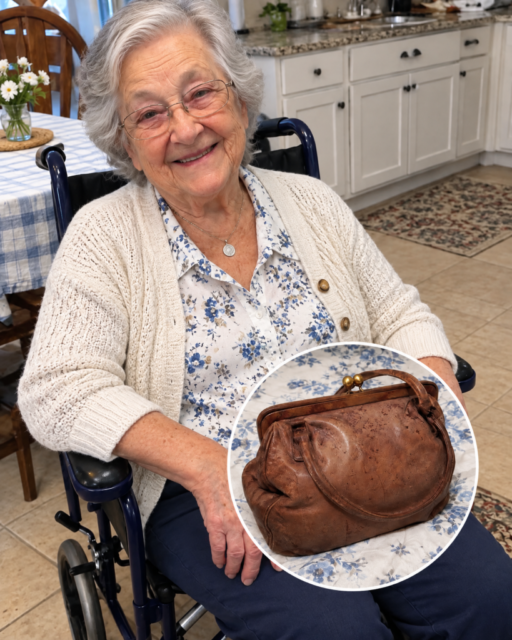
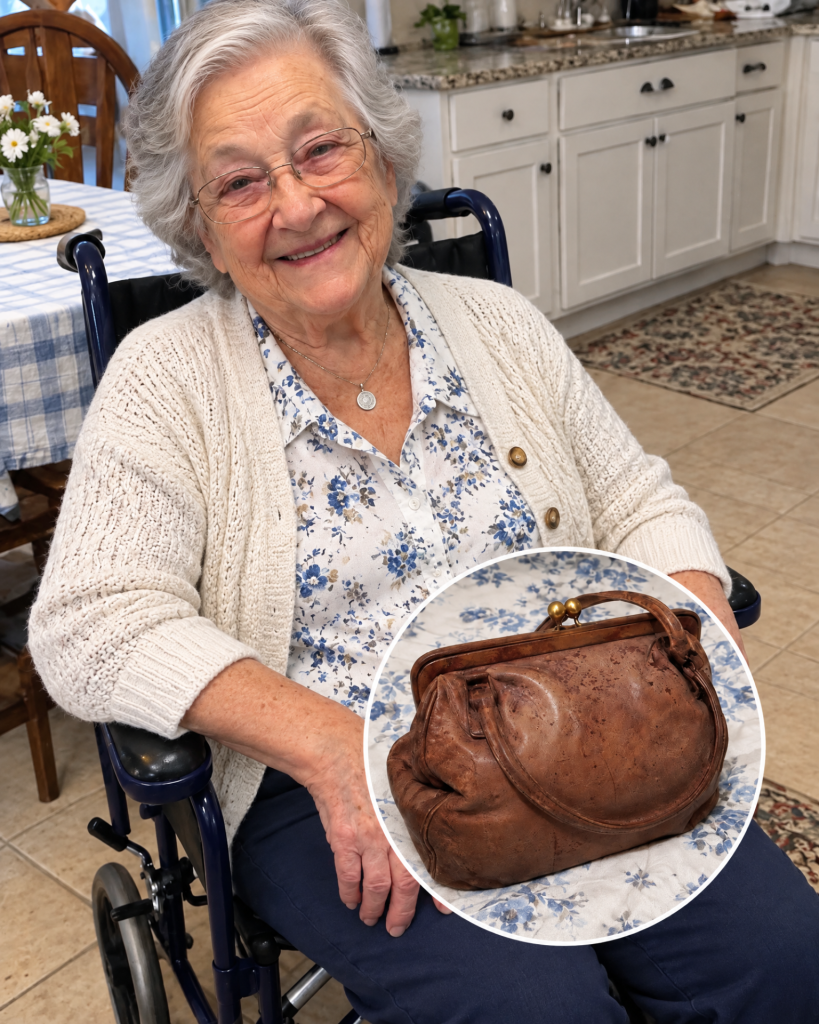

For as long as I could remember, my grandmother Harriet kept an old brown handbag on the highest shelf of her bedroom closet. It wasn’t expensive or beautiful, yet she guarded it more fiercely than anything else she owned, and every member of our family eventually learned the same rule: never touch Grandma’s bag.
I learned how serious she was about that rule when I was fifteen.
Our family had gathered at her house one afternoon, and my Uncle Douglas was entertaining everyone the way he always did. He was charming, funny, and completely comfortable being the center of attention, so when he wandered into Grandma’s bedroom and spotted the handbag above the closet, he decided to turn it into a joke.
“Come on, Ma,” he teased, stretching toward it. “What are you hiding in there?”
His fingers never reached the strap.
Grandma slapped his wrist away so sharply that the laughter in the room disappeared. Douglas stared at her in surprise while everyone else froze, because none of us had ever seen her react that way over an ordinary possession.
“I said don’t touch it.”
There was something in her voice that made even Douglas stop smiling.
He rubbed his wrist and tried to laugh it off, but nobody joined him. From that afternoon forward, no one in our family joked about the handbag again.
What none of them knew was that Grandma later gave me a separate instruction.
Every few months, usually when we were alone in her kitchen, she would reach across the table and take my hand between hers. Her fingers grew thinner and colder as she aged, but the seriousness in her eyes never changed.
“Promise me something, sweetheart.”
I always knew what was coming.
“You don’t open that handbag until I’m gone.”
“I promise.”
Then came the second part, the one that confused me even more.
“After you take out what’s inside, put the bag back with me.”
The first few times she said it, I assumed she was talking about old photographs or private letters from my grandfather Walter. Grandma once told me the handbag contained personal memories from their marriage, and because I loved her, I respected that explanation.
But eventually I asked the obvious question.
“Why me, Grandma?”
She squeezed my fingers and gave me the same answer she always would.
“You’ll understand when you open it.”
That was all.
Years passed, and the handbag remained untouched.
Then Grandma Harriet died.
I was twenty-eight when our family gathered in Willow Creek, Ohio, for her funeral. The little church smelled of lilies and polished wood, and nearly every branch of our family filled the pews: eleven grandchildren, my aunts, my uncles, cousins I hadn’t seen in years, and people Grandma had somehow managed to make feel important throughout her life.
My mother, Beatrice, sat almost completely alone.
She had spent most of my childhood on the edges of the family, and I had never fully understood why. Nobody openly fought with her, but they didn’t include her either; invitations disappeared, conversations stopped when she entered rooms, and holidays somehow happened without us.
Mom never explained it.
Eventually, I stopped asking.
Uncle Douglas, meanwhile, moved comfortably through the church as though he belonged everywhere. He hugged relatives, whispered comforting words, and made grieving people smile, which was exactly the man I had always known.
He had taught me to ride a bicycle when I was seven. When I was a teenager, he occasionally slipped twenty-dollar bills into my hand, and when my car broke down at nineteen, Douglas had been the first relative I called.
I trusted him.
That morning, I had no reason not to.
The funeral service ended, and the director stepped toward Grandma’s casket to prepare it for the procession. I was staring at her when a memory suddenly hit me so hard that I stood up.
The handbag.
We had forgotten it.
“We forgot Grandma’s bag.”
Several relatives turned toward me.
Mom’s face immediately tightened. “Chloe, please sit down. The cars are waiting.”
“No. I promised her.”
Before Mom could answer, Douglas stepped into the aisle.
“Sweetheart, this isn’t the time,” he said gently. “I’ll drive back and get it. We can put it with her at the cemetery.”
His offer sounded reasonable.
But something about the speed with which he made it bothered me.
“I’ll get it myself.”
Douglas moved closer.
“Chloe, listen to me.”
“No.” I looked directly at him. “She asked me to do it.”
For the first time that morning, his familiar warmth seemed to disappear for half a second.
Then his smile returned.
I walked out of the church before anyone could stop me and drove straight to Grandma’s house. Fifteen minutes later, I was climbing onto a heavy wooden chair in her bedroom and reaching toward the handbag she had protected for decades.
The moment I lifted it from the shelf, I knew something was wrong with the explanation she’d given me.
There were no pieces of jewelry rattling inside.
No keepsakes.
The handbag was heavy with paper.
I sat on Grandma’s bed, placed it across my knees, and slowly opened the brass clasp.
Inside were twelve envelopes.
Eleven had names written across them in Grandma’s unmistakable handwriting—one for each grandchild.
Mine was there.
So were Hannah’s, Mason’s, Paige’s, Lucas’s, and the others.
But underneath all eleven was another envelope.
It had no name.
Only four words were written across the front.
READ THIS LAST.
I stared at it, suddenly remembering every warning Grandma had given me and every time she had insisted that I—not my mother, not Douglas, not any of her other children—had to be the person who opened this bag.
Then I remembered how quickly Uncle Douglas had offered to come retrieve it himself.
For the first time, I wondered whether Grandma had been protecting something inside that handbag.
Or protecting it from someone.
I sat on the edge of Grandma’s bed with the twelve envelopes spread across my lap, trying to understand why she had hidden them for so many years.
Eleven belonged to her grandchildren. The twelfth belonged to no one.
READ THIS LAST.
I ran my thumb across those four words but didn’t break the seal. Grandma Harriet had spent years teaching me that when she gave an instruction, she meant it, and even now I couldn’t bring myself to disobey her.
So I gathered the eleven named envelopes and tucked the final one deep inside my purse.
Then I looked at the empty brown handbag.
Grandma’s instructions suddenly made sense, at least partly. She hadn’t wanted to be buried with whatever secrets she’d kept inside it; she wanted those secrets removed first, while the empty bag went into the ground with her.
I still didn’t understand why.
When I returned to the church, the funeral director was waiting near the casket, and nearly everyone turned as I walked through the doors. Uncle Douglas was the first person whose expression I noticed.
He wasn’t smiling anymore.
“I found it,” I said.
His eyes dropped immediately to the handbag in my hand, then shifted toward my purse.
“What was inside?”
The question came too quickly.
I didn’t answer him. Instead, I walked down the aisle and began handing the envelopes to my cousins one by one.
“This was Grandma’s.”
Hannah stared at her name before accepting hers. Mason turned his envelope over as though expecting some explanation on the back, while Paige pressed hers against her chest without opening it.
Soon, all eleven grandchildren were holding letters.
Douglas watched the entire time.
When I reached Grandma’s casket, I gently placed the empty handbag between her folded hands. The brass clasp tapped softly against her dress, and for a moment I heard her voice in my memory.
You’ll understand when you open it.
But I didn’t understand.
Not yet.
We buried Grandma Harriet with that empty handbag later that morning.
Nobody opened their letter at the cemetery. Maybe grief made the moment feel too private, or perhaps everyone sensed that Grandma hadn’t written ordinary goodbye notes.
By the time we gathered at Aunt Georgia’s house for the wake, curiosity had become impossible to ignore.
I slipped upstairs alone and closed myself inside a quiet guest room before opening mine.
The first lines nearly broke me.
Grandma told me she was proud of the woman I had become. She remembered tiny things I had forgotten myself, including the stray cat I fed every afternoon when I was seven because I’d decided nobody else cared whether it ate.
She thanked me for calling her every Sunday.
She thanked me for listening.
Then the tone changed.
All I ever protected was the silence.
I stopped reading.
The sentence felt completely out of place among her warm memories, so I read it again.
Grandma explained that our family had spent years hiding uncomfortable truths from one another. Her adult children had brought secrets to her over the decades, and because she believed keeping the family together was more important than exposing painful mistakes, she had helped bury them.
But now she regretted it.
She had convinced herself that silence protected people from pain when, in reality, silence had protected the people responsible for causing it.
I lowered the letter.
“What did you know, Grandma?”
Voices were beginning to rise downstairs.
I stepped into the hallway and looked over the railing. Several cousins had opened their letters now, and the atmosphere had changed completely.
People who had been hugging an hour earlier were standing apart.
Hannah was whispering urgently to her husband. Mason kept rereading the same paragraph, while Paige sat rigidly on the edge of the sofa with her letter folded tightly between both hands.
Then Mason came upstairs.
“Did Grandma mention my dad in yours?”
The question caught me off guard.
“No.”
He studied my face. “Nothing?”
“Mine was mostly about me.”
That was technically true.
Mason nodded, but he didn’t look relieved.
When he walked away, I looked downstairs again and noticed something even stranger.
Everyone was staring at my mother.
Beatrice stood alone beside the bay window, holding a paper cup she hadn’t touched. For most of my life, our relatives had treated her as though she carried some invisible stain, yet nobody had ever explained what she’d supposedly done.
Now their expressions weren’t cold.
They looked guilty.
Mom noticed me watching and lifted her eyes toward mine.
There was fear in them.
I started downstairs.
I had barely reached the bottom when Douglas appeared beside me and took my elbow.
“Chloe.”
His grip wasn’t painful, but it was firm enough to stop me.
“What?”
He guided me toward the side hallway, away from everyone else.
His voice dropped.
“There were twelve envelopes.”
My stomach tightened.
I hadn’t told anyone that.
“You gave out eleven,” he continued. “Where’s the other one?”
I stared at him.
Douglas’s expression was calm, but his eyes weren’t. They kept moving between my face and the purse hanging from my shoulder.
“How do you know there was another envelope?”
He hesitated.
Only for a second.
But I noticed.
“I saw you put something in your purse when you came back.”
That explanation didn’t make sense. The twelfth envelope had already been hidden inside my purse before I returned to church.
“I haven’t opened it,” I said.
His shoulders relaxed slightly.
That frightened me more than anything else he’d done.
“Good.”
“Why?”
Douglas released my arm and immediately softened his voice.
“Because everyone is emotional right now. Your grandmother was old, Chloe. People write things near the end of their lives that can be misunderstood.”
I stared at the man who had taught me how to ride a bicycle.
The uncle I’d trusted my entire life.
For the first time, I wondered why he was trying so hard to control a letter he claimed to know nothing about.
Before I could challenge him, Mom suddenly walked past the hallway.
She wouldn’t look at Douglas.
And Douglas wouldn’t look at her.
That was when I knew the secret inside Grandma’s handbag wasn’t simply about something that happened years ago.
Whatever Harriet had hidden was connected to the reason my mother had been treated like an outsider for most of my life.
The next morning, my cousin Hannah called me before seven.
She didn’t say hello.
“Chloe, tell me the truth. Did Grandma’s letter say anything about my father?”
“No. Why?”
“Because nobody will show anyone else what they got.”
I sat up in bed.
“Hannah—”
“And everyone knows you still have that last envelope.”
My hand instinctively moved toward the nightstand drawer where I’d hidden it.
“What exactly are you asking me?”
Hannah went silent for a moment.
Then she said something I wasn’t expecting.
“I want to know if Grandma finally wrote down the truth about the missing money.”
My breath caught.
“What money?”
But Hannah had already hung up.