
She would never again protect Caleb from the consequences of the truth.
Recovery demanded more from Rebecca than she had expected. Physical therapy often left her exhausted and in tears, and movements she once performed without thinking now required patience, concentration, and the willingness to endure discomfort simply to make another small step forward.
Emma remained close throughout the process. She brought her homework to the hospital, sat beside Rebecca while completing assignments, and quietly pretended not to notice whenever her mother winced while adjusting her legs or struggled through another difficult day.
Meanwhile, the hospital social worker helped Rebecca prepare for what would happen after she was discharged. Instead of assuming she would return to the home she had shared with Caleb, they developed a safety plan that allowed Rebecca to think about her future without automatically placing her husband at the center of it.
For the first time in years, Rebecca began making decisions according to what she and Emma needed. The uncertainty frightened her because she had no clear idea how she would support them financially or rebuild the independence she had surrendered when she left accounting, but uncertainty no longer seemed as frightening as returning to the life she had escaped.
Months later, Rebecca entered a family courtroom using a walker. Her sister stayed beside her, while Rebecca carried a thick folder containing the hospital records, nursing notes, visitor logs, and incident report documenting what had happened inside her room.
Across the courtroom, Caleb looked different from the man who had once seemed capable of controlling every part of her life. He had not physically changed, but he no longer had a closed hospital door, an injured wife, or eleven years of silence protecting his version of events.
His attorney argued that the incident had been misunderstood. Rebecca listened without interrupting while the judge carefully reviewed the documentation created by the nurses and hospital staff who had witnessed what Caleb had done.
This time, Rebecca did not have to convince anyone that her pain was real. There were records, timestamps, witnesses, and pages of evidence speaking alongside her.
The judge granted the temporary protective order. Caleb’s contact with Emma was restricted, and any future communication would have to take place through approved legal channels rather than through Rebecca directly.
Rebecca felt no desire to celebrate. She was too exhausted to experience the ruling as a victory, but when she left the courtroom, she understood that Caleb no longer had unrestricted access to the two people who had spent years adjusting their lives around his anger.
Emma was waiting outside with Rebecca’s sister. In her hands was a terrible cup of coffee from the courthouse vending machine, still far too hot and barely drinkable, but Rebecca accepted it as though her daughter had handed her something precious.
“Are we going to be okay?”
Rebecca looked into Emma’s worried eyes. She could have promised that everything would become easy, but after years of pretending problems did not exist, she no longer wanted to build their relationship around comforting lies.
“We are going to be honest. That’s where okay starts.”
As Rebecca held the warm cup between her hands, she realized that she still had a long recovery ahead. Her marriage was ending, her finances were uncertain, and the future she had once imagined had disappeared.
Yet for the first time in years, the uncertainty belonged to her.
And so did every decision that came next.
Life did not suddenly become easy after the court ruling, but it gradually became quieter. Rebecca continued healing while learning how to make decisions without wondering whether Caleb would criticize them, and the absence of his constant anger slowly transformed uncertainty from something frightening into something that felt remarkably close to freedom.
As her strength returned, Rebecca began searching for ways to support herself and Emma. Years had passed since she left accounting, but the skills she once believed were buried beneath school schedules, grocery lists, and household responsibilities had never completely disappeared.
Eventually, she found part-time accounting work she could perform from home. The income was modest at first, yet every completed assignment reminded Rebecca that the career she had sacrificed for her family had not vanished forever and that Caleb had been wrong to make her believe she could not survive without him.
When the first payment arrived, Rebecca printed the confirmation and taped it inside her planner. The amount itself would not solve every financial problem waiting for her, but the deposit represented something far more important because, for the first time in years, money had entered her life through work that belonged entirely to her.
Emma noticed the changes too. Their home gradually became a place where neither of them needed to study another person’s mood before speaking, and silence no longer meant that an argument was temporarily being avoided.
Nearly a year after the accident, Rebecca was finally able to drive herself to Emma’s school. Her legs still ached whenever rainy weather arrived, and some days reminded her that recovery would never follow the simple timeline she once hoped for, but she had learned to measure progress differently.
She parked near the curb and waited until students began pouring from the building. When Emma appeared among them and started walking toward the car, Rebecca noticed something about her daughter’s expression that she had almost forgotten how to recognize.
Emma was smiling.
There was no hesitation behind it and no cautious glance to determine what mood awaited her inside the car. It was simply the uncomplicated smile of a thirteen-year-old girl who finally felt safe enough to be happy.
Rebecca smiled back as Emma climbed inside. In that ordinary moment, she finally understood the enormous difference between keeping peace and actually being loved.
For years, she had believed love meant making sacrifices without complaint, preventing arguments, and quietly absorbing another person’s frustration so the household could continue functioning. Now she understood that love should never require someone to disappear piece by piece merely to keep another person comfortable.
Love had appeared in unexpected places during the worst year of her life. It was the nurse who opened a hospital door, recognized what was happening, and refused to look away.
It was the social worker who asked whether Rebecca felt safe without blaming her for staying. It was her sister standing beside her in court, and Emma waiting outside afterward with a nearly undrinkable cup of vending-machine coffee.
Most importantly, love was learning that protecting herself did not make Rebecca selfish. Signing her own name on documents that established boundaries, rebuilding her career, and creating a peaceful home for Emma were not acts of betrayal against her marriage but steps toward recovering the life she had surrendered.
The accident had broken Rebecca’s legs and left scars that would remain with her long after the casts disappeared. Yet it had also forced open a truth she had spent eleven years avoiding: Caleb’s behavior had never been love simply because she had learned how to survive it.
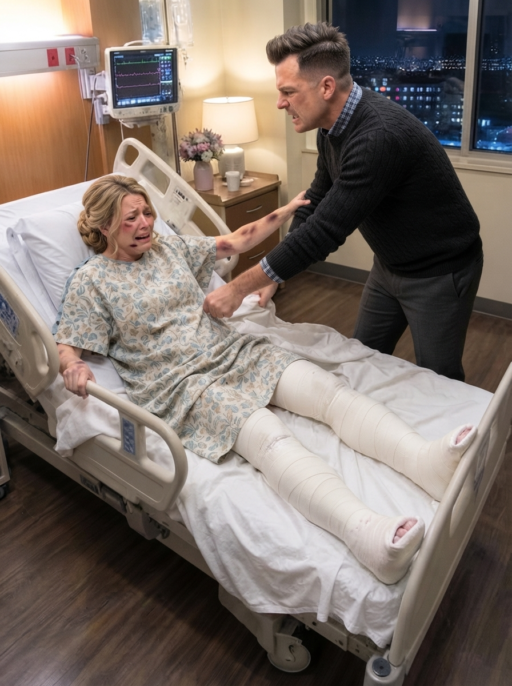
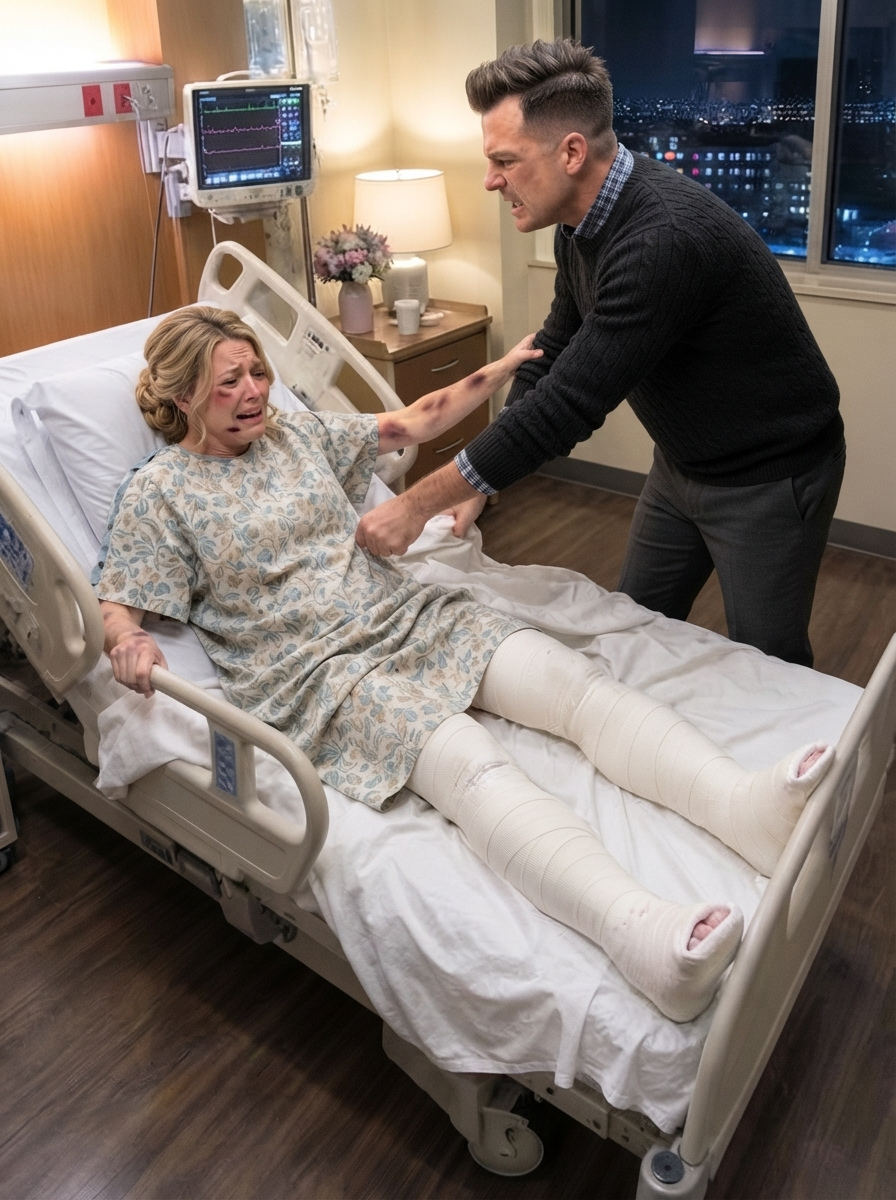
Freedom had not begun with the judge’s ruling or Rebecca’s first paycheck. It had begun months earlier, while she lay injured in a hospital bed with Caleb trying to force her back into obedience.
There had been no grand speech and no carefully prepared declaration. Rebecca had simply wrapped her hands around the bed rail, protected the last piece of herself that still belonged entirely to her, and spoken the word that changed everything.
“No.”