
The first time I held my daughter, Sophie, I wasn’t the woman who had given birth to her. That woman was Brianna, a nineteen-year-old girl who had endured nineteen exhausting hours of labor at St. Vincent’s Hospital in Indianapolis. At 3:17 in the morning, I stood beside my husband, Marcus, watching the moment that would change all our lives.
For several frightening seconds after Sophie was born, the room remained silent. Then a nurse gently stimulated her, and she released such an indignant cry that Brianna began laughing through her tears.
“She’s angry! Oh my God, she’s really angry!”
The nurse placed Sophie against Brianna’s chest, allowing her to hold the little girl she’d carried for nine months. Brianna studied her tiny fingers and dark, damp hair before looking toward me.
“Leah, come here.”
I approached with trembling legs, uncertain what she wanted. Brianna carefully lifted the baby toward me, her exhausted face brightening with a gentle smile.
“You should hold her first. She needs to know you.”
Sophie weighed seven pounds and four ounces, and the moment I gathered her into my arms, her crying stopped. She opened her gray newborn eyes and stared up at me while Marcus began crying quietly beside us.
“Hello, Sophie. I’m your mom.”
Brianna watched from the hospital bed, her blond hair damp with perspiration. When I asked whether she’d like to choose Sophie’s middle name, she considered the question before answering.
“Grace. Sophie Grace. Because that’s what this feels like.”
For Marcus and me, becoming parents had been a painful journey. We’d spent five years pursuing fertility treatments and endured three pregnancies that ended far too early. After the third loss, I finally admitted that I couldn’t bear another attempt.
Marcus sat beside me on our bed and held my hand.
“Then we’ll find another way to become parents.”
We contacted an adoption agency in Indianapolis, completed the required assessments, and prepared a family profile featuring photographs of our home, backyard, and golden retriever, Waffles. Six months later, the agency informed us that an expectant mother had selected us from approximately forty prospective families.
Her name was Brianna, and she was five months pregnant. According to our caseworker, she’d chosen our profile because of a photograph showing Marcus laughing on the living room floor while playing with Waffles.
“She said he looked like someone who would be a wonderful father.”
We met Brianna at a diner near the agency. She was nervous and barely looked up from the table while explaining that her mother had died when she was fourteen, leaving her to move between foster homes. She’d dropped out of high school, worked at a gas station, and was staying with a friend because the baby’s father had disappeared.
“I want to raise her, but I know I can’t give her what she needs. She deserves a better life.”
I reached across the table and explained that adoption didn’t necessarily mean she had to disappear from her daughter’s life. We were willing to arrange an open adoption, allowing her to visit, exchange letters, and remain someone Sophie could know.
Brianna looked at me in disbelief.
“You’d really let me see her?”
“Of course. If that’s something you want, we can make it work.”
She began crying, explaining that nobody had ever made her feel welcome in their life before.
For the first three years after Sophie’s birth, our arrangement worked beautifully. Brianna visited every few months, bringing inexpensive toys and spending afternoons playing with Sophie on our living room floor.
Sophie affectionately called her Bri, and we explained their relationship in simple terms. She understood that Brianna had carried her before she was born and that Marcus and I were the parents raising her.
Then Brianna’s visits became unpredictable. She began canceling appointments, disappearing for weeks, and occasionally arriving looking exhausted and unwell. Having witnessed addiction within my extended family, I recognized several troubling signs, although Marcus insisted she might simply be struggling with difficult circumstances.
Everything changed on Sophie’s fourth birthday.
We’d organized a backyard celebration with preschool friends, relatives, a princess cake, and a bounce house. Brianna unexpectedly appeared through the side gate after five months without contact, carrying a stuffed unicorn and looking visibly unsteady.
When Sophie spotted her, she smiled and hurried across the lawn.
“Bri!”
Brianna knelt to embrace her, but she lost her balance as Sophie approached. She fell forward, accidentally knocking Sophie onto the edge of the patio.
Marcus rushed to lift our crying daughter, who had suffered a small cut near her hairline. Brianna remained on the grass, repeatedly apologizing while Ryan, Marcus’s older brother, arranged a taxi to take her home.
Sophie needed three stitches, and the remainder of her birthday was spent receiving medical care.
That evening, after putting our daughter to bed, I confronted Marcus at the kitchen table.
“No more visits until Brianna is sober and stable. Sophie’s safety has to come first.”
Marcus believed Brianna needed compassion and support, but eventually agreed that our daughter couldn’t be exposed to another unpredictable incident. The following week, I sent Brianna a letter through the adoption agency, explaining that contact would remain suspended until she could demonstrate lasting stability.
She never replied.
Four years passed, and I believed that painful chapter of our lives had finally ended.
I had no idea that Brianna would eventually return to our lives through a secret my own husband was keeping, or that our eight-year-old daughter would be the one who suffered because of it.
Four years after we ended contact with Brianna, our family was preparing for what should have been a joyful celebration. Marcus’s younger sister, Jenna, had become engaged to Chris, a kindhearted high school chemistry teacher, and their wedding was scheduled for June at a restored barn outside Bloomington.
Jenna had always been Sophie’s favorite aunt. They shared sleepovers, watched princess movies, and ate ice cream together, so when Jenna invited Sophie to become her flower girl, my daughter was absolutely thrilled.
For three months, Sophie practiced walking down our hallway with a basket filled with torn pieces of construction paper. She talked constantly about her dress, sparkling shoes, and the responsibility of walking ahead of the bride.
“Aunt Jenna says I’m the most important person after her and Uncle Chris because I get to go first!”
Then, just one month before the wedding, Jenna called while I was preparing dinner. Her voice sounded unusually distant as she announced that Sophie would no longer be participating in the ceremony.
“We’ve decided to keep everything simple. No flower girls or ring bearers.”
I reminded her how much Sophie had been looking forward to the occasion, but Jenna insisted the decision was final. She even rejected my suggestion that Sophie could hand out programs instead.
After the call, I discovered that Sophie had overheard enough to understand what had happened. Her expression crumpled when I confirmed that she wouldn’t be walking down the aisle.
“But Aunt Jenna promised me.”
She didn’t cry or argue. Instead, she quietly returned to her homework, and later that evening, I found her homemade flower basket discarded in the bathroom trash.
Marcus reacted with a strange indifference when I told him. He insisted that Jenna had the right to organize her wedding however she wanted and suggested that Sophie would eventually recover from the disappointment.
His response troubled me because he was normally an exceptionally affectionate father. Recently, however, he’d been distracted, taking private phone calls, working late, and offering vague explanations whenever I questioned him.
I assumed he was under pressure at work.
On the wedding day, Sophie wore her favorite yellow sundress, and I braided her hair with a matching ribbon. She remained unusually quiet during the drive, but she held my hand as we approached the beautifully decorated ceremony grounds.
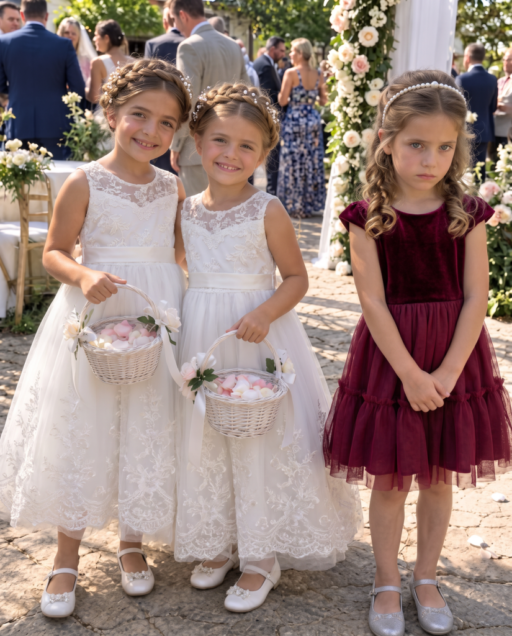
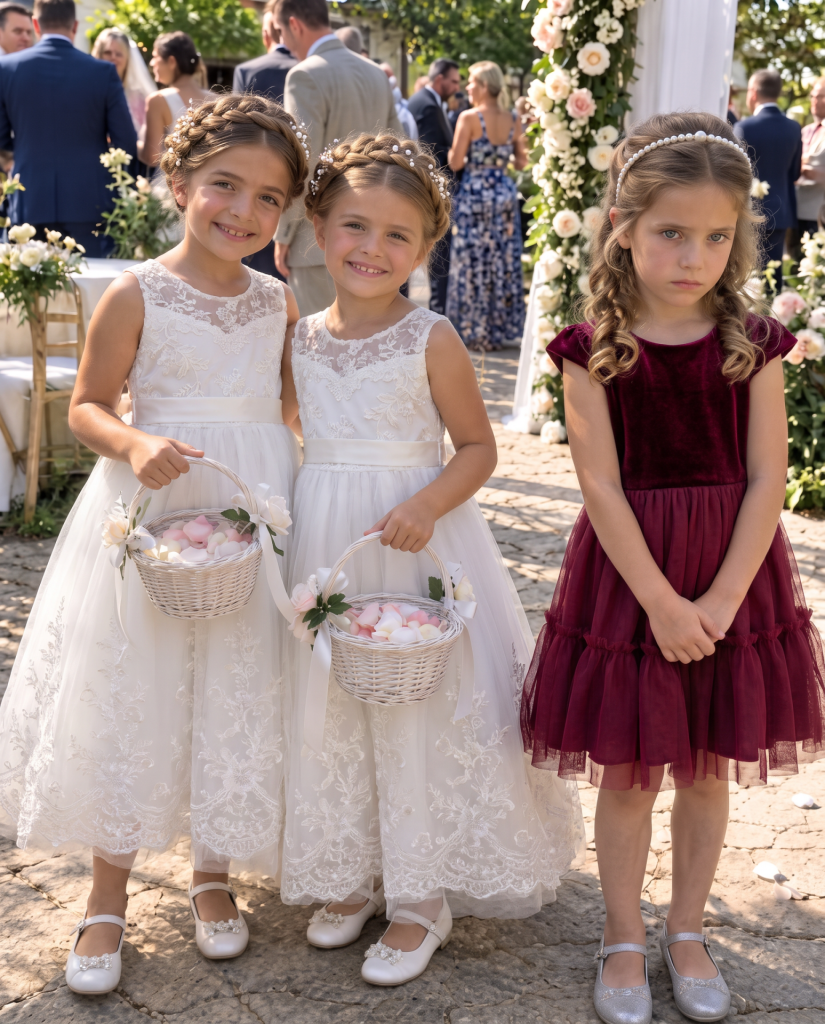
Then I noticed a little girl wearing a pale pink dress and carrying a basket of rose petals. Another girl followed, dressed identically, with a crown of tiny white flowers resting on her blond curls.
I stopped walking.
“Marcus, I thought Jenna wasn’t having flower girls.”
He avoided my eyes and pretended to concentrate on his phone.
As we moved toward our seats, I spotted two boys dressed as ring bearers, including Marcus’s nephew Max. Another young girl was distributing programs, while a five-year-old relative proudly wore a badge identifying her as a junior bridesmaid.
Every child seemed to have been given a special responsibility.
Every child except Sophie.
My daughter sat beside me, watching the flower girls rehearse their entrance. Her hands rested neatly in her lap, and when she finally spoke, her voice was barely audible.
“Mom, why did Aunt Jenna lie to me?”
I looked across the field and saw Jenna laughing with the two flower girls beneath a rose-covered arch. Unable to ignore what was happening, I stood to confront her, but Marcus immediately caught my arm.
“Don’t do this now, Leah.”
I demanded to know why our daughter had been deliberately excluded while every other child participated. Marcus continued urging me to remain seated, but something about his reaction disturbed me more than his words.
He wasn’t confused by the flower girls or surprised by the ceremony arrangements.
He already knew.
“Marcus, did you know Sophie was the only child being left out?”
He looked away.
“Please. Not here.”
I pulled my arm free and walked toward Jenna, determined to get an explanation.
When she saw me approaching, her smile disappeared. She dismissed the photographer and waited until the children had moved away before speaking.
“Leah, I love Sophie. I never wanted her to feel unwanted.”
“Then why did you take away something you’d promised her?”
Jenna hesitated, glancing toward Marcus as he hurried across the grass.
“Because your husband asked me to.”
I stared at her, unable to understand what I’d just heard. Marcus arrived moments later, visibly alarmed, and tried to stop his sister from continuing.