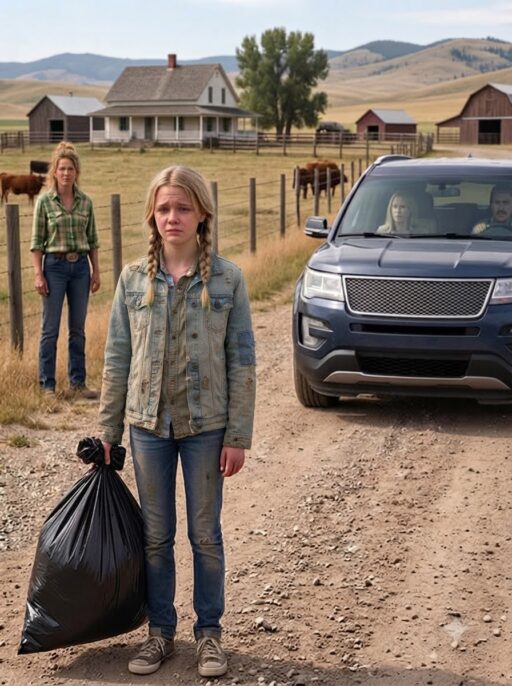
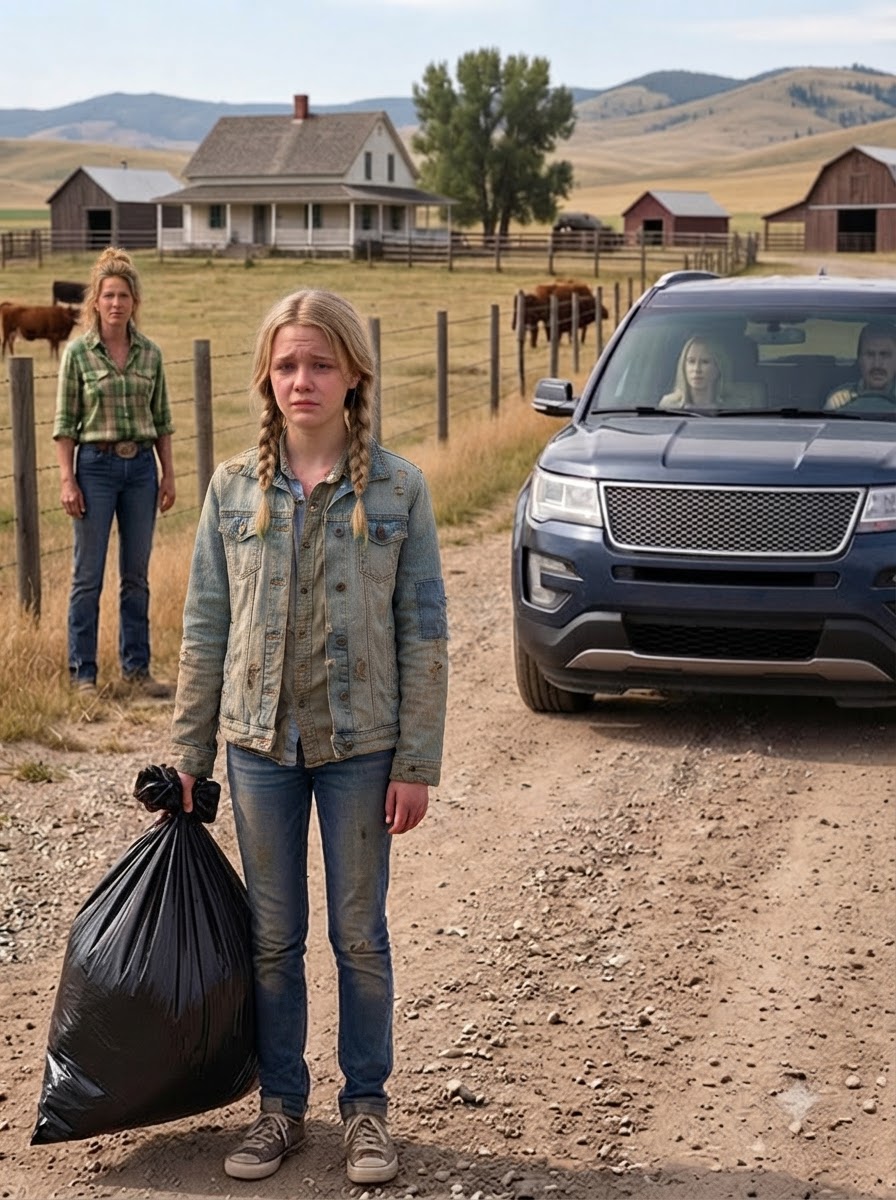

I was thirteen years old when my mother abandoned me at Aunt June’s cattle ranch with everything I owned stuffed into a black garbage bag. It was the beginning of summer, and while most children were looking forward to vacations, I was standing in a dusty driveway wondering why my own family no longer wanted me.
My father remained behind the steering wheel while my younger sister, Claire, sat comfortably in the back seat. Mom placed my bag beside me, straightened her sunglasses, and delivered a sentence that would remain with me for the next eighteen years.
“Your sister deserves real summers, Hannah. You only ruin them.”
I wanted to ask what I’d done wrong, but the words wouldn’t come. Before I could gather the courage to speak, Mom climbed into the car, Dad started the engine, and Claire looked away as they drove toward the main road.
I stood there holding the garbage bag until their taillights disappeared beyond the trees. Even then, I couldn’t bring myself to move because I was convinced they would realize their mistake and turn around.
About twenty minutes later, Aunt June found me standing in exactly the same place. She had been checking the cattle in a distant pasture and hadn’t expected to find her thirteen-year-old niece alone in the driveway.
“Hannah? What are you doing out here?”
I tightened my grip on the plastic bag, embarrassed by the tears gathering in my eyes.
“Mom said they’re coming back in August. I’m supposed to stay here until then.”
June looked toward the empty road, and something in her expression changed. She asked whether my parents had explained the arrangement to me, then quietly admitted that nobody had mentioned an August pickup.
“They didn’t tell me anything about that, sweetheart.”
I tried to convince myself that it was simply a misunderstanding. My parents had always favored Claire, but I still believed they wouldn’t deliberately leave me somewhere without making proper arrangements.
June didn’t question me further or criticize my parents in front of me. Instead, she carried my belongings inside, prepared the spare bedroom with clean sheets, and made grilled cheese sandwiches while I sat silently at her kitchen table.
That evening, she stayed beside me until I finally stopped crying. She never demanded an explanation for my parents’ behavior, and she didn’t make me feel ashamed for wanting them to return.
The following morning, June handed me a pair of work gloves and invited me to help with the morning chores. As we walked toward the barn, she said something I had never heard an adult say to me before.
“You can stay here for as long as you need, Hannah. There’s always a place for you.”
Her words were simple, but they meant more than she probably realized. For the first time, someone was offering me a home without making me feel that I had to compete with Claire to deserve it.
August eventually arrived, and I began watching the road whenever I heard a vehicle approaching. I kept telling myself that my parents would appear before school started, ready to take me home.
But August ended without a phone call or a visit. September came, the new school year began, and still nobody returned.
June repeatedly tried contacting my parents, but they ignored her calls. Eventually, an envelope arrived containing my school records and a notarized guardianship document granting June the authority to care for me.
There was no letter explaining their decision, no apology, and no message asking whether I was happy or safe. My parents had arranged the paperwork necessary to keep me away, then continued their lives as though nothing extraordinary had happened.
Meanwhile, Claire’s photographs began appearing online, showing family trips to beaches, amusement parks, and expensive vacation resorts. Every picture featured smiling faces, beautiful destinations, and the childhood experiences my mother had decided my sister deserved.
I searched those photographs for some indication that my absence mattered to anyone. But there was never an empty place at the table, never a message mentioning me, and never a suggestion that my family intended to bring me home.
For the next three years, I continued believing there had been some terrible misunderstanding. I thought that if I behaved well enough, worked hard enough, and stopped causing whatever problems my mother believed I’d created, my parents might finally want me back.
Then, at sixteen, I learned something that destroyed the last excuse I’d been making for them: leaving me at Aunt June’s ranch had never been a temporary arrangement. They had planned to abandon me from the beginning.
By the time I turned sixteen, I had stopped waiting for my parents to come back. Three years of unanswered calls, forgotten birthdays, and family photographs that never included me had finally taught me what I had refused to believe at thirteen.
My parents hadn’t accidentally left me behind. They had deliberately removed me from their lives so they could devote their attention, money, and affection to Claire.
Accepting that truth hurt more than I expected, but Aunt June refused to let their rejection determine my future. She never told me to forgive them or pretend their behavior hadn’t mattered, and she certainly never suggested that I should be grateful for being abandoned.
Instead, she gave me responsibilities and treated me as someone capable of building a meaningful life. Every morning before school, I helped feed the cattle, inspect the fences, and check the water troughs scattered across Cedar Ridge Ranch.
During weekends, June taught me how to recognize healthy livestock, understand breeding records, and identify problems before they became expensive emergencies. She explained that ranching required more than physical strength because every decision affected the animals, the land, and the people depending on it.
“Land remembers who takes care of it, Hannah,” she often told me.
At first, I thought she was simply encouraging me to work harder. As I grew older, I understood that she was teaching me something my parents never had: belonging wasn’t determined by who claimed ownership, but by who accepted responsibility.
June also insisted that I take my education seriously. Even when the ranch struggled financially, she made sure I had school supplies, transportation, and enough time to study after completing my chores.
By graduation, I knew I wanted to study agricultural science and eventually help improve Cedar Ridge. June encouraged me to attend college, even though my leaving meant she would have to manage much of the work without me.
“You’ve got a good head for this business,” she said. “Go learn everything you can, then decide what kind of future you want.”
At twenty-two, I returned from agricultural college with a degree, several notebooks full of ideas, and a determination to make the ranch financially sustainable. Cedar Ridge had survived years of difficult weather and rising expenses, but its traditional operations were barely producing enough income.
June listened patiently as I explained my plans for rotational grazing, improved livestock management, and selling our beef directly to customers. She was skeptical about some of my proposals, particularly the idea of leasing unused acreage for solar infrastructure, but she trusted me enough to try.
We began implementing the changes gradually, carefully tracking expenses and measuring the results. Within a few years, our cattle operations became more efficient, the solar lease provided reliable additional revenue, and our direct-to-market beef business developed a loyal customer base.
For the first time in decades, Cedar Ridge was producing a healthy profit. June took enormous pride in those improvements, although she always insisted that the ranch’s success belonged to both of us.
As the years passed, I became responsible for more of the daily operations while June gradually stepped away from physically demanding work. She remained my closest adviser, and even after I had learned to negotiate complicated contracts, I still valued her judgment more than anyone else’s.
Then, nine years after I returned from college, June passed away. Losing her felt like losing my mother all over again, except this time I had no doubts about whether the woman I’d lost had truly loved me.
Her will left Cedar Ridge Ranch entirely to me. She hadn’t given me the property because my parents abandoned me there, but because I’d spent years protecting it, improving it, and making it my home.
I continued running the ranch and never attempted to reconnect with my parents. By then, eighteen years had passed since they’d left me in the driveway with a garbage bag.
One afternoon, my real-estate broker, Tom Alvarez, called with an unusual request.
“Hannah, I have a buyer interested in Cedar Ridge Ranch.”
“It’s not for sale, Tom.”
“I already explained that. But there’s something you need to know.”
His hesitation immediately caught my attention.
“The buyer is Robert Harper. Your father.”
I gripped the edge of my desk, struggling to understand why the man who had abandoned me eighteen years earlier suddenly wanted my property.
Then Tom revealed the reason.