
She hugged me only after asking permission.
I hadn’t expected to feel comforted by that small gesture.
When I returned to Charleston, my house felt unfamiliar.
Susan’s coffee mug was still in the kitchen cabinet, and her spare key hung beside the back door. I removed it that evening and arranged to have the locks changed.
Then I placed Michael’s letters and the storage key in my desk drawer.
For three days, I avoided opening it.
On the fourth morning, I called the storage facility.
The manager confirmed that Michael had rented a unit for several years and that the account had been prepaid through the end of the month. After reviewing the documentation, he explained what I’d need to establish my authority to access the unit.
I contacted the attorney who had handled Michael’s estate, and we arranged to review the situation before I went there.
A week later, I stood in front of a gray metal storage door, holding the key Susan had given me.
I had imagined finding evidence of romantic weekends, expensive gifts, or photographs of Michael and Susan together.
Instead, the unit contained several neatly labeled boxes.
One held Emily’s childhood drawings, school photographs, and birthday cards. Another contained receipts and documents relating to the trust Michael had established for her.
But the largest box was labeled with my name.
Inside were photographs from our wedding, letters I’d written to Michael during his business trips, and small souvenirs from vacations we’d taken together.
I sat on a folding chair and opened a worn leather notebook.
Michael had written in it during the final months of his illness.
The first pages contained ordinary observations about his treatment, medications, and fears about dying.
Then I reached an entry dated six weeks before his death.
Susan came to the hospital today. She still believes Linda shouldn’t know until I’m stronger. I agreed again, and I hate myself for it.
I turned the page.
Linda spent the afternoon reading beside my bed. She looked exhausted, but when I woke up, she smiled as though being there was exactly where she wanted to be.
I wanted to tell her everything. Instead, I asked her to bring me water.
My eyes filled with tears.
Michael had watched me care for him while carrying the knowledge that he’d betrayed me for most of our marriage.
He hadn’t been ignorant of my devotion.
He’d simply lacked the courage to face what he’d done.
I kept reading until I found an entry written only days before he lost consciousness.
I don’t know whether Linda will ever forgive me. I don’t think she should feel obligated to. But I hope someday she understands that my love for her was real, even though my honesty wasn’t.
I closed the notebook.
For months after his death, I’d clung to the belief that Michael had been a wonderful husband whose only failure was leaving me too soon.
Now I had to accept a more complicated truth.
He had loved me in some ways and betrayed me in others.
Neither fact erased the other.
I brought the notebook home but left the remaining boxes in storage until I could decide what to do with them.
That evening, I received a message from Emily.
I hope you’re doing okay. You don’t need to reply. I just wanted you to know I’m thinking of you.
I stared at the screen before answering.
I’m taking things one day at a time. Thank you for checking on me.
It was a small exchange, but it felt honest.
Three weeks passed before Susan contacted me.
She didn’t call or ask to visit.
Instead, she sent a thick envelope containing a handwritten timeline of her relationship with Michael.
She listed when they’d first been together, when he learned about Emily, when their affair began, and the periods when they’d stopped seeing each other romantically.
I read it slowly, matching dates against my memories.
Some entries made me physically ill.
Others surprised me.
Then I reached a date I recognized immediately.
It was the night my mother died.
Susan had spent nearly twelve hours beside me at the hospital, holding my hand while I waited for the doctors and helping me make arrangements afterward.
Beside that date, she’d written:
I was with Linda the entire night. Michael was at home. There was nothing secret happening between us that evening. I was there because she was my best friend, and I loved her.
I stared at the sentence until the words blurred.
For the first time since the beach vacation, I cried over a memory that hadn’t been ruined.
Susan had betrayed me terribly, but that night at the hospital had still been real.
I wasn’t ready to forgive her.
I didn’t know whether I ever would be.
But I began to understand that I didn’t have to erase every good memory to acknowledge the harm she’d caused.
Several months later, Emily called with a question.
“Linda, would you consider visiting the lake house with me?”
I looked toward the photograph of Michael on my bookshelf.
The property was still connected to both of us, and neither of us had decided what to do with it.
“Why now?” I asked.
Emily hesitated.
“Because there’s something about the cabin I’ve wanted to ask you since Dad died.”
I felt my stomach tighten.
“What is it?”
She took a breath.
“Did he ever tell you why he kept the old dock locked?”
I went completely still.
The dock had a small storage shed at the far end, and Michael had always kept it secured. He’d told me the floorboards were unsafe and that he’d repair it someday.
“No,” I answered slowly. “Why?”
Emily’s voice became quiet.
“Because he told me that if anything ever happened to him, we should open it together.”
And suddenly, I realized Michael had left behind one more place where our two lives might finally meet.
Six months after discovering that my best friend had been involved with my husband for seventeen years, I stood beside his daughter at the entrance to our lake house. Emily was holding a small brass key, and I was staring at the locked storage shed at the end of the dock.
Michael had always told me the shed was unsafe. Whenever I suggested cleaning it out, he promised he’d repair the floorboards someday, but that day never came.
Now Emily was telling me he’d left instructions for us to open it together.
“Are you sure you want to do this?” she asked.
I looked at the young woman beside me. She had Michael’s blue eyes, but over the previous months, I’d begun seeing her as someone entirely separate from the man who had deceived us both.
“Yes,” I answered. “I’m tired of wondering what he was hiding.”
The lake was calm that morning, and the wooden dock creaked beneath our shoes as we approached the shed. Emily inserted the key into the old padlock, turned it carefully, and stepped aside so I could open the door.
Inside were several fishing rods, folded lawn chairs, and a dusty wooden chest.
Nothing looked particularly remarkable.
Then I noticed two names carved into the chest’s lid.
LINDA AND EMILY.
I stared at the letters.
“He put my name on it?” I whispered.
Emily nodded.
“He showed me the chest shortly before he died. He said he wanted us to open it together someday.”
I knelt beside it and lifted the lid.
Inside were two thick envelopes, a photo album, and a small wooden box containing old keys and photographs. One envelope bore my name, while the other was addressed to Emily.
I picked up mine.
Michael’s handwriting was unmistakable.
Linda,
If you’re reading this, then you and Emily have found a way to stand in the same room despite everything I did to keep your lives separate.
I know I have no right to ask either of you for forgiveness. I only hope you’ll understand that the secrecy was my failure, not yours.
I stopped reading.
For years, Michael had made decisions for everyone around him, convincing himself that hiding the truth was a form of protection. Even his final letters carried that same instinct to control how we discovered his mistakes.
But this time, I wasn’t alone with the consequences.
Emily sat beside me and opened her envelope.
We read silently for several minutes.
Michael had written to her about the years he’d missed, the birthdays he’d celebrated privately, and his regret that she’d never been able to introduce him openly as her father.
He also explained why he’d transferred half the lake property into her trust.
He wanted her to have something permanent that acknowledged her place in his life.
I understood that desire.
What I couldn’t accept was the way he’d pursued it without telling me.
When Emily finished reading, she folded her letter and looked at me.
“Dad said this place should belong to both of us,” she whispered.
I nodded.
“He said something similar in my letter.”
She hesitated.
“I don’t want you to think I’m trying to take anything away from you.”
I looked around the shed, remembering summers spent painting the porch, repairing the dock, and cooking dinner while Michael complained about mosquitoes.
“You didn’t take those memories away, Emily. Your father made choices that changed how I understand them.”
She lowered her eyes.
“I know.”
We carried the chest’s contents into the cabin and spent the afternoon looking through the photographs.
Some showed Michael holding Emily as a little girl. Others were pictures of our wedding, vacations, and holidays I’d nearly forgotten.
For the first time, I saw the two halves of his life placed side by side.
It was painful.
But there was something strangely comforting about no longer having to imagine what he’d hidden.
Later, Emily found a photograph of Michael standing beside the dock, holding a fishing rod and smiling proudly.
“He taught me how to fish here,” she said.
I laughed softly.
“He tried to teach me too. I was terrible at it.”
Emily smiled.
“He wasn’t very patient.”
“No,” I agreed. “He certainly wasn’t.”
We both laughed.
The sound surprised me.
For months, every mention of Michael had felt like another injury. That afternoon, I discovered that sharing an ordinary memory with Emily didn’t mean I was excusing his betrayal.
It simply meant we had both known him.
As the sun began to set, we sat on the porch overlooking the lake.
“What do you want to do with the property?” Emily asked.
I considered the question carefully.
Michael had transferred half the cabin to her trust before his death, and the remaining ownership had passed to me through his estate. Our attorneys had confirmed the arrangement, but neither of us had decided whether to keep or sell it.
“I don’t know yet,” I admitted.
Emily looked relieved.
“Neither do I.”
“Then we don’t have to decide today.”
She smiled.
For once, nobody was making decisions on our behalf.
Over the following months, Emily and I continued getting to know each other. We spoke on the phone, occasionally met for lunch, and gradually became comfortable discussing subjects that had nothing to do with Michael.
I learned about her work, her friends, and her plans for the future.
She learned that I loved gardening, hated crowded restaurants, and had recently started taking painting classes.
We didn’t try to become mother and daughter.
We didn’t need to.
We were two women connected by a complicated past, choosing to build an honest relationship in the present.
Susan, meanwhile, respected my request for distance.
Almost a year passed without a phone call.
Then, on the anniversary of Michael’s death, she sent a short message.
Thinking of you today. I know I don’t deserve a reply, and I’m not asking for one.
I stared at the screen for a long time.
Thirty-seven years of friendship couldn’t be erased simply because I wanted to forget the betrayal. I still remembered the girl who’d shared her lunch with me on our first day of school and the woman who’d held my hand when my mother died.
Those memories had been real.
So had the deception.
Finally, I typed two words.
I know.
It wasn’t forgiveness.
It was simply an acknowledgment that we both remembered the life we’d once shared.
Six months later, Susan asked whether I’d consider meeting for coffee.
I thought about refusing.
But I realized I wanted to see whether we could speak honestly without pretending our friendship had survived unchanged.
We met at a small café outside Charleston.
Susan arrived early, just as she always had. When I approached the table, she stood nervously but didn’t try to hug me.
“Thank you for coming,” she said.
I sat across from her.
For a while, we talked about ordinary things. Her mother had recently moved into a retirement community, Emily was doing well at work, and I’d begun spending more time at the lake house.
Eventually, Susan looked down at her coffee.
“I miss you, Linda.”
I believed her.
But believing her didn’t make the past disappear.
“I miss who I thought we were,” I replied.
Tears gathered in her eyes.
“So do I.”
We sat quietly for a moment.
Then Susan said something I hadn’t expected.
“I know I can’t ask you to trust me again. If we ever become friends in any way, I understand it will have to be different.”
I studied her face.
For the first time since the beach vacation, she wasn’t trying to explain away what she’d done.
She was simply accepting the consequences.
“I don’t know what our relationship will look like,” I admitted.
Susan nodded.
“I understand.”
When we stood to leave, her eyes briefly moved toward my phone on the table.
I knew what she was thinking.
Another photograph.
A new memory to replace the one we’d taken beside the ocean.
But she didn’t ask.
I picked up my phone and slipped it into my purse.
“Not yet, Susan.”
She gave me a small, sad smile.
“Okay.”
We parted outside the café without making promises.
As I drove home, I realized something important had changed.
For most of my life, I’d believed loyalty meant staying beside the people I loved, regardless of what happened. I’d forgiven small disappointments, overlooked uncomfortable questions, and trusted that the people closest to me would never deliberately cause me pain.
Now I understood that loyalty without honesty could become another kind of trap.
I didn’t need to hate Susan forever.
But I didn’t need to restore our friendship simply because we’d shared thirty-seven years.
The following weekend, Emily visited me at the lake house.
We spent the afternoon cleaning the porch and discussing repairs to the old dock. When we finished, she suggested taking a photograph together.
I hesitated for a moment.
Then I smiled.
“Of course.”
We stood beside the railing with the lake behind us, and Emily held up her phone.
There were no hidden promises, no rehearsed confessions, and no secrets waiting for the following morning.
Just two women smiling because they wanted to remember an ordinary afternoon.
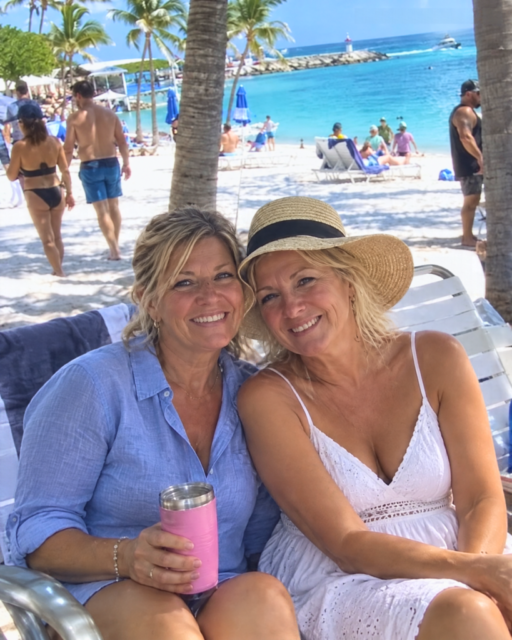
Later that evening, I looked at the photograph Susan and I had taken on our final day at the beach.
I’d kept it hidden in a folder on my phone for months.
In the picture, we stood shoulder to shoulder beneath the bright afternoon sun. I was smiling because I believed I understood my life, while Susan was smiling despite knowing she was about to destroy that certainty.
For a long time, I couldn’t bear to look at it.
Now I saw something different.
It was the last photograph of a friendship built on trust I hadn’t known was broken.
I decided to keep it.
Not because I’d forgiven everything, but because I no longer needed to pretend those thirty-seven years had never existed.
Susan had been right when she called it our last picture as friends.
Whatever relationship we might have in the future would have to begin again, without the secrets that had defined so much of our past.
And as I placed my phone beside Emily’s new photograph, I understood that losing the life I thought I had didn’t mean losing the chance to build something meaningful.
Michael and Susan had spent years deciding which truths I was allowed to know. From that day forward, the decisions about my life belonged to me.